Temperance in Love
Temperance in love readings gets read as 'be patient and wait.' What it actually describes is the active work of blending two incompatible rhythms into one functional system.
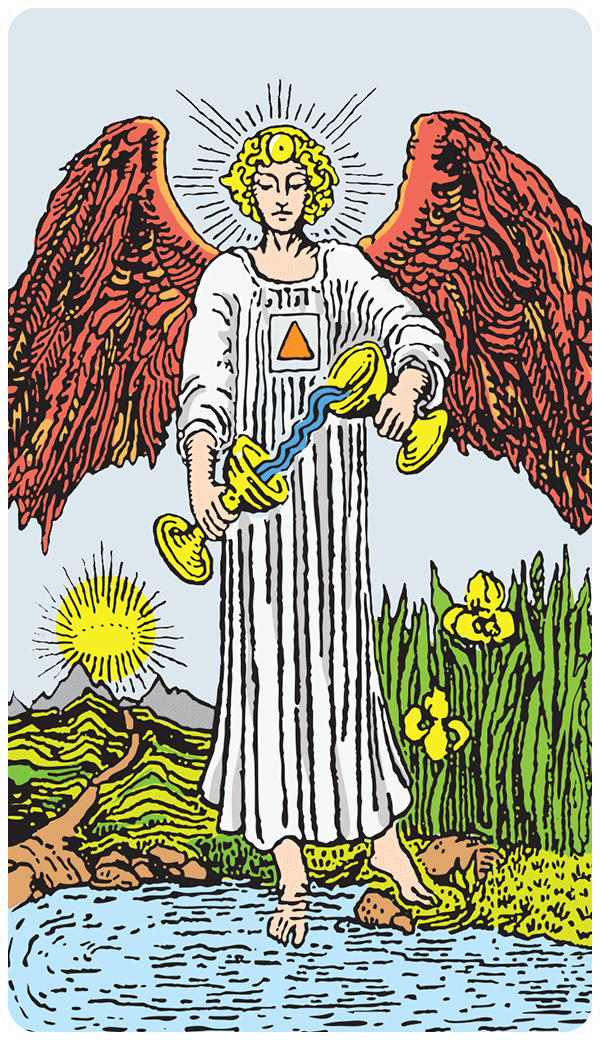
Temperance · plate 14
What the card is actually doing
Temperance shows up in a love reading and the querent hears it as cosmic permission to stay exactly where they are. Wait it out. Don't push. The universe is mixing things behind the scenes and eventually it will all balance out on its own. That is not what the card is doing. Temperance is not describing patience. It is describing the ongoing mechanical work of integration — the part where two people who operate at different speeds, with different needs, with different tolerances for closeness have to actively build a third rhythm that neither of them brought into the relationship.
Reading Temperance in love
What the image, the rank, and the alchemical move are each doing
Temperance is Major Arcana, which means it describes a structural lesson, not a passing mood. It sits at fourteen in the sequence — past the Death card's ending, before the Devil's binding. It names the work that happens after something has been dismantled but before the new form has solidified. The angel on the card is pouring water between two cups. One foot is on land, one is in water. The liquid does not spill. The transfer is controlled, deliberate, repeated.
This is alchemical tempering. You heat metal, you cool it, you heat it again. The process makes the material stronger by forcing it to hold two states at once. In a relationship, Temperance describes the same move: you are learning to hold your own needs and someone else's needs in the same container without one of you evaporating. The card is not saying 'wait for balance to arrive.' It is saying 'you are in the part where you actively create balance by moving energy back and forth until you find the ratio that holds.'
The most common misreading is that Temperance means don't act. Stay neutral. Let things settle. But look at the card again — the angel is doing something. The pouring is the work. If you stop pouring, the liquid stays in one cup and the system stays imbalanced.
How the card reads for two different relationship states
If you are in an established relationship and Temperance appears, it is naming the exact negotiation you are avoiding. One of you wants more time together; the other needs more space. One of you processes conflict by talking it through immediately; the other needs to sit with it alone first. Temperance is the card that says: you will not fix this by waiting for the other person to become more like you. You fix it by building a third option neither of you would choose alone — the structured compromise that lets both people stay intact.
If you are single or early-stage dating and Temperance shows up, the card is usually pointing at your own internal imbalance. You are toggling between two extremes — pursuing hard, then withdrawing completely. Wanting deep intimacy, then panicking when someone gets close. The work is not about finding the right person. The work is learning to hold both impulses at once without letting one flood the other out. The person you date next will require you to have done this work, or the same cycle repeats.
The tell that you are misreading Temperance on yourself
You keep saying 'I'm being patient' but what you are actually doing is waiting for the other person to change. You have not proposed a new structure. You have not named what you need. You are hoping that if you stay calm long enough, the problem will resolve itself. That is avoidance wearing the Temperance card as a costume. The real Temperance move is the conversation where you say: here is what I need, here is what you need, here is the third thing we could try that gives us both some of what we are asking for.
From the practice
“A card never tells you what to do. It tells you what you're already deciding — and gives you the words to name it.”
A grounded observation
Go back through your last three relationship arguments. If you resolved any of them by actually building a new shared system instead of one person giving in, that was Temperance. If you are still waiting for the other person to come around, you have not started the work yet.
Key themes to watch for
- № 01Theme
Vulnerability
- № 02Theme
New chapters
- № 03Theme
Emotional truth
What to do with this reading
Read the upright meaning first, even if you pulled the card reversed. The reversal is a commentary on the upright — not a separate card.
Notice what your body did when you saw Temperance. That reaction is usually closer to the truth than the interpretation.
Write down one sentence: What is this card asking me to stop avoiding? Let the answer be smaller than you expect.
Come back to this card in 48 hours. Most love readings sharpen with a little distance.
Questions answered
Frequently asked
In the realm of love, Temperance suggests a harmonious connection, where differences blend into a beautiful relationship. It's not about losing oneself in the other, but about finding a balance where both partners thrive. Consider the ways you and your partner complement each other. This card invites you to appreciate the dance of give and take that makes a relationship resilient. Is there a shared goal or dream that you both can nurture together, creating a partnership that's more than the sum of its parts?
Temperance reversed in love points to potential discord or a struggle to find common ground. Perhaps there's a push and pull happening, where harmony feels elusive. This isn't necessarily a sign of doom, but an opportunity to recognize where things might be out of balance. Are there expectations or habits that need reevaluation? This card suggests a moment to step back and see where adjustments could bring a sense of peace. Even small gestures can help restore the connection.
Temperance colors the cards around it. Pay attention to where its themes — archetype, pattern, invitation — show up in the next card. That is usually where the story is.
Tarot is observational, not predictive. Temperance describes the conditions in front of you right now and where they tend to lead if nothing changes — not a guarantee of timing.
Repeat cards are the deck underlining a theme. With Temperance, that usually means the question you are asking is the right one — but you have not yet acted on what the card is showing you.
Read next
Related readings
Other Temperance readings
- General MeaningTemperance read for general meaning.
- Career & WorkTemperance read for career & work.
- Money & FinanceTemperance read for money & finance.
- Health & WellbeingTemperance read for health & wellbeing.
- SpiritualityTemperance read for spirituality.
- Yes / No AnswerTemperance read for yes / no answer.