Temperance in Career
Temperance in career readings gets read as 'be patient and wait.' The card is not describing patience. It's describing active recalibration.
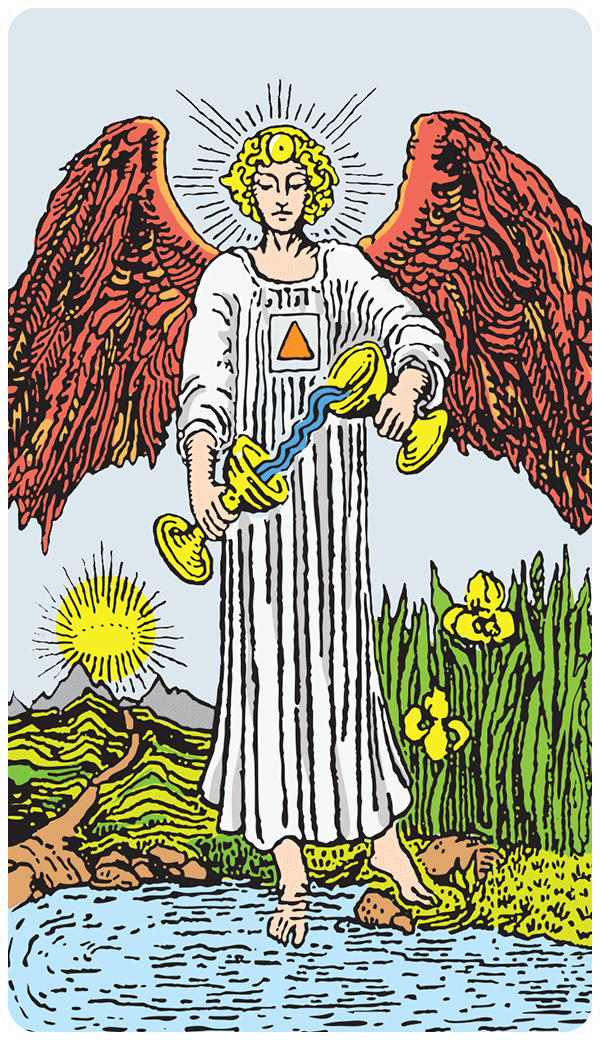
Temperance · plate 14
What the card is actually doing
Temperance shows up in a career reading and the querent slumps. They read it as cosmic delay. As 'not yet.' As the universe telling them to sit tight and trust the timing. They wanted the Chariot or the Magician — something that says move, act, claim. Instead they got the angel with two cups and they interpret it as a holding pattern they didn't ask for.
That is not what the card is doing. Temperance is not about waiting. It is about the active work of mixing two incompatible things until they become a third thing that can actually function.
Reading Temperance in career
What the Major Arcana rank and the image are each doing
Temperance is Major Arcana, which means it describes a developmental threshold, not a circumstantial event. Major cards point to internal shifts that change how you move through the world. When Temperance lands in a career reading, it is naming a recalibration process that is already underway — not telling you to pause.
Look at the image. An angel stands with one foot on land, one foot in water. They are pouring liquid between two cups, back and forth, in a continuous flow. The liquid does not spill. The angel is not waiting for something to happen. They are actively tempering — the alchemical term for heating and cooling a substance repeatedly until it becomes structurally sound. This is not patience. This is deliberate adjustment.
The most common misreading in career contexts is that Temperance means 'slow down' or 'don't push.' The querent hears it as a command to be passive. But the card is describing integration work. It shows up when you are holding two modes that don't yet fit together — the job that pays and the work that matters, the role you were hired for and the role you actually want, the pace your body needs and the pace the industry demands. Temperance names the period where you are actively learning to pour between the two without losing what's in either cup.
How the card reads differently depending on what the querent is actually doing
For someone who is sprinting — working 70-hour weeks, chasing every opportunity, saying yes to everything — Temperance reads as a structural warning. The card is not moralizing about hustle. It is pointing to the moment where the system you are running is no longer sustainable and you are about to either burn out or make a mistake that costs you credibility. The recalibration it describes is forced: your body, your relationships, or your reputation will make you slow down if you don't choose it first.
For someone who has been stalling — sitting in a role they've outgrown, telling themselves they need one more certification before they move, waiting for permission that will not come — Temperance reads as a different kind of threshold. The card is naming the mixing work you have been avoiding. You have been treating two parts of your career as incompatible when the actual task is to integrate them. The person who wants to lead but thinks they need to stay technical forever. The person who wants to freelance but thinks they need to quit their job first. Temperance is the card that says: pour between the two. The third thing emerges from the pouring.
The tell that someone is misreading Temperance on themselves
The tell is always the same. The querent says 'I guess I just need to be more patient' and then describes a situation where patience is not the variable. They are waiting for clarity that will only come from action. They are waiting for conditions to improve when the conditions are waiting for them to make a decision. Temperance gets used as spiritual cover for inertia. The card does not say wait. It says temper. Those are not the same instruction.
From the practice
“A card never tells you what to do. It tells you what you're already deciding — and gives you the words to name it.”
A grounded observation
Go back through your calendar and look for the moments in the last six months where you tried to force two incompatible work modes into the same week. That's the recalibration Temperance is naming.
Key themes to watch for
- № 01Theme
Creative purpose
- № 02Theme
Heart-led work
- № 03Theme
Right alignment
What to do with this reading
Read the upright meaning first, even if you pulled the card reversed. The reversal is a commentary on the upright — not a separate card.
Notice what your body did when you saw Temperance. That reaction is usually closer to the truth than the interpretation.
Write down one sentence: What is this card asking me to stop avoiding? Let the answer be smaller than you expect.
Come back to this card in 48 hours. Most career readings sharpen with a little distance.
Questions answered
Frequently asked
Temperance in your career indicates a period of integration and balance. You might be finding ways to blend different skills or perspectives into a cohesive approach. It's about creating synergy in your professional life, where each task or project complements the other. Consider how you might be weaving different threads into a single tapestry. This card suggests a moment to appreciate the harmony in your work life and invites you to explore new ways these elements might come together for greater success.
In the context of career, Temperance reversed hints at disarray or a lack of coordination. Projects might feel scattered, or collaboration could be challenging. It might be a period where different aspects of your work life are pulling in opposite directions. This card suggests a need to identify where things have unraveled. Pay attention to small details that could help in knitting things back together, creating a more cohesive work environment. Sometimes, it's about finding the right rhythm for productivity.
Temperance colors the cards around it. Pay attention to where its themes — archetype, pattern, invitation — show up in the next card. That is usually where the story is.
Tarot is observational, not predictive. Temperance describes the conditions in front of you right now and where they tend to lead if nothing changes — not a guarantee of timing.
Repeat cards are the deck underlining a theme. With Temperance, that usually means the question you are asking is the right one — but you have not yet acted on what the card is showing you.
Read next
Related readings
Other Temperance readings
- General MeaningTemperance read for general meaning.
- Love & RelationshipsTemperance read for love & relationships.
- Money & FinanceTemperance read for money & finance.
- Health & WellbeingTemperance read for health & wellbeing.
- SpiritualityTemperance read for spirituality.
- Yes / No AnswerTemperance read for yes / no answer.