Temperance in General
Temperance shows up and people think it means calm down. What it actually names is the active work of holding two incompatible things in the same container.
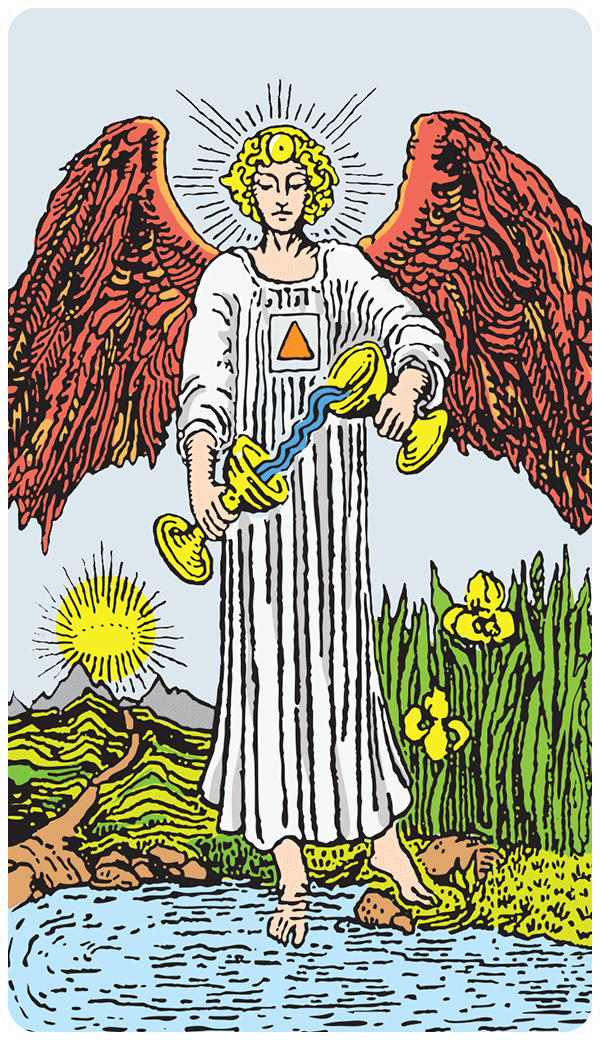
Temperance · plate 14
What the card is actually doing
Temperance shows up in a general reading and the querent hears it as instruction. They think the card is telling them to be patient, to slow down, to stop wanting what they want so badly. They read it as a cosmic "not yet" or a reminder to practice self-control. That is not what the card is doing. Temperance does not describe waiting. It describes the mechanical process of mixing two things that do not naturally combine — and the attention required to keep them from separating again.
Reading Temperance in general
What the rank, the image, and the angel are each doing
Temperance is Major Arcana, which means it names a structural principle, not a mood or a moment. Major cards describe the architecture underneath a situation — the larger pattern the querent is inside of, whether they see it yet or not. When a Major shows up, the question being asked is almost always bigger than the querent phrased it.
Look at the image. An angel stands with one foot on land, one foot in water. They are pouring liquid from one cup into another, and the liquid flows upward, defying gravity. The two cups are different vessels. The liquid moves between them in both directions. This is not stillness. This is active transfer. The angel is not waiting for the right moment. They are performing a continuous operation that requires their full attention.
The most common misreading is that Temperance means moderation in the self-help sense — eat less, want less, be less intense. But the card is not about dampening. It is about synthesis. It names the moment when you are holding two incompatible priorities, two conflicting truths, two parts of yourself that do not agree, and you cannot resolve the conflict by choosing one. The work is to keep both in play. The pouring is the work.
How the card reads for two different situations
For a querent in the middle of a life transition — new job, new city, relationship ending — Temperance describes the disorienting overlap period where the old structure has not fully dissolved and the new one has not fully formed. They are living in two realities at once. One foot is still in the old apartment; one foot is already in the new time zone. The card is not telling them to be patient. It is naming what is actually happening: they are performing the alchemy of becoming someone slightly different, and that process requires them to hold both versions of themselves without collapsing into either one.
For a querent asking about a relationship or a creative project, Temperance shows up when two strong, distinct forces are in the room and neither one can be sacrificed. The relationship works because both people are independent. The project works because it holds both rigor and intuition. The card describes the ongoing negotiation required to keep both forces live. Most people read this as "find balance," which sounds easy. The honest version is: you will be adjusting the ratio every day. The pouring never stops.
The tell that someone is misreading Temperance on themselves
The tell is when the querent reads Temperance and feels scolded. They think the card is saying they are too much — too impatient, too hungry, too loud. They decide they need to tone themselves down, and then they spend three months performing calm while the actual problem festers. What they missed is that Temperance does not ask you to be less. It asks you to hold more. If reading the card makes you feel like you need to shrink, you are reading someone else's card.
From the practice
“A card never tells you what to do. It tells you what you're already deciding — and gives you the words to name it.”
A grounded observation
Go back through your last six months and find the moment you were holding two true things that contradicted each other. That is where Temperance was operating, whether you pulled the card or not.
Key themes to watch for
- № 01Theme
Beginnings
- № 02Theme
Inner movement
- № 03Theme
Receptivity
What to do with this reading
Read the upright meaning first, even if you pulled the card reversed. The reversal is a commentary on the upright — not a separate card.
Notice what your body did when you saw Temperance. That reaction is usually closer to the truth than the interpretation.
Write down one sentence: What is this card asking me to stop avoiding? Let the answer be smaller than you expect.
Come back to this card in 48 hours. Most general readings sharpen with a little distance.
Questions answered
Frequently asked
Temperance speaks of balance and harmony, like a symphony where every instrument finds its place. In your life, this card suggests that you might be finding a rhythm between seemingly contradictory elements. It's not about choosing one path over another, but blending them into something unique. Consider the areas where you've been juggling priorities. How can they complement rather than compete with each other? This card invites you to step back and appreciate the subtle dance of your daily routines, finding peace in the equilibrium.
With Temperance reversed, there's a sense of imbalance, like a pendulum swinging too far in one direction. Are you feeling pulled between extremes, unable to find a middle ground? This card might reflect a period where patience is wearing thin, and things feel out of sync. It could be a cue to pause and assess where things have tipped too far. Notice where small adjustments might restore a sense of calm. Perhaps the key lies in tiny shifts rather than grand gestures.
Temperance colors the cards around it. Pay attention to where its themes — archetype, pattern, invitation — show up in the next card. That is usually where the story is.
Tarot is observational, not predictive. Temperance describes the conditions in front of you right now and where they tend to lead if nothing changes — not a guarantee of timing.
Repeat cards are the deck underlining a theme. With Temperance, that usually means the question you are asking is the right one — but you have not yet acted on what the card is showing you.
Read next
Related readings
Other Temperance readings
- Love & RelationshipsTemperance read for love & relationships.
- Career & WorkTemperance read for career & work.
- Money & FinanceTemperance read for money & finance.
- Health & WellbeingTemperance read for health & wellbeing.
- SpiritualityTemperance read for spirituality.
- Yes / No AnswerTemperance read for yes / no answer.