Temperance in Health
Temperance in health readings gets read as 'balance' when it's naming the feedback loop between input and recovery. Here's what the card is doing.
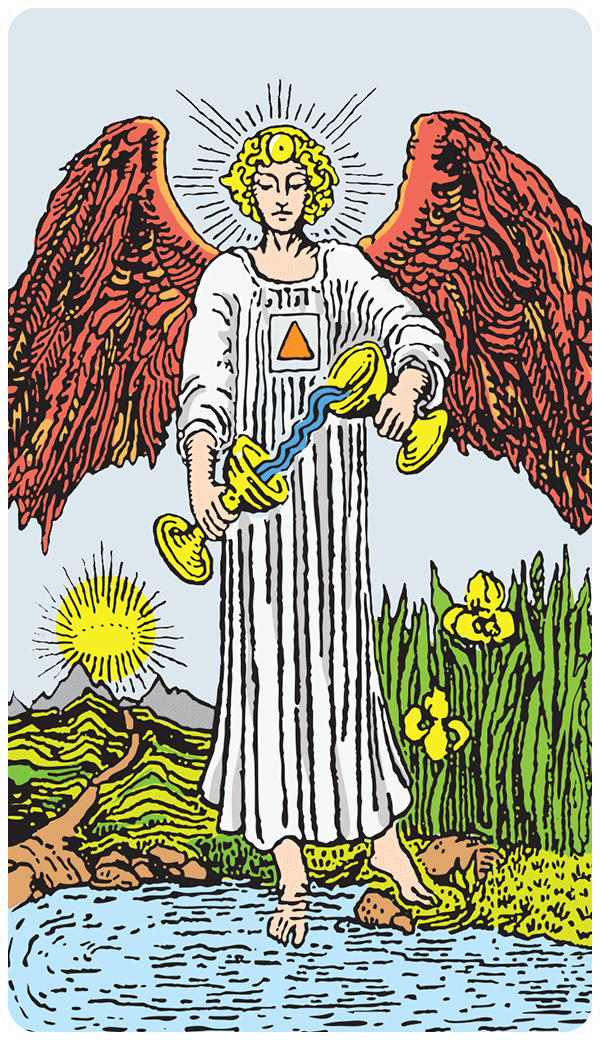
Temperance · plate 14
What the card is actually doing
Temperance shows up in a health reading and the querent nods before I finish the sentence. They already know what it means: balance. They need to eat better, sleep more, stress less, find equilibrium. The card becomes a gentle scolding dressed as guidance. That is not what the card is doing. Temperance is not diagnosing imbalance. It is naming the mechanism through which the body self-regulates when you stop overriding the signal.
Reading Temperance in health
What the rank, the image, and the angel are each doing
Temperance is Major Arcana fourteen. It sits between Death and The Devil — between the card that names what has to end and the card that names what you keep choosing even when it hurts. Temperance describes the space between those two: the part of you that knows how to metabolize what just happened and return to baseline if you let it.
The image shows an angel pouring water between two cups. One foot is on land, one in water. The liquid moves in both directions without spilling. This is not balance as stasis. This is circulation. The body taking something in, processing it, moving it through, letting it go. Temperance describes homeostasis — the body's capacity to adjust, recalibrate, and self-correct when the conditions allow it.
The most common misreading in health contexts is treating Temperance as an instruction to do balance instead of recognizing it as the body's natural state when interference stops. Someone reads the card and thinks: I need to add yoga, cut sugar, start meditating, drink more water. They bolt three new habits onto an already overloaded week. Two weeks later they are more exhausted than before and confused about why the card "didn't work." The card was not asking you to perform moderation. It was naming the thing your body already does when you stop forcing it to run on fumes.
How the card reads for two different querent situations
For someone in active crisis — injury, illness, post-surgery, chronic flare — Temperance reads as: your body is trying to heal and you are still asking it to perform. The card is not saying "find balance." It is saying: the healing is happening and you keep interrupting it. Go back through your calendar and look at how many times you pushed through fatigue, skipped rest because it felt indulgent, or treated recovery as something you do after you finish everything else. The angel pouring water is your nervous system trying to downregulate. The tell that you are blocking it is that you feel guilty every time you stop.
For someone in maintenance mode — no acute issue, just low energy or vague malaise — Temperance reads as: there is a mismatch between input and recovery and your body has been trying to tell you for months. The card points to the thing you keep doing that you already know costs more than it returns. Not the obvious vice. The thing you defend. The late nights you call productive. The training plan you refuse to adjust. The relationship that leaves you depleted but you call it love. Temperance does not tell you what to stop. It confirms you already know.
The tell that someone is misreading the card on themselves
The tell is addition. If Temperance shows up and your first move is to add something — a supplement, a routine, a new practitioner, a stricter rule — you are reading it backwards. The card describes subtraction. It describes the body's intelligence reasserting itself when the override stops. When someone is reading Temperance correctly, the question shifts from "what should I do" to "what am I still doing that I know I need to stop."
From the practice
“A card never tells you what to do. It tells you what you're already deciding — and gives you the words to name it.”
A grounded observation
If you pulled Temperance in a health reading, write down the one thing you already stopped twice this month and then talked yourself back into. That is what the card is naming.
Key themes to watch for
- № 01Theme
Emotional renewal
- № 02Theme
Mind-body link
- № 03Theme
Soft restoration
What to do with this reading
Read the upright meaning first, even if you pulled the card reversed. The reversal is a commentary on the upright — not a separate card.
Notice what your body did when you saw Temperance. That reaction is usually closer to the truth than the interpretation.
Write down one sentence: What is this card asking me to stop avoiding? Let the answer be smaller than you expect.
Come back to this card in 48 hours. Most health readings sharpen with a little distance.
Questions answered
Frequently asked
When it comes to health, Temperance suggests a well-rounded approach, where physical and mental well-being find balance. It might be a time when lifestyle choices are aligning with your health goals. This card invites you to notice how small, consistent habits contribute to your overall sense of wellness. Is there a new balance you can strike that continues to support this harmonious state?
Temperance reversed in health might indicate a lack of balance in your well-being. Perhaps stress or lifestyle choices are tipping the scales in an undesired direction. It suggests a moment to pause and reassess where adjustments are needed. Consider small changes that could help restore a sense of equilibrium, nurturing both body and mind.
Temperance colors the cards around it. Pay attention to where its themes — archetype, pattern, invitation — show up in the next card. That is usually where the story is.
Tarot is observational, not predictive. Temperance describes the conditions in front of you right now and where they tend to lead if nothing changes — not a guarantee of timing.
Repeat cards are the deck underlining a theme. With Temperance, that usually means the question you are asking is the right one — but you have not yet acted on what the card is showing you.
Read next
Related readings
Other Temperance readings
- General MeaningTemperance read for general meaning.
- Love & RelationshipsTemperance read for love & relationships.
- Career & WorkTemperance read for career & work.
- Money & FinanceTemperance read for money & finance.
- SpiritualityTemperance read for spirituality.
- Yes / No AnswerTemperance read for yes / no answer.