Page of Wands in Yes / No
The Page of Wands leans yes in yes/no readings, but only if you're willing to start before you're ready. Here's what the card is actually measuring.
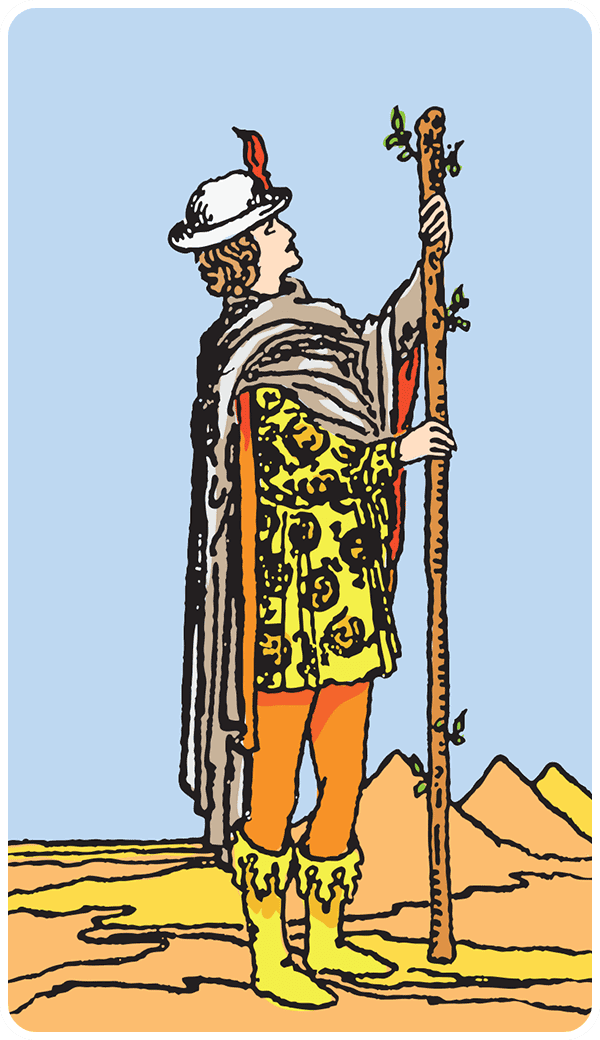
Page of Wands · plate page
YES
The Page of Wands is a yes — but not to the question you think you asked. Most querents read this card as confirmation that the thing they want is coming. What it actually confirms is that the impulse to move is present. The energy is there. The question is whether you're going to act on it before the feeling passes. The gap between "I feel excited about this" and "I am doing this" is where most Page of Wands yeses turn into nos by default.
Why Page of Wands reads this way
What the suit, the rank, and the image are doing
Wands is the suit of will, initiative, and forward motion. It governs the part of you that wants to start things, the part that gets restless when nothing is happening, the part that would rather try and fail than sit still. When Wands cards show up, the question being asked is almost always about momentum — do I have it, will I get it, should I trust it.
Pages in tarot are beginners. They are not masters, not even journeymen. A Page is someone standing at the threshold of a new skill or project or identity, holding the tool of their suit but not yet fluent in its use. The Page of Wands is not a seasoned entrepreneur; they are the person who just registered the LLC. They are not a confident performer; they are the person who just signed up for the open mic. The card describes the moment right before competence, when enthusiasm is doing all the work.
Look at the image. A young figure stands in a desert, holding a staff, staring at it. The landscape is barren. There is no destination visible. The figure is not moving yet. They are looking at the thing in their hand, deciding whether to plant it or carry it forward. The card is not motion; it is the split second before motion, when the idea is still just an idea and the body has not committed.
Why people misread it as "the thing is happening"
The most common misreading in a yes/no context is treating the Page of Wands as confirmation that external circumstances are aligning. The project will get funding. The person will text back. The opportunity will arrive. That is not what the card measures. It measures internal readiness — whether the querent has enough enthusiasm to act without external validation. If you are waiting for conditions to improve before you move, this card is a no. If you are willing to move badly, clumsily, with no guarantee of success, it is a yes.
Here's what tends to happen when someone gets the Page of Wands and reads it as "yes, it's coming." They wait. They prepare. They refine the plan. Three months later, the enthusiasm has leaked out, the moment has passed, and they are confused about why the card didn't deliver. The card did deliver. It delivered the window. They didn't use it.
The reversed version and the tell you are misreading it
Reversed, the Page of Wands is a clean no — the enthusiasm is not sustainable. You are performing interest in something you do not actually want to do, or you are excited about the idea of the thing but allergic to the mechanics of the thing. A reversed Page in a yes/no reading is the card saying: you will not follow through, so do not pretend you will.
The tell that you are misreading the upright Page of Wands on yourself is if you are using the card to justify waiting. If you are saying "the card said yes, so I will start when X happens," you have flipped the card's meaning. The Page of Wands is yes if you start now, while the feeling is live. It is no if you wait for permission.
A grounded observation
Go back through your text history and look for the last time you said "I'm going to" about something and then didn't. That is what this card is measuring — the gap between impulse and action.
Key themes to watch for
- № 01Theme
Affirmative current
- № 02Theme
Open door
- № 03Theme
Forward motion
What to do with this reading
Read the upright meaning first, even if you pulled the card reversed. The reversal is a commentary on the upright — not a separate card.
Notice what your body did when you saw Page of Wands. That reaction is usually closer to the truth than the interpretation.
Write down one sentence: What is this card asking me to stop avoiding? Let the answer be smaller than you expect.
Come back to this card in 48 hours. Most yes / no readings sharpen with a little distance.
Questions answered
Frequently asked
The Page of Wands is a yes — but not to the question you think you asked. Most querents read this card as confirmation that the thing they want is coming. What it actually confirms is that the impulse to move is present. The energy is there. The question is whether you're going to act on it before the feeling passes. The gap between "I feel excited about this" and "I am doing this" is where most Page of Wands yeses turn into nos by default.
Reversed cards are rarely "bad." Page of Wands reversed asks you to look at where the same theme is blocked, postponed, or being avoided — usually with more compassion than the upright version.
Page of Wands colors the cards around it. Pay attention to where its themes — creative momentum, will and appetite, the spark that wants to be tended — show up in the next card. That is usually where the story is.
Tarot is observational, not predictive. Page of Wands describes the conditions in front of you right now and where they tend to lead if nothing changes — not a guarantee of timing.
Repeat cards are the deck underlining a theme. With Page of Wands, that usually means the question you are asking is the right one — but you have not yet acted on what the card is showing you.
Read next
Related readings
More Wands · Yes / No
- Ace of Wands — Yes / NoHow Ace of Wands reads in a yes / no context.
- Two of Wands — Yes / NoHow Two of Wands reads in a yes / no context.
- Three of Wands — Yes / NoHow Three of Wands reads in a yes / no context.
- Four of Wands — Yes / NoHow Four of Wands reads in a yes / no context.
- Five of Wands — Yes / NoHow Five of Wands reads in a yes / no context.
- Six of Wands — Yes / NoHow Six of Wands reads in a yes / no context.
Other Page of Wands readings
- General MeaningPage of Wands read for general meaning.
- Love & RelationshipsPage of Wands read for love & relationships.
- Career & WorkPage of Wands read for career & work.
- Money & FinancePage of Wands read for money & finance.
- Health & WellbeingPage of Wands read for health & wellbeing.
- SpiritualityPage of Wands read for spirituality.