Page of Swords in General
The Page of Swords isn't about being clever or curious. It's about the specific moment you start asking questions you weren't asking before.
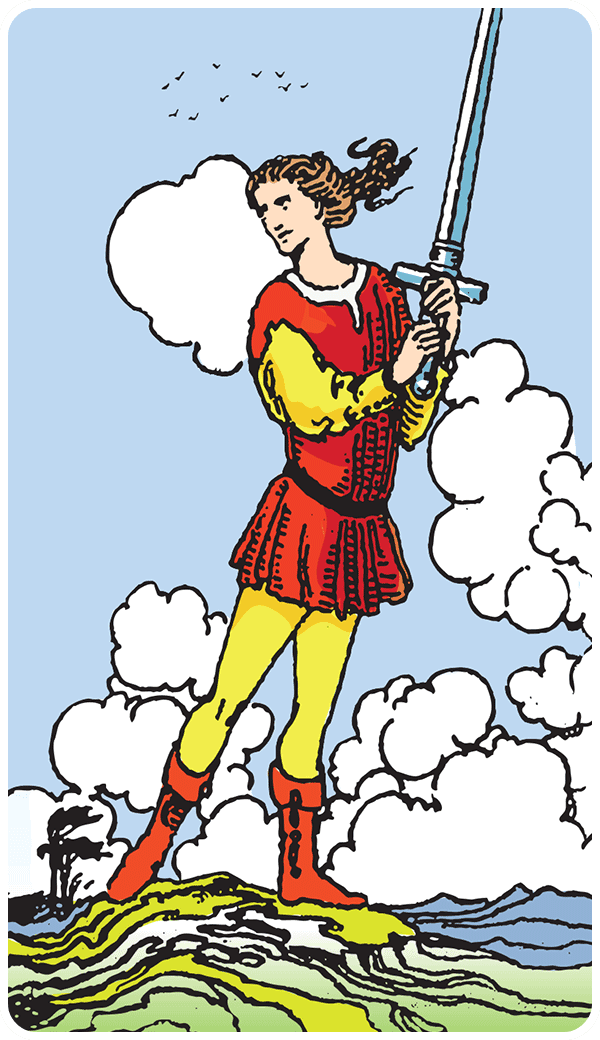
Page of Swords · plate page
What the card is actually doing
The Page of Swords shows up and people read it as 'be curious' or 'stay sharp' or 'use your intellect.' They treat it like a personality trait being celebrated. That's not what's happening. The card isn't describing a quality you have. It's describing a specific action you're taking right now: you are asking a question you weren't asking last week. You are investigating something. The investigation itself — not the answer, not the cleverness — is what the card is naming.
Reading Page of Swords in general
What the suit, the rank, and the image are each doing
Swords is the suit of thought, language, and the questions you ask when something doesn't add up. It governs analysis, pattern recognition, the part of you that needs to understand before it can move forward. When Swords cards dominate a reading, the querent is almost always in their head, trying to think their way through something that feeling or action hasn't resolved.
Pages in tarot are messengers and beginners. They are not mastery. They are the first movement into a suit's domain — tentative, inexperienced, often clumsy. The Page of Pentacles is someone just starting to build something material. The Page of Cups is the first flutter of a new feeling. Pages describe the moment you step into unfamiliar territory and don't yet know the rules.
Now look at the image. A young figure stands alone, holding a sword upright, alert. The wind is blowing. The ground is uneven. They are not in a library. They are not sitting down. They are out in the field, watching, scanning. The sword is raised not for combat but for readiness — they are looking for something they haven't found yet. This is surveillance, not certainty.
The Page of Swords is the moment you start actively looking for information you don't have. You are asking questions, testing assumptions, checking the story you've been told against what you can see for yourself. The card describes investigative energy, not intellectual capacity. Most people miss this. They read it as 'you're smart' when it actually means 'you're suspicious, and the suspicion is making you pay attention.'
How it reads differently depending on what the querent is actually doing
If the querent is in a situation where they've been passive or trusting, the Page of Swords reads as the moment they stop taking things at face value. They start fact-checking. They re-read the email. They notice the gap between what someone said last month and what they're saying now. The card isn't advising them to do this — it's naming that they're already doing it. The investigation has started.
If the querent is someone who is always in their head, always analyzing, the Page of Swords reads differently. It's the moment the questioning becomes unproductive. They are gathering information they don't actually need. They are asking questions that have no answers. The sword is up, but there's nothing to defend against. The wind is just wind. Here, the card describes mental spinning — the investigation that never reaches a conclusion because the querent doesn't actually want the conclusion. They want the safety of still looking.
The tell that someone is misreading it on themselves
The tell is when someone reads the Page of Swords and feels validated for being 'a thinker' or 'intellectually curious' but doesn't name a specific question they are currently asking. If you can't say what you're investigating, you're not in the card. The Page of Swords is not a personality type. It is not a vibe. It is a description of active inquiry. If the inquiry isn't happening, the card is describing the idea of inquiry — the performance of looking smart — which is the shadow version. That's when the Page becomes the person who asks questions to look engaged but isn't actually listening to the answers.
From the practice
“A card never tells you what to do. It tells you what you're already deciding — and gives you the words to name it.”
A grounded observation
Go back through the last week and find the moment you started asking a question you weren't asking before. That's the Page of Swords. The card doesn't care if the question was smart. It cares that you asked it.
Key themes to watch for
- № 01Theme
Beginnings
- № 02Theme
Inner movement
- № 03Theme
Receptivity
What to do with this reading
Read the upright meaning first, even if you pulled the card reversed. The reversal is a commentary on the upright — not a separate card.
Notice what your body did when you saw Page of Swords. That reaction is usually closer to the truth than the interpretation.
Write down one sentence: What is this card asking me to stop avoiding? Let the answer be smaller than you expect.
Come back to this card in 48 hours. Most general readings sharpen with a little distance.
Questions answered
Frequently asked
The Page of Swords carries the restless energy of curiosity and the thrill of new ideas. Imagine a young person eager to explore the world, brimming with questions and possibilities. This card suggests a time when your mind is buzzing with fresh insights or concepts. It's a call to engage with your thoughts and let them lead you down unexpected paths. Notice what captures your attention and consider what it sparks in you. Are you ready to learn something new or approach problems with a fresh perspective?
When the Page of Swords appears reversed, it can feel like a clouded mind or scattered thoughts. Perhaps you're wrestling with indecision or feeling overwhelmed by too much information. It's a moment to pause and gather your thoughts before leaping into action. Imagine a gusty wind stirring up fallen leaves; it might be time to let things settle before making any decisions. Consider what might help you find clarity—jotting down your thoughts or talking things through with someone you trust.
Page of Swords colors the cards around it. Pay attention to where its themes — mental clarity, the truth being named, what the mind needs to release — show up in the next card. That is usually where the story is.
Tarot is observational, not predictive. Page of Swords describes the conditions in front of you right now and where they tend to lead if nothing changes — not a guarantee of timing.
Repeat cards are the deck underlining a theme. With Page of Swords, that usually means the question you are asking is the right one — but you have not yet acted on what the card is showing you.
Read next
Related readings
More Swords · General
- Ace of Swords — GeneralHow Ace of Swords reads in a general context.
- Two of Swords — GeneralHow Two of Swords reads in a general context.
- Three of Swords — GeneralHow Three of Swords reads in a general context.
- Four of Swords — GeneralHow Four of Swords reads in a general context.
- Five of Swords — GeneralHow Five of Swords reads in a general context.
- Six of Swords — GeneralHow Six of Swords reads in a general context.
Other Page of Swords readings
- Love & RelationshipsPage of Swords read for love & relationships.
- Career & WorkPage of Swords read for career & work.
- Money & FinancePage of Swords read for money & finance.
- Health & WellbeingPage of Swords read for health & wellbeing.
- SpiritualityPage of Swords read for spirituality.
- Yes / No AnswerPage of Swords read for yes / no answer.