Nine of Swords in General
The Nine of Swords doesn't predict disaster. It names the anxiety loop already running. Here's what the card is doing when it appears in a reading.
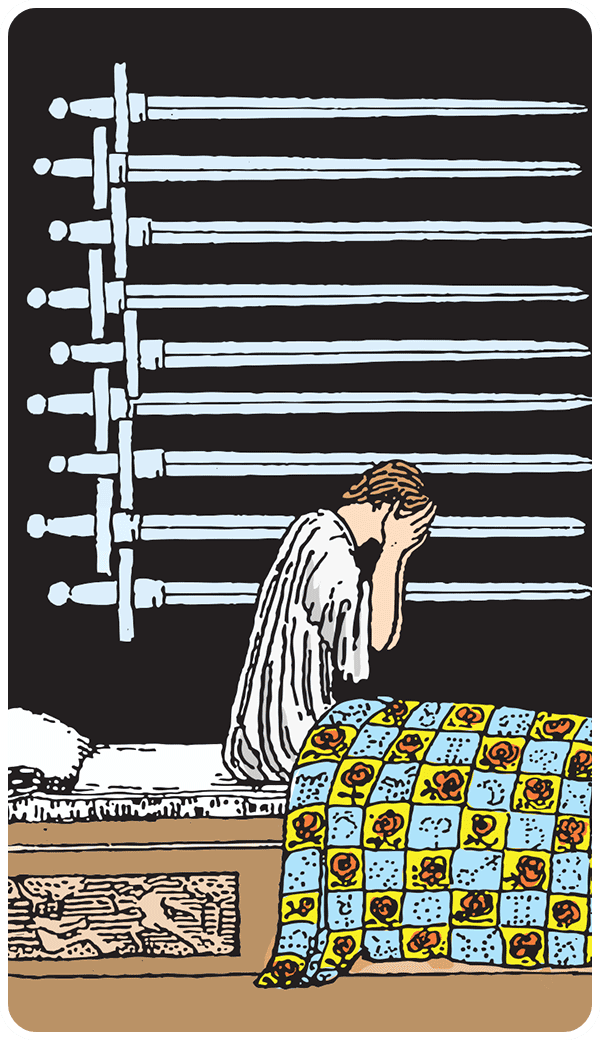
Nine of Swords · plate 9
What the card is actually doing
The Nine of Swords shows up and the querent's shoulders tense. They assume it means something terrible is coming — that the card is warning them, that the disaster they've been afraid of is now confirmed by the deck. That is backward. The card is not predicting a future crisis. It is naming the crisis of rumination that is happening right now, in the body, at 3am or in the grocery store or whenever the mind loops back to the same seven fears and runs them again.
Reading Nine of Swords in general
What the suit, the rank, and the image are each doing
Swords is the suit of thought, language, and the cuts thought makes. It governs how the mind organizes information, what stories it tells about what happened, and how those stories then dictate what you expect to happen next. When Swords dominate a reading, the question is almost always being asked from inside a narrative the querent has already committed to — they are not asking what is true; they are asking the deck to confirm or deny the story they are already telling themselves.
Nines in tarot are culmination cards. They describe the moment a suit's energy has built to its fullest expression before the closure of the Ten. The Nine of Pentacles is material self-sufficiency achieved. The Nine of Cups is emotional satisfaction arrived at. The Nine of Swords is the thought process taken to its breaking point — the mind running every scenario, preparing for every threat, until preparation becomes the threat.
Now look at the image. A figure sits upright in bed, head in hands. Nine swords hang on the wall behind them. The bed is still made. The room is dark. This is not someone who has been attacked. This is someone who cannot sleep because the mind will not stop generating the list of everything that could go wrong. The swords are not coming for them. The swords are the thoughts. The card describes insomnia of the psyche.
How the card reads differently depending on what the querent is actually asking
If the querent is asking about a decision — should I take the job, should I move, should I end this — the Nine of Swords is not answering the question. It is describing the state they are asking the question from. The anxiety is not information about the job or the move. The anxiety is what happens when the mind has been tasked with preventing all future harm and has taken the assignment seriously. The card says: you are not weighing options right now; you are rehearsing disaster.
If the querent is asking about a relationship, the Nine of Swords describes the 2am spiral where you re-read old texts and re-litigate old fights and imagine the fifteen ways the other person might leave. It does not mean they are leaving. It means you are alone with your thoughts about them leaving, and the thoughts have become more real than the person.
Reversed, the card sometimes softens — the querent is coming out of the spiral, the grip is loosening. But more often, reversed Nine of Swords describes someone who has been in the anxiety loop so long they no longer register it as abnormal. The insomnia has become baseline.
The tell that someone is misreading the card on themselves
The misreading sounds like this: "The Nine of Swords showed up, so now I know something bad is going to happen." That sentence makes the card a cause instead of a description. The card is not generating the fear. The card is naming the fear you brought to the table. If you pull the Nine of Swords and your first thought is "this confirms it," go back and notice what you were already convinced of before you shuffled the deck.
From the practice
“A card never tells you what to do. It tells you what you're already deciding — and gives you the words to name it.”
A grounded observation
The Nine of Swords does not arrive with new information. It reflects the loop you are already in. If the card feels accurate, the question is not what disaster is coming — the question is how long you have been preparing for it.
Key themes to watch for
- № 01Theme
Beginnings
- № 02Theme
Inner movement
- № 03Theme
Receptivity
What to do with this reading
Read the upright meaning first, even if you pulled the card reversed. The reversal is a commentary on the upright — not a separate card.
Notice what your body did when you saw Nine of Swords. That reaction is usually closer to the truth than the interpretation.
Write down one sentence: What is this card asking me to stop avoiding? Let the answer be smaller than you expect.
Come back to this card in 48 hours. Most general readings sharpen with a little distance.
Questions answered
Frequently asked
The Nine of Swords brings the creeping shadows of worry into your thoughts. It's like that nagging feeling in the pit of your stomach when you wake up in the middle of the night. This card suggests sleepless moments filled with imagined fears or regrets. Consider what might be keeping you up—are these worries grounded in reality or are they spiraling out of control? Sometimes, writing down your thoughts can help you see them in a new light. This card invites you to face these fears head-on, for they may not be as formidable as they seem.
The Nine of Swords reversed hints at a break in the clouds, where anxieties begin to dissipate. It's the relief of realizing that the imagined monsters under the bed were just shadows. You may find yourself emerging from a period of worry, understanding that some concerns were exaggerated. However, this card also suggests not to ignore what you’ve learned from this period. Acknowledge what has been troubling you, and consider how you might prevent a reoccurrence. It's an opportunity to transform past distress into newfound clarity.
Nine of Swords colors the cards around it. Pay attention to where its themes — mental clarity, the truth being named, what the mind needs to release — show up in the next card. That is usually where the story is.
Tarot is observational, not predictive. Nine of Swords describes the conditions in front of you right now and where they tend to lead if nothing changes — not a guarantee of timing.
Repeat cards are the deck underlining a theme. With Nine of Swords, that usually means the question you are asking is the right one — but you have not yet acted on what the card is showing you.
Read next
Related readings
More Swords · General
- Ace of Swords — GeneralHow Ace of Swords reads in a general context.
- Two of Swords — GeneralHow Two of Swords reads in a general context.
- Three of Swords — GeneralHow Three of Swords reads in a general context.
- Four of Swords — GeneralHow Four of Swords reads in a general context.
- Five of Swords — GeneralHow Five of Swords reads in a general context.
- Six of Swords — GeneralHow Six of Swords reads in a general context.
Other Nine of Swords readings
- Love & RelationshipsNine of Swords read for love & relationships.
- Career & WorkNine of Swords read for career & work.
- Money & FinanceNine of Swords read for money & finance.
- Health & WellbeingNine of Swords read for health & wellbeing.
- SpiritualityNine of Swords read for spirituality.
- Yes / No AnswerNine of Swords read for yes / no answer.