Knight of Swords in General
The Knight of Swords gets read as 'take action now' — but the card describes momentum without a map. Here's what it's actually naming.
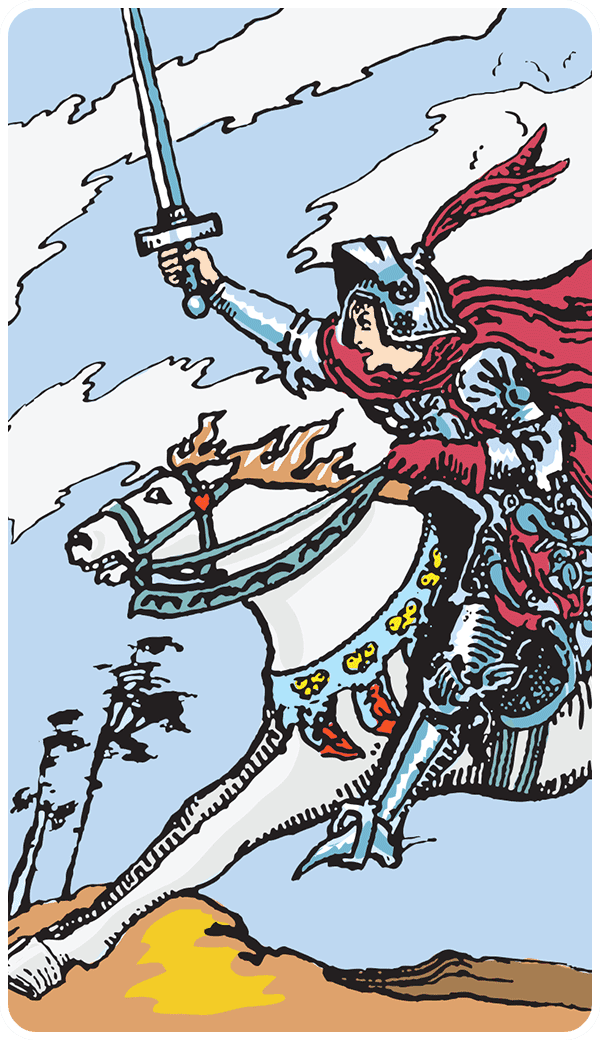
Knight of Swords · plate knight
What the card is actually doing
The Knight of Swords shows up and most readers land on the same word: decisive. They see the horse at full gallop, the sword raised, the forward lean of the figure, and they read it as clarity in motion. The querent hears 'this is the moment to act' and feels validated. But that is not what the card is doing. The Knight of Swords does not describe clarity. It describes velocity without a destination — the mental state of someone who has confused momentum with direction and is now moving too fast to notice the difference.
Reading Knight of Swords in general
What the suit, the rank, and the image are each doing
Swords is the suit of thought, analysis, and the way the mind cuts through ambiguity to make a decision. It governs how you think, what you prioritize when you reason, and how quickly you move from question to conclusion. When Swords cards dominate a reading, the querent is almost always in their head — solving, planning, or trying to think their way out of something that may not be a thinking problem.
Knights in tarot are momentum cards. They describe energy in motion, a direction that has been chosen and is now being pursued. Knights are not stable. They are not reflective. They are already moving when they arrive in the reading, and the question the card asks is whether the movement is serving you or whether you are just along for the ride.
Now look at the image. A knight charges forward on a white horse, sword raised, clouds churning behind him. The trees bend in the wind. There is no opponent visible. There is no clear target. The knight is moving at full speed through a landscape that offers no feedback about whether this is the right direction. The horse's front legs are off the ground. This is someone who cannot stop even if they wanted to.
How the card reads for two different situations
If the querent is stuck — circling the same problem for weeks, paralyzed by overthinking — the Knight of Swords names the moment they finally pick a direction and move. It is not the right direction. It may be a terrible direction. But the card is not grading the choice; it is describing the fact that a choice has been made and the querent is now in motion. The relief they feel is real. The risk is that they are moving so fast they will not notice when the landscape changes and the direction stops making sense.
If the querent is already in motion — pushing a project, ending a relationship, making a big decision quickly — the Knight of Swords is a flag. It names the state they are in: committed to the momentum, unwilling to slow down long enough to check whether the original reason for moving still applies. They are not being strategic. They are being fast. The card is the moment someone says 'I've already decided' when what they mean is 'I'm already moving and I don't want to stop.'
The tell that someone is misreading the card on themselves
The misreading sounds like this: 'The card is telling me to take action.' No. The card is naming the action you are already taking or about to take, and it is pointing at the speed. If you are reading the Knight of Swords as permission or validation, go back and look at what you are not letting yourself think about. The card shows up when the momentum is louder than the map. It does not arrive to tell you the map is correct.
From the practice
“A card never tells you what to do. It tells you what you're already deciding — and gives you the words to name it.”
A grounded observation
Go back through the last six months and find the moment you made a decision fast. Not because you were clear, but because staying still felt worse than moving. That was this card.
Key themes to watch for
- № 01Theme
Beginnings
- № 02Theme
Inner movement
- № 03Theme
Receptivity
What to do with this reading
Read the upright meaning first, even if you pulled the card reversed. The reversal is a commentary on the upright — not a separate card.
Notice what your body did when you saw Knight of Swords. That reaction is usually closer to the truth than the interpretation.
Write down one sentence: What is this card asking me to stop avoiding? Let the answer be smaller than you expect.
Come back to this card in 48 hours. Most general readings sharpen with a little distance.
Questions answered
Frequently asked
The Knight of Swords charges into the scene with determined focus and a clear plan. This card suggests a moment where swift action and decisiveness are paramount. You're likely feeling a surge of energy and ambition, ready to tackle challenges with a courageous heart. However, speed can sometimes overlook detail, so remain aware of what's around you. Consider whether this urgency is warranted or if a breath might offer better clarity. Notice if your drive is aligned with your true intentions, and reflect on the balance between haste and thoughtfulness.
When the Knight of Swords appears reversed, it hints at a rush without direction, perhaps a whirlwind of thoughts without grounding. You might feel like you're chasing after too many things at once. This scattered energy can lead to frustration or missteps. Before charging ahead, pause and assess what truly matters to you. There's an invitation here to slow down and refocus, ensuring that your actions are aligned with your genuine priorities rather than impulsive desires.
Knight of Swords colors the cards around it. Pay attention to where its themes — mental clarity, the truth being named, what the mind needs to release — show up in the next card. That is usually where the story is.
Tarot is observational, not predictive. Knight of Swords describes the conditions in front of you right now and where they tend to lead if nothing changes — not a guarantee of timing.
Repeat cards are the deck underlining a theme. With Knight of Swords, that usually means the question you are asking is the right one — but you have not yet acted on what the card is showing you.
Read next
Related readings
More Swords · General
- Ace of Swords — GeneralHow Ace of Swords reads in a general context.
- Two of Swords — GeneralHow Two of Swords reads in a general context.
- Three of Swords — GeneralHow Three of Swords reads in a general context.
- Four of Swords — GeneralHow Four of Swords reads in a general context.
- Five of Swords — GeneralHow Five of Swords reads in a general context.
- Six of Swords — GeneralHow Six of Swords reads in a general context.
Other Knight of Swords readings
- Love & RelationshipsKnight of Swords read for love & relationships.
- Career & WorkKnight of Swords read for career & work.
- Money & FinanceKnight of Swords read for money & finance.
- Health & WellbeingKnight of Swords read for health & wellbeing.
- SpiritualityKnight of Swords read for spirituality.
- Yes / No AnswerKnight of Swords read for yes / no answer.