Justice in Yes / No
Justice in a yes/no reading says 'yes if you've done the work, no if you're bypassing the process.' Here's what the card is actually weighing.
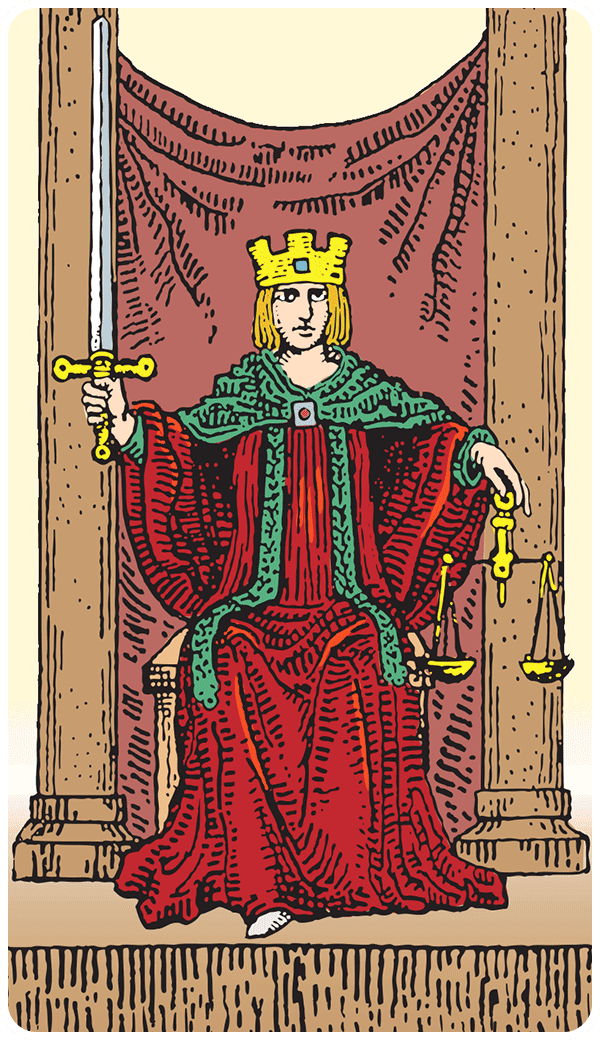
Justice · plate 11
YES
Justice in a yes/no reading leans yes — but only if the situation has already earned it. The card does not predict outcomes. It describes whether the conditions for fairness have been met. Most querents misread Justice as cosmic approval, a sign that the universe will deliver what they want because they deserve it. That is not what the scales are weighing. Justice asks: have you done what the situation required? If yes, the card confirms momentum. If no, it names the gap.
Why Justice reads this way
What the rank, the symbol, and the image are doing
Justice is Major Arcana — it governs structural themes, not day-to-day fluctuations. This is the card of equilibrium, of cause meeting effect, of contracts honored or broken. The figure sits between two pillars, holding a sword in one hand and scales in the other. The sword is discernment. The scales are reciprocity. The card is not measuring your moral worth. It is measuring whether input and output are balanced in the situation you are asking about.
The most common misreading in yes/no contexts is treating Justice as a guarantee. People see the card and think: I've been good, I've waited, I deserve this, so the answer is yes. But Justice does not care about patience or virtue in the abstract. It cares about whether you have met the specific conditions the situation requires. If you are asking about a job offer and you did not follow up after the interview, Justice says no. If you are asking about reconciliation and you have not apologized for the thing that ended it, Justice says no. The card does not bypass process.
How the answer shifts depending on what you have actually done
For a querent who has done the work — who has filed the paperwork, had the hard conversation, followed through on the promise, shown up when it mattered — Justice reads as yes. The card confirms that the situation is moving toward resolution because the structural requirements have been satisfied. The yes is not dramatic. It is mechanical. You met the terms; the outcome follows.
For a querent who is hoping the situation will resolve without their participation, Justice reads as no. The card does not soften this. If you are asking whether someone will come back and you have not reached out, the answer is no. If you are asking whether you will get the result and you have not submitted the application, the answer is no. Justice does not intervene on your behalf. It reflects what is already in motion.
Reversed, Justice often points to a situation where the terms were unfair to begin with, or where you are being asked to meet conditions that are not reciprocal. In those cases, the card still says no — but the no is protective. It is naming that the situation will not resolve in your favor because the structure itself is imbalanced, and participating further will cost you more than it returns.
The tell that you are misreading Justice on yourself
If you pull Justice in a yes/no reading and feel relief, check what you are relieved about. If the relief is 'I knew I was right,' you are misreading the card. Justice does not take sides. If the relief is 'I did what I said I would do and now I can stop second-guessing it,' you are reading it correctly. The other tell: if you are asking the same yes/no question for the third time, Justice is almost always saying no, and the repetition is you trying to argue with the answer.
A grounded observation
Go back through your last five yes/no questions and check whether you were asking about an outcome or asking for permission to skip a step. Justice answers the second question first.
Key themes to watch for
- № 01Theme
Affirmative current
- № 02Theme
Open door
- № 03Theme
Forward motion
What to do with this reading
Read the upright meaning first, even if you pulled the card reversed. The reversal is a commentary on the upright — not a separate card.
Notice what your body did when you saw Justice. That reaction is usually closer to the truth than the interpretation.
Write down one sentence: What is this card asking me to stop avoiding? Let the answer be smaller than you expect.
Come back to this card in 48 hours. Most yes / no readings sharpen with a little distance.
Questions answered
Frequently asked
Justice in a yes/no reading leans yes — but only if the situation has already earned it. The card does not predict outcomes. It describes whether the conditions for fairness have been met. Most querents misread Justice as cosmic approval, a sign that the universe will deliver what they want because they deserve it. That is not what the scales are weighing. Justice asks: have you done what the situation required? If yes, the card confirms momentum. If no, it names the gap.
Reversed cards are rarely "bad." Justice reversed asks you to look at where the same theme is blocked, postponed, or being avoided — usually with more compassion than the upright version.
Justice colors the cards around it. Pay attention to where its themes — archetype, pattern, invitation — show up in the next card. That is usually where the story is.
Tarot is observational, not predictive. Justice describes the conditions in front of you right now and where they tend to lead if nothing changes — not a guarantee of timing.
Repeat cards are the deck underlining a theme. With Justice, that usually means the question you are asking is the right one — but you have not yet acted on what the card is showing you.
Read next
Related readings
Other Justice readings