Justice in Health
Justice in a health reading gets read as karmic illness or moral payback. What it actually describes is pattern recognition — the body naming what's been ignored.
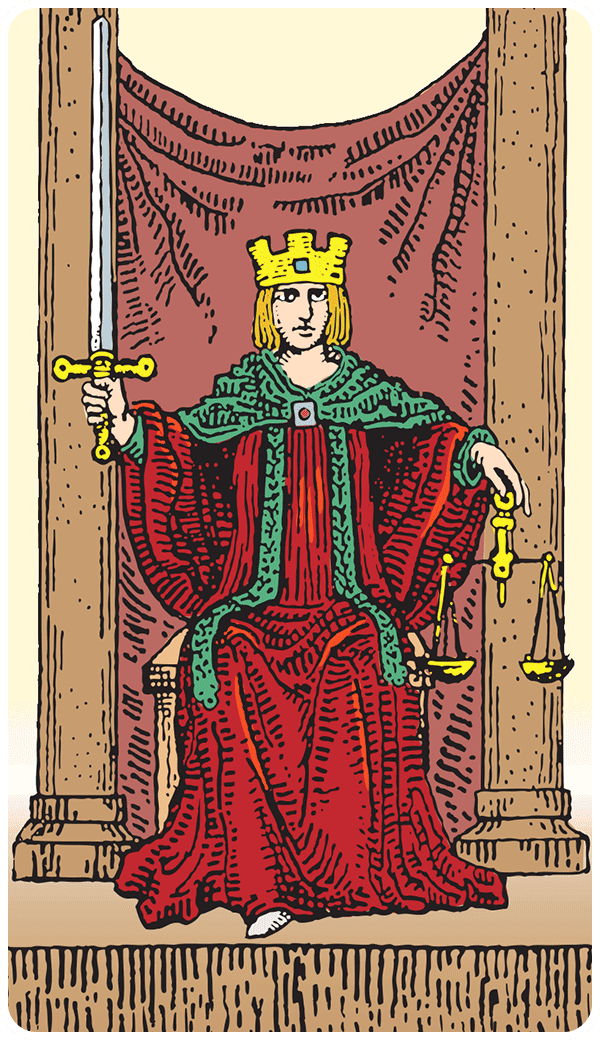
Justice · plate 11
What the card is actually doing
Justice shows up in a health reading and the querent hears punishment. They think the card is saying their body is betraying them because they didn't meditate enough, or ate the wrong foods, or carried too much stress. They read it as cosmic payback — you did something wrong, so now your body is making you pay. That is not what the card describes. Justice is not about moral judgment. It is about correspondence. The card names the moment when cause and effect become visible enough that you can no longer pretend they aren't connected.
Reading Justice in health
What the card image is actually doing
Justice sits enthroned, holding a sword in one hand and scales in the other. The sword is upright — it cuts through, it clarifies, it makes a distinction. The scales are balanced — they weigh, they measure, they register what has been added and what has been taken away. This is a Major Arcana card, which means it describes a structural pattern, not a passing symptom. When Justice appears in a health reading, it is pointing to a feedback loop that has been running long enough to produce a measurable result. The body is not punishing you. The body is reporting.
The most common misreading is to treat Justice as a morality card — as if health outcomes are rewards or punishments handed down by the universe. People read it and think: I must have done something to deserve this. That is shame talking, not the card. What Justice actually describes is pattern recognition. You have been doing X, and your body has been responding with Y, and the card is naming the moment when you can no longer ignore that X and Y are related. The correspondence has become legible. The scales have tipped far enough that you can see the weight.
How the card reads differently depending on what the querent is asking
For someone asking why a chronic condition keeps flaring, Justice tends to point to a behavioral or environmental pattern they have been treating as unrelated. They think the flare-ups are random. The card says: go back through your calendar and track what you were doing in the 48 hours before each one. You will find the same stressor, the same food, the same sleep deficit, the same argument. The body has been naming the pattern the entire time. You have been calling it bad luck.
For someone asking whether a new treatment or lifestyle change will work, Justice describes accountability, not outcome. The card is not saying the treatment will or won't work. It is saying: this will require you to actually do the thing consistently, and the result will correspond to the consistency. If you take the medication five days out of seven, your body will give you a five-out-of-seven result. If you rest when you say you will rest, your nervous system will register that you meant it. The scales measure what you put in.
The tell that someone is misreading Justice on themselves
The tell is moral language. If the querent is talking about what they "should have done" or what they "deserve," they are reading the card through shame, not through mechanics. Justice does not care about should. It cares about correspondence. When you hear yourself say my body is punishing me, stop and rewrite the sentence: my body is responding to a pattern I have been running. That is the correction. The card is not interested in blame. It is interested in whether you are willing to see the pattern clearly enough to change it.
From the practice
“A card never tells you what to do. It tells you what you're already deciding — and gives you the words to name it.”
A grounded observation
Go back through the last month and track one recurring physical complaint against one recurring behavior. You will find the correspondence. That is what Justice is pointing to.
Key themes to watch for
- № 01Theme
Emotional renewal
- № 02Theme
Mind-body link
- № 03Theme
Soft restoration
What to do with this reading
Read the upright meaning first, even if you pulled the card reversed. The reversal is a commentary on the upright — not a separate card.
Notice what your body did when you saw Justice. That reaction is usually closer to the truth than the interpretation.
Write down one sentence: What is this card asking me to stop avoiding? Let the answer be smaller than you expect.
Come back to this card in 48 hours. Most health readings sharpen with a little distance.
Questions answered
Frequently asked
In health matters, Justice brings a sense of balance and accountability. It suggests that taking a fair and consistent approach to health routines can lead to positive outcomes. This card encourages you to be honest about any unhealthy habits and consider how balance aids in overall well-being. It's a moment to reflect on how your choices impact your health and how fairness to yourself might promote better habits.
Reversed, Justice in health might indicate imbalance or neglect. There may be areas of your health that are being overlooked or treated unfairly. This card prompts you to reflect on whether all aspects of your health are being addressed equally and whether there’s a need for a more balanced approach.
Justice colors the cards around it. Pay attention to where its themes — archetype, pattern, invitation — show up in the next card. That is usually where the story is.
Tarot is observational, not predictive. Justice describes the conditions in front of you right now and where they tend to lead if nothing changes — not a guarantee of timing.
Repeat cards are the deck underlining a theme. With Justice, that usually means the question you are asking is the right one — but you have not yet acted on what the card is showing you.
Read next
Related readings
Other Justice readings