Justice in General
Justice isn't karma or fairness. It's the card that names what you've been pretending doesn't count. Here's what the scales are actually weighing.
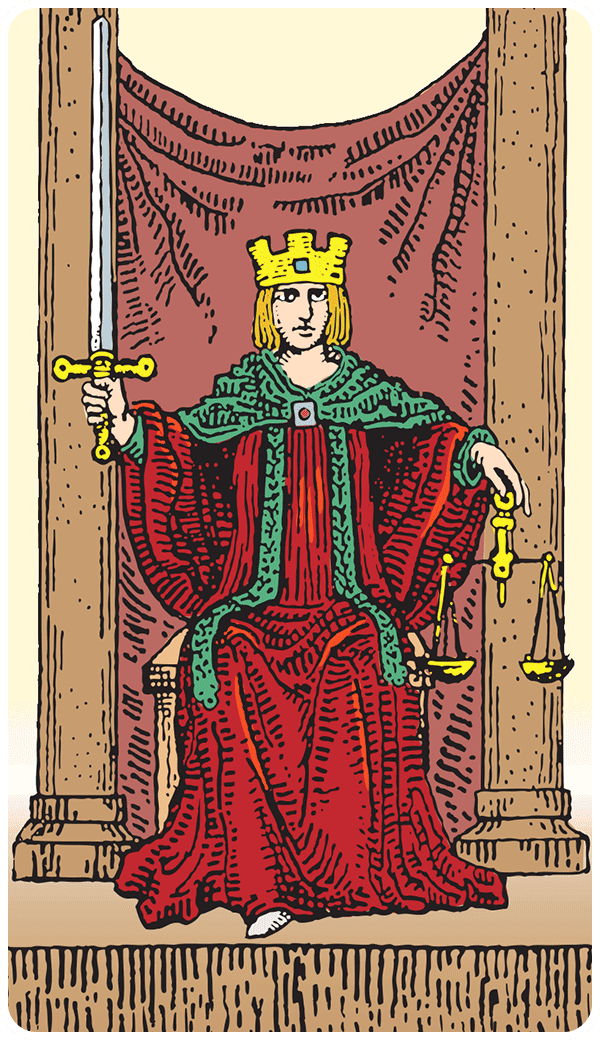
Justice · plate 11
What the card is actually doing
Justice shows up in a general reading and the querent nods. They think they know what it means: fairness is coming. The universe will balance the scales. What was taken will be returned. The person who wronged them will finally understand. That is not what the card is doing. Justice is not a promise that the world will become fair. It is the moment you stop pretending the math doesn't add up.
Reading Justice in general
The card is named for the principle, not the outcome
Justice sits at number eleven in the Major Arcana — the first card past the Wheel of Fortune's midpoint turn. The Wheel named what you can't control. Justice names what you can measure. The figure holds a sword in one hand and scales in the other. The sword is upright. The scales are level. This is not an emotional card. It is a structural one.
The scales are weighing something specific: input against output, action against consequence, what you said against what you did. The most common misreading is to project the weighing outward — to read Justice as "they will get what's coming to them" or "I will finally be vindicated." But the scales are not weighing other people. They are weighing the querent's own ledger. What you put in is producing what you're getting out, and the card is the moment you stop arguing with that fact.
Here's what tends to happen when Justice appears. The querent has been in a situation for months where the results don't match the effort. They've been kind to someone who stays cruel. They've been working a job that doesn't pay them correctly. They've been pretending a relationship is equal when they are doing seventy percent of the labor. Justice is the card that says: the imbalance you're experiencing is information. The math has been visible the entire time.
How the card reads for two different situations
For the querent who has been overgiving — who shows up on time, remembers birthdays, makes the call, does the favor, and receives almost nothing back — Justice reads as permission to stop. Not as punishment for the other person, but as structural correction. The scales are showing you what the exchange actually is. You are allowed to match it.
For the querent who has been undergiving — who has been late on rent three months running, who borrowed money and didn't return it, who said they'd show up and didn't — Justice reads as the bill. The card is not moral judgment. It is the moment the system corrects. The friend stops lending. The landlord files. The relationship ends. The consequence was always going to arrive; Justice is the point where it does.
In both cases, the card is describing the same mechanism: cause producing effect at a one-to-one ratio. The sword cuts through the story you've been telling yourself about why the imbalance is fine or temporary or someone else's fault. The scales don't care about the story. They care about the weight.
The tell that someone is misreading Justice on themselves
The querent reads Justice and immediately starts talking about someone else. What that person owes them. What that person deserves. What should happen to that person for what they did. If the first sentence out of your mouth after seeing Justice is about another person's behavior, you are misreading the card. Justice is a mirror card. It is showing you your own pattern, your own ledger, your own half of the equation. The other person's card is not in your reading.
From the practice
“A card never tells you what to do. It tells you what you're already deciding — and gives you the words to name it.”
A grounded observation
Go back through the last six months and look for the place where you kept adding weight to one side of a scale and expected it to stay level. That's the situation Justice is naming.
Key themes to watch for
- № 01Theme
Beginnings
- № 02Theme
Inner movement
- № 03Theme
Receptivity
What to do with this reading
Read the upright meaning first, even if you pulled the card reversed. The reversal is a commentary on the upright — not a separate card.
Notice what your body did when you saw Justice. That reaction is usually closer to the truth than the interpretation.
Write down one sentence: What is this card asking me to stop avoiding? Let the answer be smaller than you expect.
Come back to this card in 48 hours. Most general readings sharpen with a little distance.
Questions answered
Frequently asked
Justice in its upright position calls for truth and fairness. This card invites you to examine situations with a clear, unbiased lens. Are you being honest with yourself and others? It suggests that decisions made now will be based on integrity and balance, leading to outcomes that reflect these values. Consider how you might weigh your decisions more carefully, ensuring that each choice aligns with your core values. Reflect on how balance and fairness manifest in your daily life, and if any adjustments need to be made to maintain this equilibrium.
Reversed, Justice hints at imbalance and unfairness, perhaps suggesting that something is not quite right in your world. It can indicate a feeling that things are skewed or that decisions are being made without full transparency. This card asks you to consider if you're ignoring inconvenient truths or overlooking important details. Reflect on whether there's a part of your life where you feel misjudged or misunderstood, and how you might address this. It’s an invitation to seek clarity and ensure that fairness is restored.
Justice colors the cards around it. Pay attention to where its themes — archetype, pattern, invitation — show up in the next card. That is usually where the story is.
Tarot is observational, not predictive. Justice describes the conditions in front of you right now and where they tend to lead if nothing changes — not a guarantee of timing.
Repeat cards are the deck underlining a theme. With Justice, that usually means the question you are asking is the right one — but you have not yet acted on what the card is showing you.
Read next
Related readings
Other Justice readings