Justice in Money
Justice in a finance reading names what you already know about your money choices. Not karma arriving — the moment you stop pretending the pattern isn't there.
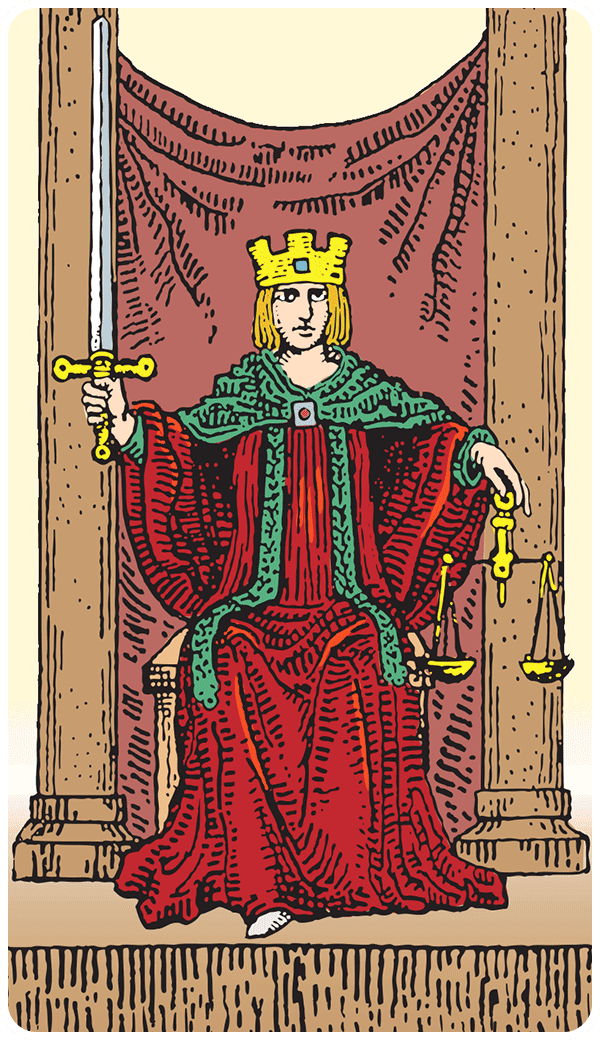
Justice · plate 11
What the card is actually doing
Justice shows up in a finance reading and people hear "fairness." They think: the tax refund is coming, the raise will finally land, the court case will break their way, the universe will correct what was unfair. That is not what the card does. Justice does not describe fairness arriving from outside. It describes the moment you stop lying to yourself about what the numbers have been saying for six months.
The card names the pattern you've been watching form. It does not resolve it. It does not punish or reward. It holds up the ledger and says: here is what you've been doing, here is what that produces, and you already know this.
Reading Justice in money
What the Major Arcana rank and the image are doing
Justice is Major Arcana, which means it describes a structural threshold — not a transaction, not an event, but a shift in how you see the situation. Major cards don't predict outcomes; they name the psychological or relational architecture the querent is standing inside. Justice specifically governs accountability, equilibrium, and the moment cause-and-effect becomes visible.
Look at the image. A figure sits between two pillars, holding a sword in one hand and scales in the other. The sword is raised. The scales are balanced. This is not a card about waiting for judgment. The judgment has already been made. The sword names the cut — the decision that separates one financial reality from another. The scales name the ledger: what you spent, what you earned, what you promised, what you delivered. The figure is still. The weighing is done.
The most common misreading in a finance context is treating Justice as cosmic fairness — "I've been underpaid for years, so this card means I'm finally getting what I deserve." That is wishful thinking dressed as tarot. What the card actually does is surface the pattern. If you've been underpaid and you keep accepting the underpayment, Justice names that as the active agreement. If you've been overspending on credit and pretending the balance isn't climbing, Justice is the moment you open the statement and see the number you already knew was there.
How the card reads for two different querents
For someone asking "Should I take this job offer?": Justice says the terms are clear. You know what the salary is, you know what your expenses are, you know whether the math works. The card is not telling you the answer is yes or no. It is telling you that you already have the information and the decision is about whether you're willing to act on what you see. If you keep asking the question after the numbers are in front of you, you are avoiding the cut.
For someone asking "Why is money always tight?": Justice points to the pattern you are maintaining. Go back through three months of transactions. Not to judge yourself — to see what you've been choosing. The card does not care if the choices were survival or self-sabotage. It names the structure. Most people who pull Justice in this context already know what they're going to find. They've been waiting for permission to see it.
The tell that someone is misreading the card on themselves
If you pull Justice in a finance reading and your first thought is "finally, I'm going to get what's fair," you are misreading it. The card does not describe fairness arriving. It describes the moment you see the trade you've been making — time for money, security for autonomy, present spending for future stability — and recognize it as the trade it is. If you're waiting for Justice to fix your financial situation, you are treating the card as a promise instead of a mirror.
From the practice
“A card never tells you what to do. It tells you what you're already deciding — and gives you the words to name it.”
A grounded observation
Pull your bank statements from the last ninety days and look for the recurring line item you've been pretending isn't recurring. That's what Justice is naming.
Key themes to watch for
- № 01Theme
Non-material wealth
- № 02Theme
Generosity
- № 03Theme
Values check
What to do with this reading
Read the upright meaning first, even if you pulled the card reversed. The reversal is a commentary on the upright — not a separate card.
Notice what your body did when you saw Justice. That reaction is usually closer to the truth than the interpretation.
Write down one sentence: What is this card asking me to stop avoiding? Let the answer be smaller than you expect.
Come back to this card in 48 hours. Most money readings sharpen with a little distance.
Questions answered
Frequently asked
Upright, Justice in finances encourages fairness and balance. It’s a good time to review your financial dealings and ensure that they are transparent and equitable. You might find that being meticulous and honest with your money management pays off now. Reflect on how you handle financial responsibilities and whether there’s room for more balance. Consider how fairness in financial agreements impacts your overall stability.
Reversed, Justice may signify financial imbalance or unfair dealings. There could be disputes or misunderstandings about money. This card invites you to examine financial relationships and ensure that all agreements are clear and equitable. Reflect on whether your financial dealings are as fair as they could be.
Justice colors the cards around it. Pay attention to where its themes — archetype, pattern, invitation — show up in the next card. That is usually where the story is.
Tarot is observational, not predictive. Justice describes the conditions in front of you right now and where they tend to lead if nothing changes — not a guarantee of timing.
Repeat cards are the deck underlining a theme. With Justice, that usually means the question you are asking is the right one — but you have not yet acted on what the card is showing you.
Read next
Related readings
Other Justice readings