Three of Swords in Career
The Three of Swords in career readings gets read as betrayal or firing. What it actually names is the moment you stop pretending the structure still works.
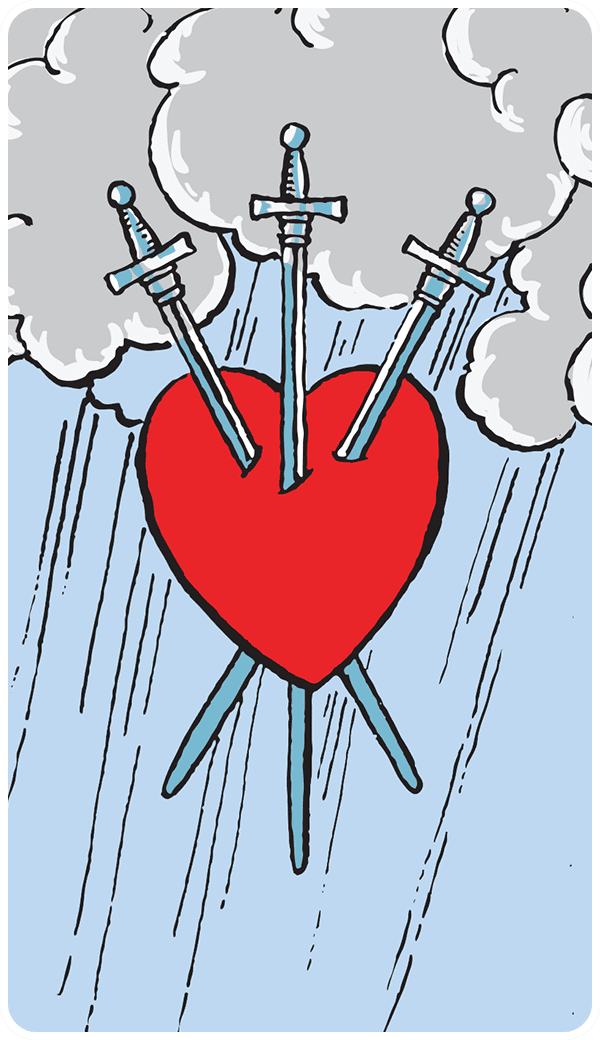
Three of Swords · plate 3
What the card is actually doing
The Three of Swords shows up in a career reading and the querent assumes the worst. Someone is going to betray them. They're about to get fired. A colleague is undermining them behind closed doors. The card reads as threat, as incoming damage, as something being done to them. That is not what the card is describing. The Three of Swords names the moment a professional illusion breaks — when you can no longer pretend the job, the team, or the trajectory still makes sense. The pain is real. The betrayal reading is almost always wrong.
Reading Three of Swords in career
What the suit, the rank, and the image are actually doing
Swords is the suit of thought, clarity, and the stories you tell yourself about what is true. It governs how you think through problems, what narratives you construct to make sense of your situation, and the moment those narratives stop holding. When Swords cards dominate a career reading, the question is almost never about what is happening externally. It is about what you are finally willing to see.
Threes in tarot describe the first consequence of a pairing. The Ace opens a channel, the Two holds a tension, and the Three shows what happens when that tension produces a result. Threes are not stable. They are the outcome that forces the next move.
Now look at the image. A heart pierced by three swords. Rain falling. Gray sky. No people. The card is often read as betrayal because people assume the swords came from someone else. But there are no hands on those swords. The image does not show an attack. It shows a heart that has been penetrated by clarity — by three separate thoughts that all arrived at once and could not be ignored. The rain is what happens after. The grief of finally seeing what you had been refusing to see.
The most common misreading in a career context is "someone is going to betray me." What the card actually describes is the moment your own thoughts betray the story you had been telling yourself about the job. You realize your manager has been lying for six months. You see that the promotion was never real. You understand that the company culture you believed in does not exist. The swords are your own clarity, and they hurt because clarity always costs something.
How the card reads for two different querent situations
For someone early in their career, the Three of Swords often describes the first time they realize a workplace is not a meritocracy. They did the work. They were loyal. They believed the right effort would produce the right outcome. The card names the moment they see that the game has different rules than they thought. The pain is not about being fired. It is about the innocence breaking.
For someone mid-career or senior, the Three of Swords tends to show up when they finally admit they have been staying in a role out of fear, inertia, or sunk cost. They have known for months or years that the work no longer fits. The card does not create the misalignment. It names the moment they stop pretending the misalignment is not there. The grief is not about loss. It is about how long they waited to act on what they already knew.
The tell that someone is misreading the card on themselves
The tell is when the querent frames the card as something being done to them by an external actor. "My boss is going to screw me over." "My coworker is sabotaging me." "The company is going to betray me." If the reading stays focused on what someone else might do, the querent is missing the card. Go back and ask: what have you been pretending not to know? What story about this job have you been holding that no longer matches the evidence? The Three of Swords is not about someone else's betrayal. It is about your own clarity arriving, uninvited, in the middle of the rain.
From the practice
“A card never tells you what to do. It tells you what you're already deciding — and gives you the words to name it.”
A grounded observation
Go back through your work calendar and look for the moment you first knew something was wrong. The Three of Swords is not the moment it happened. It is the moment you stopped lying to yourself about it.
Key themes to watch for
- № 01Theme
Creative purpose
- № 02Theme
Heart-led work
- № 03Theme
Right alignment
What to do with this reading
Read the upright meaning first, even if you pulled the card reversed. The reversal is a commentary on the upright — not a separate card.
Notice what your body did when you saw Three of Swords. That reaction is usually closer to the truth than the interpretation.
Write down one sentence: What is this card asking me to stop avoiding? Let the answer be smaller than you expect.
Come back to this card in 48 hours. Most career readings sharpen with a little distance.
Questions answered
Frequently asked
In the context of career, the Three of Swords upright can indicate tension or disappointment. This might be the realization that a project isn’t going as planned, or finding that office politics are more complex than expected. It's a pointed reminder that not all paths are smooth. While this card highlights discomfort, it also provides a chance to reassess your professional landscape. It invites you to consider new strategies and perhaps find innovative solutions amidst the challenges.
Reversed, this card hints at recovery from a professional setback. You might be moving past a period of disappointment or conflict with colleagues. The turbulence is settling, allowing for clearer skies ahead. It suggests that lessons learned from recent experiences are beginning to bear fruit. Now could be the time to reestablish connections or rethink your approach to ongoing projects, with a focus on moving forward rather than dwelling on past difficulties.
Three of Swords colors the cards around it. Pay attention to where its themes — mental clarity, the truth being named, what the mind needs to release — show up in the next card. That is usually where the story is.
Tarot is observational, not predictive. Three of Swords describes the conditions in front of you right now and where they tend to lead if nothing changes — not a guarantee of timing.
Repeat cards are the deck underlining a theme. With Three of Swords, that usually means the question you are asking is the right one — but you have not yet acted on what the card is showing you.
Read next
Related readings
More Swords · Career
- Ace of Swords — CareerHow Ace of Swords reads in a career context.
- Two of Swords — CareerHow Two of Swords reads in a career context.
- Four of Swords — CareerHow Four of Swords reads in a career context.
- Five of Swords — CareerHow Five of Swords reads in a career context.
- Six of Swords — CareerHow Six of Swords reads in a career context.
- Seven of Swords — CareerHow Seven of Swords reads in a career context.
Other Three of Swords readings
- General MeaningThree of Swords read for general meaning.
- Love & RelationshipsThree of Swords read for love & relationships.
- Money & FinanceThree of Swords read for money & finance.
- Health & WellbeingThree of Swords read for health & wellbeing.
- SpiritualityThree of Swords read for spirituality.
- Yes / No AnswerThree of Swords read for yes / no answer.