Six of Swords in Career
The Six of Swords in career readings gets read as 'time to quit.' What it actually describes is the moment you stop fighting a decision you already made.
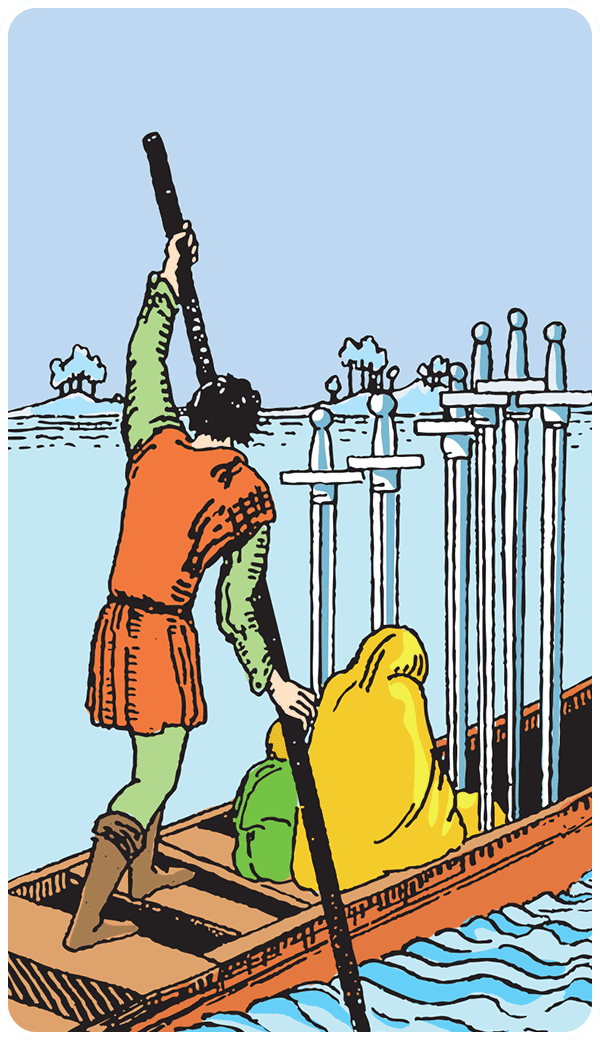
Six of Swords · plate 6
What the card is actually doing
The Six of Swords shows up in a career reading and the querent already knows what they want me to say. They want confirmation that it's time to leave. Time to quit the job, close the business, walk away from the project that isn't working. The card looks like departure — a figure in a boat, moving across water, leaving something behind — so that's what people read it as. But that's not what the card is describing. The Six of Swords is not permission to leave. It is the mechanical description of what happens after you've already decided to leave and are now in the grey middle distance between the old structure and wherever you're going next.
Reading Six of Swords in career
What the suit, the rank, and the image are each doing
Swords is the suit of thought, decision, and the frameworks you use to make sense of your work. It governs how you think about what you do, what standards you hold yourself to, and what internal arguments you're running about whether you're in the right place. When Swords cards cluster in a career reading, the real question is almost always about whether the way you're thinking about the work still makes sense.
Sixes in tarot describe a temporary equilibrium. Not resolution — equilibrium. The crisis has passed, but the new stable state hasn't arrived yet. You are in motion, but the motion is slow and the destination is not yet visible. Sixes are transition cards. They describe the part of the process where you are neither here nor there.
Now look at the image. A figure sits in a boat with their back to us, facing forward. A ferryman poles the boat across calm water. There are six swords standing upright in the boat. The sky is grey. The far shore is not visible. The figure is not rowing. They are being moved. The decision to get in the boat has already been made. What the card is showing you is the transit itself — the part where you are committed to the move but have not yet landed.
How the card reads differently depending on what the querent is actually asking
If the querent is asking whether they should leave their job, the Six of Swords is not answering that question. It is describing what it will feel like once they do. It reads as: you will not feel relief immediately. You will feel untethered. The new role or the new city or the new business model will not clarify itself the day you give notice. You will spend weeks or months in the boat, second-guessing, before the far shore becomes visible.
If the querent has already left — already quit, already been laid off, already closed the business — the Six of Swords is confirming that they are in the slowest part of the process. The part where nothing is happening on the outside but everything is recalibrating on the inside. The card is not telling them to do anything. It is naming the phase they are in so they stop mistaking it for stuckness.
The tell that someone is misreading the card on themselves
The tell is this: they are still asking whether they should leave. If you are still asking the question, you are not the Six of Swords yet. The Six of Swords describes the person who already bought the ticket, already gave notice, already told their business partner it's over. The decision is done. The card is about what happens after the decision, not before it. If you pull this card and think it means "leave now," go back and check whether you've actually made the decision or whether you're hoping the card will make it for you.
From the practice
“A card never tells you what to do. It tells you what you're already deciding — and gives you the words to name it.”
A grounded observation
Go back through your calendar and look for the last time you were in transit between two clear chapters of work. Notice how long the grey part lasted and how little you remember deciding during it.
Key themes to watch for
- № 01Theme
Creative purpose
- № 02Theme
Heart-led work
- № 03Theme
Right alignment
What to do with this reading
Read the upright meaning first, even if you pulled the card reversed. The reversal is a commentary on the upright — not a separate card.
Notice what your body did when you saw Six of Swords. That reaction is usually closer to the truth than the interpretation.
Write down one sentence: What is this card asking me to stop avoiding? Let the answer be smaller than you expect.
Come back to this card in 48 hours. Most career readings sharpen with a little distance.
Questions answered
Frequently asked
The Six of Swords in a career reading suggests a period of transition, possibly moving from a challenging work environment to a more supportive one. This could mean a new job, a different role, or even a shift in how you approach your work. It's about leaving behind stressors and finding a more balanced professional life. Consider what changes you've been contemplating and how they might guide you to a place of greater fulfillment. What does your ideal work environment look like?
In the reversed position, this card may indicate feeling stuck in a job situation that no longer feels right. Perhaps there's a fear of leaving the known, even if it's not serving you well. Career progress might feel stalled, or there could be resistance to making necessary changes. Take a moment to identify what's holding you back. Is there a step you can take to move closer to your professional goals, even if it's a small one?
Six of Swords colors the cards around it. Pay attention to where its themes — mental clarity, the truth being named, what the mind needs to release — show up in the next card. That is usually where the story is.
Tarot is observational, not predictive. Six of Swords describes the conditions in front of you right now and where they tend to lead if nothing changes — not a guarantee of timing.
Repeat cards are the deck underlining a theme. With Six of Swords, that usually means the question you are asking is the right one — but you have not yet acted on what the card is showing you.
Read next
Related readings
More Swords · Career
- Ace of Swords — CareerHow Ace of Swords reads in a career context.
- Two of Swords — CareerHow Two of Swords reads in a career context.
- Three of Swords — CareerHow Three of Swords reads in a career context.
- Four of Swords — CareerHow Four of Swords reads in a career context.
- Five of Swords — CareerHow Five of Swords reads in a career context.
- Seven of Swords — CareerHow Seven of Swords reads in a career context.
Other Six of Swords readings
- General MeaningSix of Swords read for general meaning.
- Love & RelationshipsSix of Swords read for love & relationships.
- Money & FinanceSix of Swords read for money & finance.
- Health & WellbeingSix of Swords read for health & wellbeing.
- SpiritualitySix of Swords read for spirituality.
- Yes / No AnswerSix of Swords read for yes / no answer.