Seven of Swords in Career
The Seven of Swords in career readings gets read as betrayal or theft. What it actually describes is strategic withholding — and the question is whether you're doing it consciously.
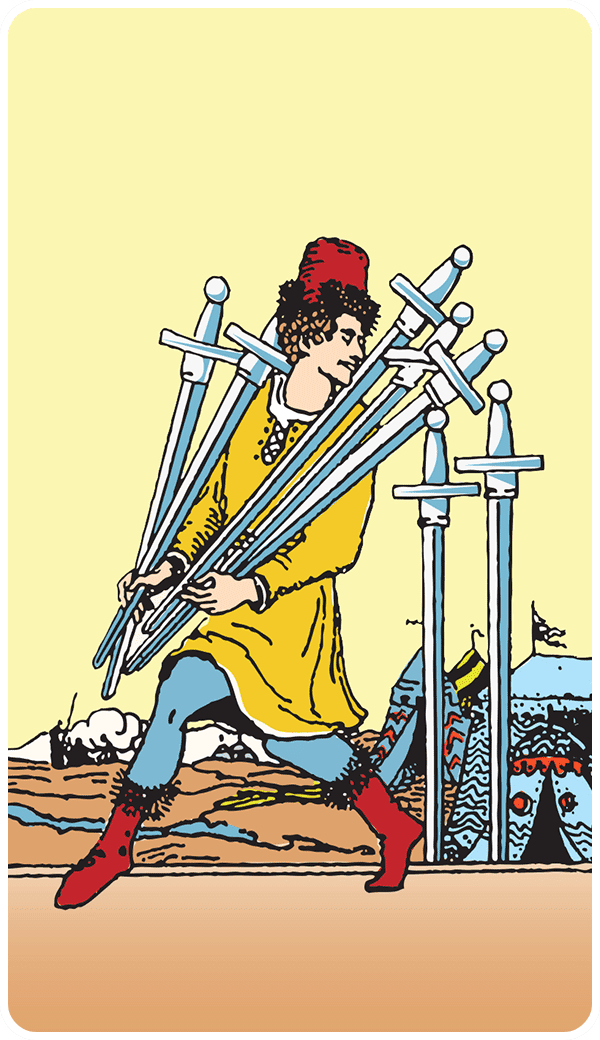
Seven of Swords · plate 7
What the card is actually doing
The Seven of Swords shows up in a career reading and the querent assumes someone is stealing from them. Credit for their work. An idea they pitched. Recognition they earned. They want to know who the thief is and how to catch them. That is rarely what the card is describing. What it names instead is the moment you realize you cannot say the whole truth out loud at work — and the specific way you edit yourself in response.
Reading Seven of Swords in career
What the suit, rank, and image are doing
Swords is the suit of thought, communication, and the social contract. It governs what you say, what you withhold, and how information moves between people in a structure. When Swords cards dominate a career reading, the question is almost always about messaging, positioning, or the gap between what you think and what you're allowed to voice.
Sevens in tarot describe a strategy under pressure. They are not stable states. A Seven is what you do when the straightforward path is blocked and you have to get clever. The Seven of Wands is defending a position you've already claimed. The Seven of Pentacles is deciding whether to keep investing. The Seven of Swords is taking what you need without asking permission.
Look at the image. A figure walks away from a military camp carrying five swords, leaving two behind. The posture is furtive. The swords are held awkwardly, bundled in the arms like stolen goods. This is not a frontal confrontation. This is extraction. The card describes the moment you stop playing by the stated rules because the stated rules were never going to let you win.
How it reads for two different situations
If you are early in your career or in a role where you have no formal power, the Seven of Swords describes strategic silence. You stop offering your best ideas in meetings because you've watched them get claimed by someone two levels up. You start keeping a second version of your work that your manager never sees. You take the skills you're building and start interviewing elsewhere without telling anyone. The card is not calling this theft. It is calling it accurate.
If you are the person with positional power, the card reads differently. Now it describes the moment you realize you are withholding information your team needs because sharing it would cost you leverage. You are not collaborating; you are controlling access. The furtive posture on the card is not about someone else stealing from you. It is about the way you move when you know what you are doing would not survive being named out loud.
The tell that you are misreading it
You are misreading the Seven of Swords if you spend the week after the reading trying to figure out who the villain is. The card does not identify external betrayal. It identifies the conditions that make strategic withholding necessary — or the moment you are using those conditions as cover for behavior you would not defend in plain language. The question is not "who is lying to me." The question is "what am I not saying, and is my reason structural or self-serving." If you cannot answer that clearly, you are still performing the card instead of reading it.
From the practice
“A card never tells you what to do. It tells you what you're already deciding — and gives you the words to name it.”
A grounded observation
Go back through your last five work conversations and notice where you edited yourself mid-sentence. The Seven of Swords is describing that edit and asking whether it was tactical or habitual.
Key themes to watch for
- № 01Theme
Creative purpose
- № 02Theme
Heart-led work
- № 03Theme
Right alignment
What to do with this reading
Read the upright meaning first, even if you pulled the card reversed. The reversal is a commentary on the upright — not a separate card.
Notice what your body did when you saw Seven of Swords. That reaction is usually closer to the truth than the interpretation.
Write down one sentence: What is this card asking me to stop avoiding? Let the answer be smaller than you expect.
Come back to this card in 48 hours. Most career readings sharpen with a little distance.
Questions answered
Frequently asked
Career-wise, the Seven of Swords points to strategic maneuvering and possibly working behind the scenes. There might be a need to keep plans close to your chest, whether to protect your ideas or navigate office politics. It's a time for cleverness and subtlety, but also a reminder to check your motivations. Are your tactics serving a greater purpose, or are they driven by self-interest? This card encourages you to assess the long-term impact of your actions and whether they align with your professional values.
In career affairs, a reversed Seven of Swords signals that covert actions may be exposed or that your strategies are not yielding the desired results. It suggests a rethink of current methods and the necessity of a more straightforward approach. Consider if there's a way to bring more transparency into your work environment. Could this be an opportunity to build stronger relationships through honesty and collaboration? Reflect on whether there are unsustainable tactics that need reevaluation.
Seven of Swords colors the cards around it. Pay attention to where its themes — mental clarity, the truth being named, what the mind needs to release — show up in the next card. That is usually where the story is.
Tarot is observational, not predictive. Seven of Swords describes the conditions in front of you right now and where they tend to lead if nothing changes — not a guarantee of timing.
Repeat cards are the deck underlining a theme. With Seven of Swords, that usually means the question you are asking is the right one — but you have not yet acted on what the card is showing you.
Read next
Related readings
More Swords · Career
- Ace of Swords — CareerHow Ace of Swords reads in a career context.
- Two of Swords — CareerHow Two of Swords reads in a career context.
- Three of Swords — CareerHow Three of Swords reads in a career context.
- Four of Swords — CareerHow Four of Swords reads in a career context.
- Five of Swords — CareerHow Five of Swords reads in a career context.
- Six of Swords — CareerHow Six of Swords reads in a career context.
Other Seven of Swords readings
- General MeaningSeven of Swords read for general meaning.
- Love & RelationshipsSeven of Swords read for love & relationships.
- Money & FinanceSeven of Swords read for money & finance.
- Health & WellbeingSeven of Swords read for health & wellbeing.
- SpiritualitySeven of Swords read for spirituality.
- Yes / No AnswerSeven of Swords read for yes / no answer.