Five of Swords in Career
The Five of Swords in career readings gets misread as total defeat. The card is naming what you sacrificed to win the argument — and whether anyone's left to work with.
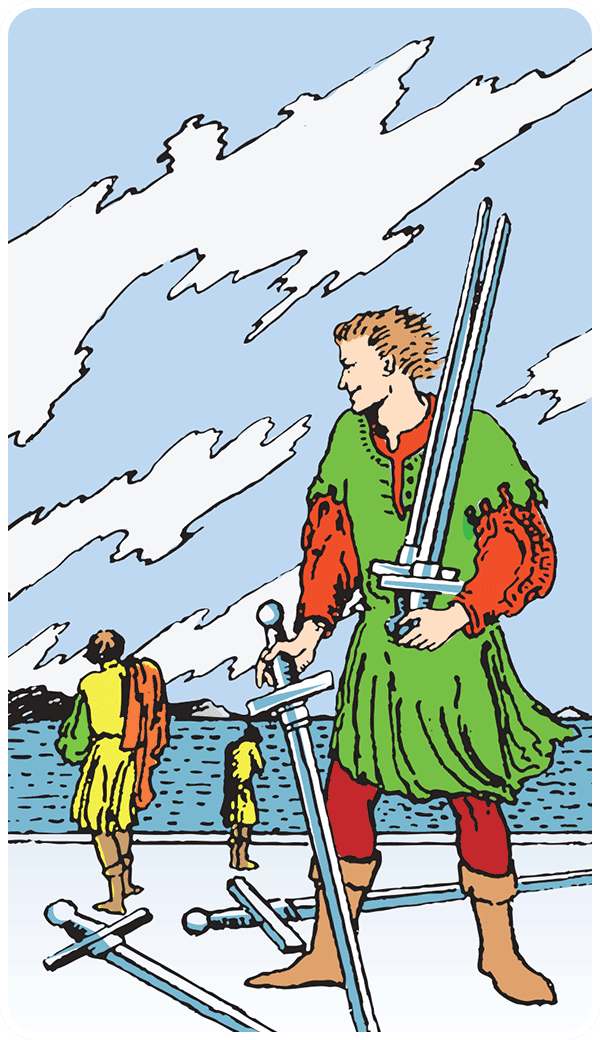
Five of Swords · plate 5
What the card is actually doing
The Five of Swords shows up in a career reading and the querent assumes they lost. Someone else got the promotion. The project failed. The team turned on them. That is not what the card is describing. The Five of Swords is not about losing — it is about winning in a way that leaves you alone on the field. The card names the moment after you proved your point, after you outmaneuvered the person who was blocking you, after you got your way. Now look around. Who is still standing next to you.
Reading Five of Swords in career
What the suit, the rank, and the image are doing
Swords is the suit of thought, argument, and the social mechanics of being right. It governs how you position yourself in a room, how you defend your territory, how you cut through someone else's logic to assert your own. When Swords cards cluster in a career reading, the question is almost never about the work itself — it is about who has power and how that power is being used.
Fives in tarot describe loss, but not the loss of the thing itself. Fives describe what you lose in the process of fighting for the thing. The Five of Pentacles is not poverty; it is being locked out in the cold while the warm room is right there. The Five of Cups is not heartbreak; it is standing over the spilled cups while three full ones sit behind you, unnoticed. Fives name the cost of the conflict, not the outcome.
Now look at the image. A figure holds three swords. Two other swords lie on the ground. Two figures walk away in the background, shoulders slumped. The central figure has won the swords — they have more than anyone else on the field. But they are alone. The victory is technical. No one is celebrating with them.
The Five of Swords is the moment you realize you won the argument and lost the room. You were right. You have the swords to prove it. The other people have left.
How the card reads for two different situations
If you are the person holding the swords — if you just pushed your idea through over someone else's objection, if you just proved your manager wrong in front of the team, if you just got the credit for work that was collaborative — the card is asking you to count what you spent to get here. Did you need to win this badly? Is the person who walked away someone you will need next month? The Five of Swords does not say you were wrong to fight. It says the fight had a price, and you are the one holding the bill.
If you are one of the figures walking away — if you just lost a political battle at work, if someone else took credit, if you got overruled in a meeting and now you are deciding whether to stay — the card is confirming that you are right to leave the field. You did not lose because you were weak. You lost because the other person was willing to burn more to win. The card is not telling you to go back and fight harder. It is telling you the fight is over and you do not have to keep standing there.
The tell that someone is misreading the card
The misreading is treating the Five of Swords as a general failure card — "I didn't get what I wanted." If you pull this card and your first thought is "I lost," go back and check: did you actually lose, or did you win in a way that isolated you? Did someone else win, and are you now deciding whether the cost of staying in the room is worth it? The Five of Swords does not describe failure. It describes hollow victory and the decision to walk away from a fight that is no longer worth having. If you cannot name the swords someone collected or the people who left the field, you are not reading the card — you are reading your anxiety about the situation.
From the practice
“A card never tells you what to do. It tells you what you're already deciding — and gives you the words to name it.”
A grounded observation
Go back through your last six months of work and find the moment you were technically right but no one wanted to work with you after. That is the Five of Swords. The card does not say you should have lost. It says the win was expensive.
Key themes to watch for
- № 01Theme
Creative purpose
- № 02Theme
Heart-led work
- № 03Theme
Right alignment
What to do with this reading
Read the upright meaning first, even if you pulled the card reversed. The reversal is a commentary on the upright — not a separate card.
Notice what your body did when you saw Five of Swords. That reaction is usually closer to the truth than the interpretation.
Write down one sentence: What is this card asking me to stop avoiding? Let the answer be smaller than you expect.
Come back to this card in 48 hours. Most career readings sharpen with a little distance.
Questions answered
Frequently asked
In the realm of career, the Five of Swords highlights a competitive or contentious atmosphere. Office politics may be rife, with colleagues vying for recognition or resources. This environment can be draining, pulling focus from collaboration to competition. One must consider if the pursuit of professional triumph is overshadowing personal values or team harmony. Reflect on how these dynamics impact your work satisfaction and growth. Are there ways you can navigate these challenges while staying true to yourself?
Reversed, the Five of Swords in your career points to the possibility of resolving past disputes or easing workplace tensions. An opportunity to clear the air might present itself, leading to more harmonious interactions. This shift can foster a more cooperative environment, where collaboration trumps competition. Take note of how this change influences your work life and relationships with colleagues. Is this a turning point for building a more supportive team dynamic?
Five of Swords colors the cards around it. Pay attention to where its themes — mental clarity, the truth being named, what the mind needs to release — show up in the next card. That is usually where the story is.
Tarot is observational, not predictive. Five of Swords describes the conditions in front of you right now and where they tend to lead if nothing changes — not a guarantee of timing.
Repeat cards are the deck underlining a theme. With Five of Swords, that usually means the question you are asking is the right one — but you have not yet acted on what the card is showing you.
Read next
Related readings
More Swords · Career
- Ace of Swords — CareerHow Ace of Swords reads in a career context.
- Two of Swords — CareerHow Two of Swords reads in a career context.
- Three of Swords — CareerHow Three of Swords reads in a career context.
- Four of Swords — CareerHow Four of Swords reads in a career context.
- Six of Swords — CareerHow Six of Swords reads in a career context.
- Seven of Swords — CareerHow Seven of Swords reads in a career context.
Other Five of Swords readings
- General MeaningFive of Swords read for general meaning.
- Love & RelationshipsFive of Swords read for love & relationships.
- Money & FinanceFive of Swords read for money & finance.
- Health & WellbeingFive of Swords read for health & wellbeing.
- SpiritualityFive of Swords read for spirituality.
- Yes / No AnswerFive of Swords read for yes / no answer.