Three of Cups in General
The Three of Cups gets read as celebration arriving. What it actually describes is the moment three people hold the same feeling at the same time.
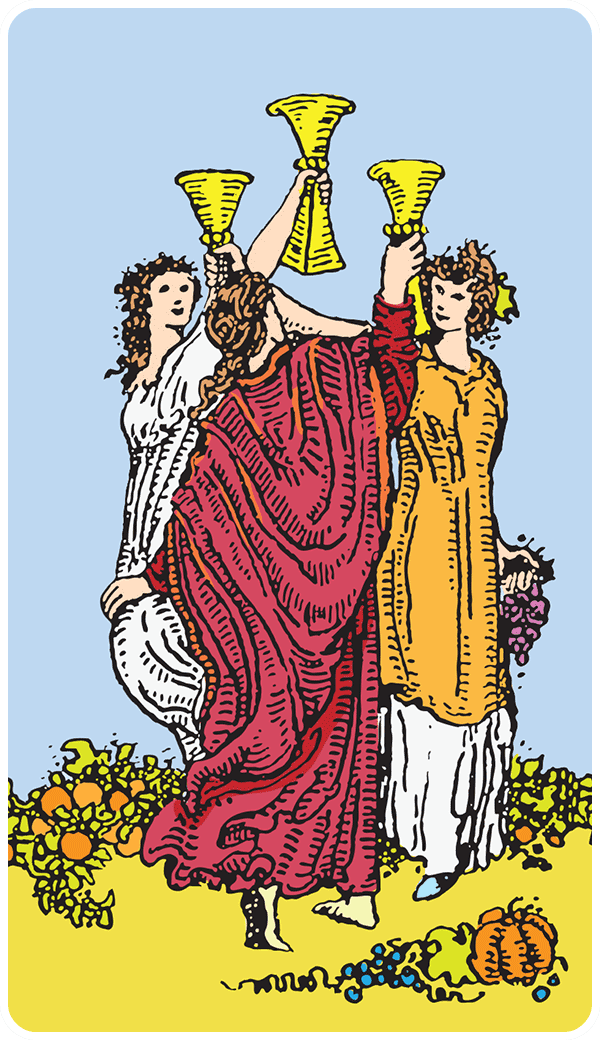
Three of Cups · plate 3
What the card is actually doing
The Three of Cups shows up in a general reading and people smile. They want it to mean good news is coming—a party, a reunion, friends gathering, something to look forward to. That is not what the card is describing. It is naming something that is already happening or has just happened, not something on the calendar. The gap between what people want this card to promise and what it actually observes is where most misreadings land.
Reading Three of Cups in general
What the suit, the rank, and the image are doing
Cups governs emotional experience and relational chemistry—how feeling moves between you and other people, what registers as intimacy, what creates the sensation of being met. When Cups cards dominate a reading, the question underneath the question is almost always about connection, even when the querent phrases it as logistics or timing.
Threes in tarot describe a third element entering a dynamic that was previously binary. The Magician-High Priestess polarity resolves into the Empress. Two becomes three and the system changes. In the minor arcana, threes name the moment a pattern clicks into place—not the setup, not the resolution, but the first full expression of what the suit does.
Now look at the image. Three figures raise cups in a toast. They are facing each other, not the viewer. The gesture is mutual. No one is watching from outside the circle. This is not performance. This is the moment three people are holding the same feeling at the same time and the feeling is amplified by being shared. The card describes synchrony, not celebration. Celebration might be the context, but synchrony is the mechanic.
How it reads differently depending on what the querent is asking about
If the querent is asking about a work situation, the Three of Cups tends to show up when a team clicks. Not when a project launches or a deal closes, but when three or more people in the room are suddenly on the same page and the work starts moving differently because of it. The card is naming the relational infrastructure that makes the outcome possible, not the outcome itself.
If the querent is asking about a friendship or social situation, the card often appears after a specific conversation where everyone said the true thing and no one had to manage anyone else's feelings. It names the moment a group stops performing friendship and starts operating as actual friends—when the stakes get real and everyone stays.
Reversed, the Three of Cups describes the same dynamic in negative: three people in a room and one of them is performing while the other two are pretending not to notice. Or three people who were synchronized and now one has drifted and no one has said it out loud yet. The card in reverse is not about conflict; it is about the feeling of being slightly out of step and not knowing if anyone else feels it.
The tell that someone is misreading the card on themselves
The tell is when someone reads the Three of Cups and immediately starts planning. They book the dinner. They text the group chat. They try to create the thing they think the card is promising. What tends to happen next is the event happens and it feels flat, or it doesn't come together at all, and they decide the card was wrong.
What they missed is that the card was describing something that already occurred—a moment when they felt met by two other people at once, even briefly. A conversation in a parking lot. A work call where everyone was honest. Three people laughing at the same joke for the same reason. The card is not a prediction. It is pointing at a relational pattern the querent might not have named yet.
From the practice
“A card never tells you what to do. It tells you what you're already deciding — and gives you the words to name it.”
A grounded observation
Go back through the last two weeks and look for the moment when you and two other people were in the same emotional state at the same time. That is what the card was naming.
Key themes to watch for
- № 01Theme
Beginnings
- № 02Theme
Inner movement
- № 03Theme
Receptivity
What to do with this reading
Read the upright meaning first, even if you pulled the card reversed. The reversal is a commentary on the upright — not a separate card.
Notice what your body did when you saw Three of Cups. That reaction is usually closer to the truth than the interpretation.
Write down one sentence: What is this card asking me to stop avoiding? Let the answer be smaller than you expect.
Come back to this card in 48 hours. Most general readings sharpen with a little distance.
Questions answered
Frequently asked
The Three of Cups in an upright position celebrates community and shared joy. It's a moment to appreciate the connections you have with friends, family, or colleagues. This card invites you to gather, whether for a joyous occasion or simply to enjoy each other's company. It highlights the richness that comes from bonding and the support that flows from these relationships. Consider what role you play in your circles and how you contribute to their happiness. It's a reminder that shared experiences can bring unexpected insights and deeper satisfaction.
When reversed, the Three of Cups suggests a disconnect or imbalance in your social life. Perhaps there's tension within a group or you're feeling left out. It might also indicate overindulgence in social activities, leading to neglect of personal needs. Take a moment to reflect on the quality of your interactions and consider if they align with your values. This reversal invites you to seek meaningful connections rather than surface-level engagements, reminding you that not all gatherings nurture the soul.
Three of Cups colors the cards around it. Pay attention to where its themes — emotional intimacy, felt-sense knowing, where the water level is rising — show up in the next card. That is usually where the story is.
Tarot is observational, not predictive. Three of Cups describes the conditions in front of you right now and where they tend to lead if nothing changes — not a guarantee of timing.
Repeat cards are the deck underlining a theme. With Three of Cups, that usually means the question you are asking is the right one — but you have not yet acted on what the card is showing you.
Read next
Related readings
More Cups · General
- Ace of Cups — GeneralHow Ace of Cups reads in a general context.
- Two of Cups — GeneralHow Two of Cups reads in a general context.
- Four of Cups — GeneralHow Four of Cups reads in a general context.
- Five of Cups — GeneralHow Five of Cups reads in a general context.
- Six of Cups — GeneralHow Six of Cups reads in a general context.
- Seven of Cups — GeneralHow Seven of Cups reads in a general context.
Other Three of Cups readings
- Love & RelationshipsThree of Cups read for love & relationships.
- Career & WorkThree of Cups read for career & work.
- Money & FinanceThree of Cups read for money & finance.
- Health & WellbeingThree of Cups read for health & wellbeing.
- SpiritualityThree of Cups read for spirituality.
- Yes / No AnswerThree of Cups read for yes / no answer.