Six of Cups in General
The Six of Cups gets read as nostalgia or a reunion. What it actually names is the moment you stop living forward and start using the past as a reference point.
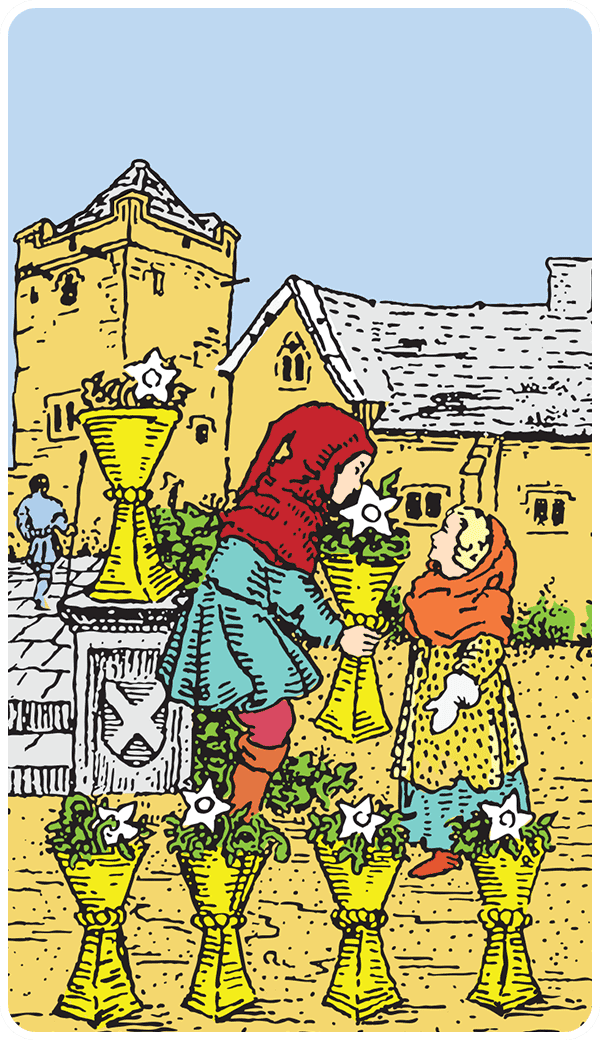
Six of Cups · plate 6
What the card is actually doing
The Six of Cups shows up and the querent immediately starts talking about an ex, or a childhood place, or someone they haven't seen in years. They want to know if that person is coming back. They want permission to reach out. They read the card as a sign that the past is trying to return.
That is not what the card is doing. The Six of Cups does not predict reunions. It describes a psychological state: you are currently orienting yourself by looking backward instead of forward. The card names the behavior, not the outcome.
Reading Six of Cups in general
What the suit, the rank, and the image are each doing
Cups governs emotion, attachment, and relational memory. It is the suit of how you feel and what those feelings attach to. When Cups cards cluster in a reading, the question is always about the heart, even if it was phrased as a question about next steps.
Sixes in tarot describe equilibrium — a stable point where the initial momentum has settled into a pattern. The Six of Pentacles is a stable exchange. The Six of Swords is stable movement away from something. Sixes are not dramatic. They describe a rhythm that has locked in.
Now look at the image. Two children in a courtyard. One child hands the other a cup filled with flowers. Five more cups sit around them, also filled with flowers. The setting feels enclosed, protected, small-scale. The children are not looking outward. They are absorbed in the exchange between them. Everything in the frame points to a closed loop — a world that already happened, being replayed.
The Six of Cups is the moment you stop generating new emotional data and start recycling old emotional data. You are pulling from memory instead of from present experience. The past has become the template.
How this reads differently depending on what the querent is actually doing
For someone stuck in a breakup, the Six of Cups describes the week they spend scrolling through old photos, re-reading texts, imagining conversations that will never happen. The card is not saying the person will come back. It is saying: you are currently living in a version of the relationship that no longer exists, and that is where your attention is.
For someone in a new relationship, the Six of Cups describes the moment they start comparing the new person to an old person. They notice what the new person doesn't do that the ex did. They feel disappointed by differences that are not actually problems. The card names the frame: you are evaluating the present using the past as the standard.
Reversed, the Six of Cups often describes someone trying very hard not to look backward and failing. They deleted the photos but they still think about the person. They moved cities but they still feel like they are living in the old apartment. The resistance to memory becomes its own kind of preoccupation.
The tell that someone is misreading this card on themselves
The tell is when someone reads the Six of Cups and immediately asks, "Does this mean they're thinking about me too?" That question reveals the misread. The card is not describing what another person is doing. It is describing what you are doing: using memory as a place to live instead of a place to visit.
Go back through your week and count how many times you referenced the past in a conversation about the future. Count how many times you said "it used to be" or "we used to" or "remember when." If the ratio is high, the Six of Cups is naming that.
From the practice
“A card never tells you what to do. It tells you what you're already deciding — and gives you the words to name it.”
A grounded observation
The Six of Cups does not mean the past is coming back. It means you have not yet left it. The card describes where your attention is, not where your life is going.
Key themes to watch for
- № 01Theme
Beginnings
- № 02Theme
Inner movement
- № 03Theme
Receptivity
What to do with this reading
Read the upright meaning first, even if you pulled the card reversed. The reversal is a commentary on the upright — not a separate card.
Notice what your body did when you saw Six of Cups. That reaction is usually closer to the truth than the interpretation.
Write down one sentence: What is this card asking me to stop avoiding? Let the answer be smaller than you expect.
Come back to this card in 48 hours. Most general readings sharpen with a little distance.
Questions answered
Frequently asked
The Six of Cups often stirs up memories and sentiments, like the scent of a familiar place from childhood. In the present, it invites a gentle reflection on past joys and how they shape your current self. This card can be a reminder to appreciate the simplicity and innocence that once brought happiness. As you navigate today, consider what aspects of your past you can bring into your life now. What small joys or forgotten hobbies could reawaken a sense of wonder and contentment?
When the Six of Cups appears reversed, it may indicate a struggle with letting go of the past. Perhaps there is a tendency to idealize what once was, leading to discontent with the present. This card suggests it might be beneficial to explore why certain memories hold such weight. Are they preventing you from moving forward? Consider how you can gently ease their grip, allowing space for new experiences and growth.
Six of Cups colors the cards around it. Pay attention to where its themes — emotional intimacy, felt-sense knowing, where the water level is rising — show up in the next card. That is usually where the story is.
Tarot is observational, not predictive. Six of Cups describes the conditions in front of you right now and where they tend to lead if nothing changes — not a guarantee of timing.
Repeat cards are the deck underlining a theme. With Six of Cups, that usually means the question you are asking is the right one — but you have not yet acted on what the card is showing you.
Read next
Related readings
More Cups · General
- Ace of Cups — GeneralHow Ace of Cups reads in a general context.
- Two of Cups — GeneralHow Two of Cups reads in a general context.
- Three of Cups — GeneralHow Three of Cups reads in a general context.
- Four of Cups — GeneralHow Four of Cups reads in a general context.
- Five of Cups — GeneralHow Five of Cups reads in a general context.
- Seven of Cups — GeneralHow Seven of Cups reads in a general context.
Other Six of Cups readings
- Love & RelationshipsSix of Cups read for love & relationships.
- Career & WorkSix of Cups read for career & work.
- Money & FinanceSix of Cups read for money & finance.
- Health & WellbeingSix of Cups read for health & wellbeing.
- SpiritualitySix of Cups read for spirituality.
- Yes / No AnswerSix of Cups read for yes / no answer.