Five of Cups in General
The Five of Cups gets read as 'you're dwelling on the past.' What it actually describes is the moment you're still standing in the wreckage, deciding what stays.
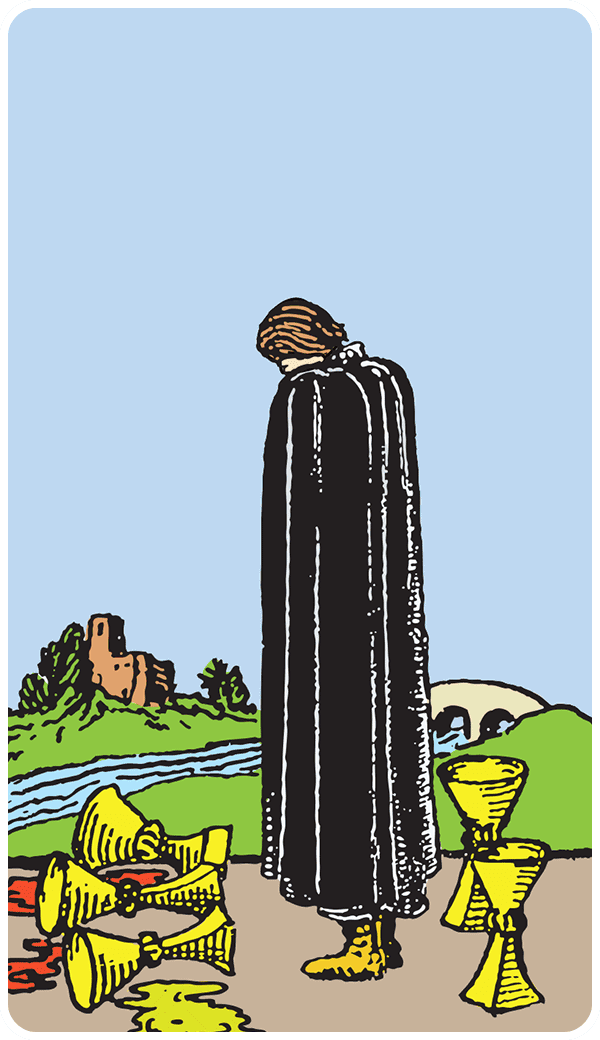
Five of Cups · plate 5
What the card is actually doing
The Five of Cups shows up and most readers land on the same phrase: you're dwelling on the past. You need to let go. Turn around and see what's still good. The card becomes a scolding, a push toward gratitude, a reminder that two cups are still standing behind you.
That is not what the card is doing. The Five of Cups describes a specific psychological state — the moment after a loss when you are still standing in the middle of it, assessing what broke and what didn't. The grief is not the problem the card is naming. The grief is the content. What the card is actually tracking is whether you can see clearly while you're still feeling it.
Reading Five of Cups in general
What the suit, the rank, and the image are each doing
Cups governs emotional reality — how you bond, what you feel toward people and situations, what moves through the heart as sensation. When Cups cards dominate a reading, the question is almost always relational or about interior emotional weather, even if the querent phrased it as logistics.
Fives in tarot describe conflict, loss, or destabilization. They are the breakdown card of each suit. The Five of Pentacles is material insecurity. The Five of Swords is relational betrayal or defeat. The Five of Wands is competing agendas that haven't resolved. Fives name the moment a structure stops working and you have to decide what to do about it.
Now look at the image. A figure in a black cloak stands before three spilled cups. Two cups remain upright behind them. A river runs nearby; a bridge crosses it in the distance. The figure is looking down at what spilled. They are not looking at what remains. They are not walking toward the bridge. They are standing still, mid-assessment.
The card is not saying "stop grieving." It is describing the moment you are taking inventory of what you lost and what you still have, and the fact that you cannot see both at the same time yet. That is the mechanical reality the card points to. The judgment about whether that's good or bad comes from the reader, not the card.
How the card reads differently depending on what the querent is actually doing
If the querent is someone who has spent six months replaying a breakup in their head, refusing every invitation, and checking their ex's social media before bed, the Five of Cups reads as: you are stuck in the story of the loss and the story is now doing more damage than the loss itself. The card is naming the moment that behavior crosses from processing into a feedback loop.
If the querent just got fired two weeks ago and is sitting on their couch trying to figure out what went wrong and what they actually want next, the Five of Cups reads as: you are doing the work. You are standing in the mess and looking at it clearly. The fact that it hurts does not mean you are doing it wrong. The two cups behind you will still be there when you turn around. Right now you are allowed to look at what broke.
The difference is time, repetition, and whether the querent is gathering information or performing grief as identity.
The tell that someone is misreading the card on themselves
The tell is this: if you pull the Five of Cups and your first instinct is to argue with it — to defend why you're still thinking about the thing, to explain why this loss was different, to insist you're not stuck — the card is probably correct and you are still mid-process. If you pull it and feel seen, like someone just named the room you've been sitting in for weeks, the card is doing what it does.
The misread happens when someone takes the card as a command to feel differently. The Five of Cups does not care how you feel. It describes where you are standing and what you are looking at. What you do with that information is a different card.
From the practice
“A card never tells you what to do. It tells you what you're already deciding — and gives you the words to name it.”
A grounded observation
Go back through your calendar and count how many days it's been since the loss the card is naming. If it's been two weeks, you're processing. If it's been two years and you're still standing in the same spot, the card is telling you something else.
Key themes to watch for
- № 01Theme
Beginnings
- № 02Theme
Inner movement
- № 03Theme
Receptivity
What to do with this reading
Read the upright meaning first, even if you pulled the card reversed. The reversal is a commentary on the upright — not a separate card.
Notice what your body did when you saw Five of Cups. That reaction is usually closer to the truth than the interpretation.
Write down one sentence: What is this card asking me to stop avoiding? Let the answer be smaller than you expect.
Come back to this card in 48 hours. Most general readings sharpen with a little distance.
Questions answered
Frequently asked
The Five of Cups often appears when you're dwelling on what's been lost. It's like standing on a riverbank, watching water rush away, unable to see the bridges behind you. It's okay to mourn, but don't forget that not everything is lost. There are still unspilled cups behind you, waiting for attention. Acknowledge your feelings, but consider what might still be salvaged or learned. The past can inform your future, but it doesn't have to dictate it. What small step might help you turn around and see what's still standing?
When the Five of Cups is reversed, it suggests a gentle release or a shift in perspective. It's like noticing that the storm has passed and the clouds are parting. You may find yourself slowly moving out of a place of sorrow or regret. This card hints that healing is possible and that there's an opportunity to embrace a new outlook. Consider what you can let go of, and what new experiences await you. How might acknowledging your progress change your view of the road ahead?
Five of Cups colors the cards around it. Pay attention to where its themes — emotional intimacy, felt-sense knowing, where the water level is rising — show up in the next card. That is usually where the story is.
Tarot is observational, not predictive. Five of Cups describes the conditions in front of you right now and where they tend to lead if nothing changes — not a guarantee of timing.
Repeat cards are the deck underlining a theme. With Five of Cups, that usually means the question you are asking is the right one — but you have not yet acted on what the card is showing you.
Read next
Related readings
More Cups · General
- Ace of Cups — GeneralHow Ace of Cups reads in a general context.
- Two of Cups — GeneralHow Two of Cups reads in a general context.
- Three of Cups — GeneralHow Three of Cups reads in a general context.
- Four of Cups — GeneralHow Four of Cups reads in a general context.
- Six of Cups — GeneralHow Six of Cups reads in a general context.
- Seven of Cups — GeneralHow Seven of Cups reads in a general context.
Other Five of Cups readings
- Love & RelationshipsFive of Cups read for love & relationships.
- Career & WorkFive of Cups read for career & work.
- Money & FinanceFive of Cups read for money & finance.
- Health & WellbeingFive of Cups read for health & wellbeing.
- SpiritualityFive of Cups read for spirituality.
- Yes / No AnswerFive of Cups read for yes / no answer.