Ten of Wands in General
The Ten of Wands gets read as burnout. It's closer to the moment you realize you've been carrying things that were never yours to carry.
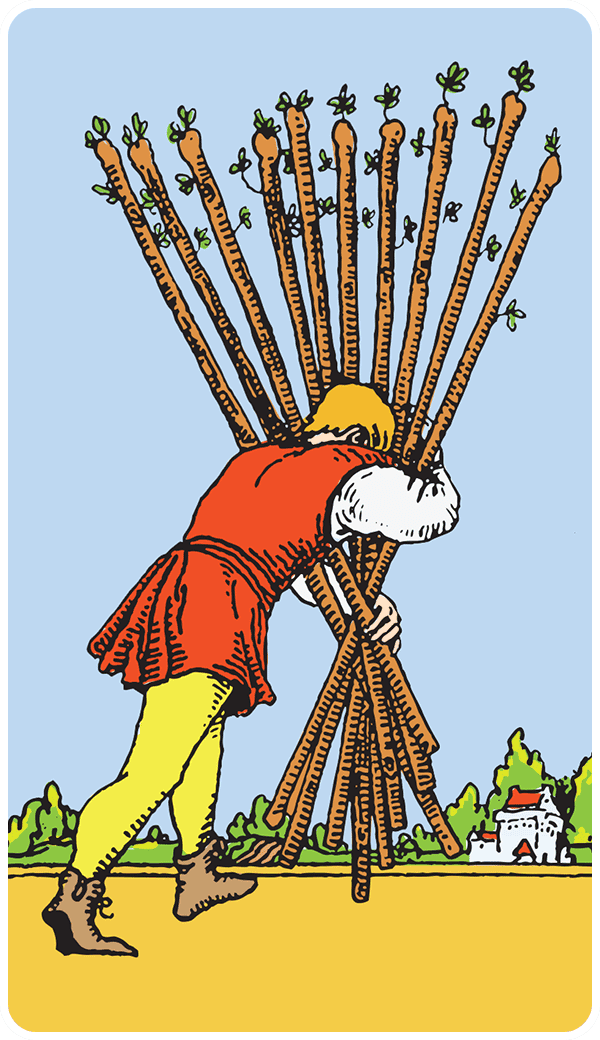
Ten of Wands · plate 10
What the card is actually doing
The Ten of Wands shows up and people call it burnout. They see the figure bent under the weight of ten staves and decide the card is telling them they're overworked, overtaxed, stretched too thin. That's close, but it misses the mechanical part. The card is not diagnosing exhaustion. It is naming the specific way you got here: you said yes when you should have said no, you kept picking things up because no one else would, and now you're carrying a load you never agreed to carry in the first place.
Reading Ten of Wands in general
What the suit, the rank, and the image are doing
Wands is the suit of will, action, and the forward-moving energy that gets things started. It governs ambition, momentum, and the part of you that says I will make this happen. When Wands cards cluster in a reading, the question is almost always about drive — where it's going, what's fueling it, whether it's still yours.
Tens in tarot mark completion, but not the satisfying kind. Tens are the point where the energy of the suit has run its full cycle and tipped into excess. The Ten of Pentacles is wealth that calcifies into obligation. The Ten of Swords is the thought that finally stops being useful. The Ten of Wands is momentum that has become load.
Now look at the image. A figure carries ten wands toward a distant village. The staves block the view. The posture is hunched. The figure is still moving, but barely. This is the mechanical answer: the card describes the moment where forward motion has turned into burden, and you are still carrying it because stopping feels impossible.
Why the burnout reading misses the point
The Ten of Wands gets called burnout because burnout is the feeling most people recognize when they see the card. But burnout is a symptom. The card is naming the cause: you are carrying things that do not belong to you.
Here's what tends to happen. The querent pulls the Ten of Wands and nods. Yes, they're exhausted. Yes, they're doing too much. The reading stops there, and the querent leaves thinking the solution is rest. Three months later they're back at the table, same card, same complaint. Nothing changed because they never asked which of these things can I put down.
The card reads differently depending on what the querent is carrying. For someone in a caretaking role — parent, manager, eldest sibling — the Ten of Wands names the moment they realize they've been solving problems no one asked them to solve. For someone in a creative or entrepreneurial push, it names the moment the project stops feeling like theirs and starts feeling like a thing they owe to people who are watching.
The tell that you are misreading the card on yourself
You are misreading the Ten of Wands if you think the card is telling you to work harder, push through, or prove you can handle it. That is the voice that got you here. The card is not endorsing that voice. It is showing you what happens when you listen to it for too long.
The other tell: you think the solution is to wait until the project is finished, the semester is over, the busy season ends. The Ten of Wands does not describe a temporary spike. It describes a structural problem. If your plan is to white-knuckle it until some future point of relief, you are not reading the card. You are arguing with it.
From the practice
“A card never tells you what to do. It tells you what you're already deciding — and gives you the words to name it.”
A grounded observation
Go back through your calendar and count how many things you said yes to because you thought no one else would do them. That number is the load.
Key themes to watch for
- № 01Theme
Beginnings
- № 02Theme
Inner movement
- № 03Theme
Receptivity
What to do with this reading
Read the upright meaning first, even if you pulled the card reversed. The reversal is a commentary on the upright — not a separate card.
Notice what your body did when you saw Ten of Wands. That reaction is usually closer to the truth than the interpretation.
Write down one sentence: What is this card asking me to stop avoiding? Let the answer be smaller than you expect.
Come back to this card in 48 hours. Most general readings sharpen with a little distance.
Questions answered
Frequently asked
The Ten of Wands is like carrying a heavy load up a hill. You might be juggling too many responsibilities, feeling the weight of obligations pressing down on you. It's a time when you might feel like you're doing everything on your own, and the burden can be exhausting. Yet, there's a sense of determination and perseverance in the air. You've come this far, and there's a satisfaction in seeing your efforts come to fruition. Consider what can be set down, even temporarily, to lighten your load and allow you to breathe a little easier.
Reversed, the Ten of Wands suggests that the burden you carry might be unnecessary or self-imposed. Perhaps you've taken on more than you should, or you're holding onto responsibilities that aren't yours. It's a moment to reflect on what truly needs your attention and what can be delegated or released. This card can indicate the beginning of shedding unnecessary weight. Look for ways to streamline or simplify your commitments, and notice how this might open up space for things that genuinely matter.
Ten of Wands colors the cards around it. Pay attention to where its themes — creative momentum, will and appetite, the spark that wants to be tended — show up in the next card. That is usually where the story is.
Tarot is observational, not predictive. Ten of Wands describes the conditions in front of you right now and where they tend to lead if nothing changes — not a guarantee of timing.
Repeat cards are the deck underlining a theme. With Ten of Wands, that usually means the question you are asking is the right one — but you have not yet acted on what the card is showing you.
Read next
Related readings
More Wands · General
- Ace of Wands — GeneralHow Ace of Wands reads in a general context.
- Two of Wands — GeneralHow Two of Wands reads in a general context.
- Three of Wands — GeneralHow Three of Wands reads in a general context.
- Four of Wands — GeneralHow Four of Wands reads in a general context.
- Five of Wands — GeneralHow Five of Wands reads in a general context.
- Six of Wands — GeneralHow Six of Wands reads in a general context.
Other Ten of Wands readings
- Love & RelationshipsTen of Wands read for love & relationships.
- Career & WorkTen of Wands read for career & work.
- Money & FinanceTen of Wands read for money & finance.
- Health & WellbeingTen of Wands read for health & wellbeing.
- SpiritualityTen of Wands read for spirituality.
- Yes / No AnswerTen of Wands read for yes / no answer.