Three of Wands in General
The Three of Wands gets read as 'expansion is coming' when it actually describes standing at the edge of what you've built, watching for what happens next.
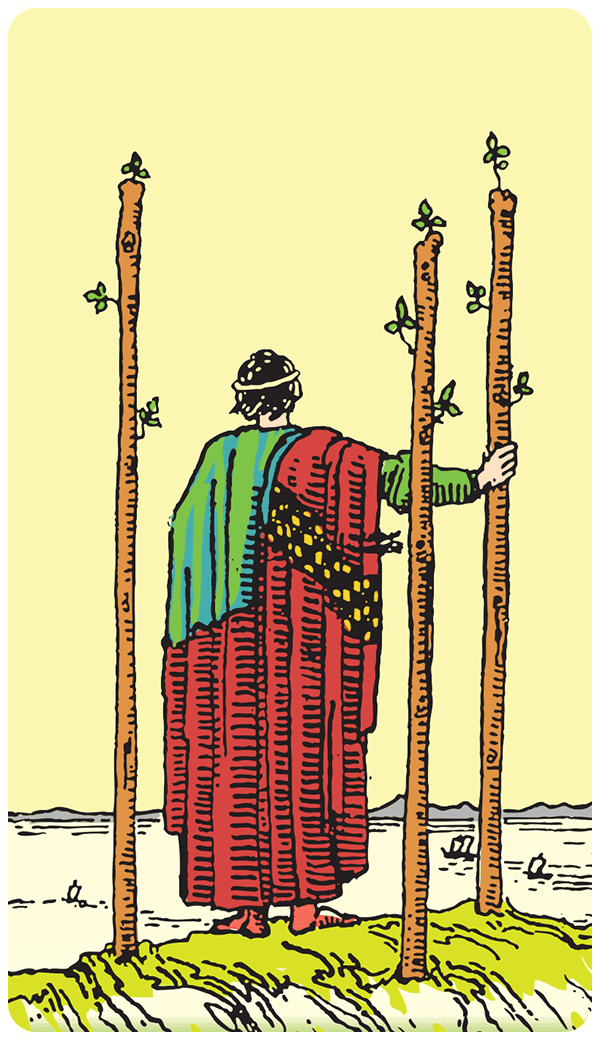
Three of Wands · plate 3
What the card is actually doing
The Three of Wands shows up in a reading and people hear 'expansion.' Growth. Progress. Things are about to get bigger. The card gets treated like a green light, like momentum confirmed, like the universe saying yes to whatever the querent just launched.
That's not what's on the card. The Three of Wands describes waiting. Not passive waiting — the kind where you've done your part and now you're standing at the edge of it, scanning the horizon, watching to see if what you sent out comes back. The action is already in motion. This card is about what it feels like to stand in that gap.
Reading Three of Wands in general
What the suit, the rank, and the image are each doing
Wands is the suit of will, initiation, and applied energy. It governs the part of you that starts things, that decides to act, that moves a thought from internal to external. When Wands cards show up, the question is almost always about momentum — whether you have it, whether you're using it, whether it's sustainable.
Threes in tarot describe the first stable form after the initial pair. The Ace is the spark. The Two is the choice or the tension between two paths. The Three is what happens when you commit to one of those paths and it starts to take shape outside your head. Threes are early structure. They are not completion. They are the moment something becomes real enough that other people can see it.
Now look at the image. A figure stands on a cliff, back to the viewer, looking out over water. Three wands are planted in the ground behind them. Ships are visible in the distance. The figure is not moving. They are not building. They are watching. They have planted the wands — the work is done — and now they are waiting to see what returns. This is the mechanical answer. The Three of Wands is the moment after you act, before you know if it worked.
How it reads differently depending on what the querent just did
If the querent just launched something — a business, a project, a pitch, a vulnerable conversation — the Three of Wands describes the specific emotional state of standing in the aftermath. You did the thing. You can't take it back. Now you're checking your phone, refreshing your email, watching for the response. The card is not saying the response will be good. It is naming the vigilance.
If the querent has not launched anything, the Three of Wands reads as a pressure card. It describes the feeling of knowing you should act, of having the infrastructure in place, of standing at the edge and not jumping. The wands are planted but nothing is moving. The card is not permission. It is the gap between ready and willing.
The tell that someone is misreading the card on themselves
The misreading sounds like this: 'Things are expanding. Opportunities are coming. I just need to stay open.' That language turns the Three of Wands into a passive receipt of good fortune, which is not what the card describes. If you are reading this card on yourself and you cannot name the specific thing you already set in motion — the email you sent, the boundary you drew, the plan you shared, the risk you took — you are misreading it. The Three of Wands does not describe expansion as a weather pattern that happens to you. It describes the part where you are standing in the consequences of your own action, watching to see what comes back.
From the practice
“A card never tells you what to do. It tells you what you're already deciding — and gives you the words to name it.”
A grounded observation
Go back through your calendar and look for the thing you did that you are still thinking about. The thing you keep checking on. That is what the card is pointing to.
Key themes to watch for
- № 01Theme
Beginnings
- № 02Theme
Inner movement
- № 03Theme
Receptivity
What to do with this reading
Read the upright meaning first, even if you pulled the card reversed. The reversal is a commentary on the upright — not a separate card.
Notice what your body did when you saw Three of Wands. That reaction is usually closer to the truth than the interpretation.
Write down one sentence: What is this card asking me to stop avoiding? Let the answer be smaller than you expect.
Come back to this card in 48 hours. Most general readings sharpen with a little distance.
Questions answered
Frequently asked
The Three of Wands in its upright position speaks to the horizon broadening before you. It’s a moment where your earlier efforts are beginning to bear fruit, and the path ahead is expanding. You may find yourself at the brink of new adventures or opportunities, where planning and foresight are your allies. It’s a time to look beyond the immediate and consider longer-term gains. Notice how your past decisions are interweaving with your present possibilities, shaping a landscape ripe for exploration.
When the Three of Wands appears reversed, it suggests a moment of pause or reconsideration. You might feel as if your progress is stalling or that anticipated outcomes are not materializing as expected. This is a time to reflect on whether you've overlooked any details or underestimated challenges. It’s not about giving up but about recalibrating your plans and expectations. Perhaps this is an invitation to look at your situation from a different angle, uncovering hidden opportunities.
Three of Wands colors the cards around it. Pay attention to where its themes — creative momentum, will and appetite, the spark that wants to be tended — show up in the next card. That is usually where the story is.
Tarot is observational, not predictive. Three of Wands describes the conditions in front of you right now and where they tend to lead if nothing changes — not a guarantee of timing.
Repeat cards are the deck underlining a theme. With Three of Wands, that usually means the question you are asking is the right one — but you have not yet acted on what the card is showing you.
Read next
Related readings
More Wands · General
- Ace of Wands — GeneralHow Ace of Wands reads in a general context.
- Two of Wands — GeneralHow Two of Wands reads in a general context.
- Four of Wands — GeneralHow Four of Wands reads in a general context.
- Five of Wands — GeneralHow Five of Wands reads in a general context.
- Six of Wands — GeneralHow Six of Wands reads in a general context.
- Seven of Wands — GeneralHow Seven of Wands reads in a general context.
Other Three of Wands readings
- Love & RelationshipsThree of Wands read for love & relationships.
- Career & WorkThree of Wands read for career & work.
- Money & FinanceThree of Wands read for money & finance.
- Health & WellbeingThree of Wands read for health & wellbeing.
- SpiritualityThree of Wands read for spirituality.
- Yes / No AnswerThree of Wands read for yes / no answer.