Ace of Wands in General
The Ace of Wands gets read as 'take action now' when it's actually naming the moment creative impulse arrives — before you know what to do with it.
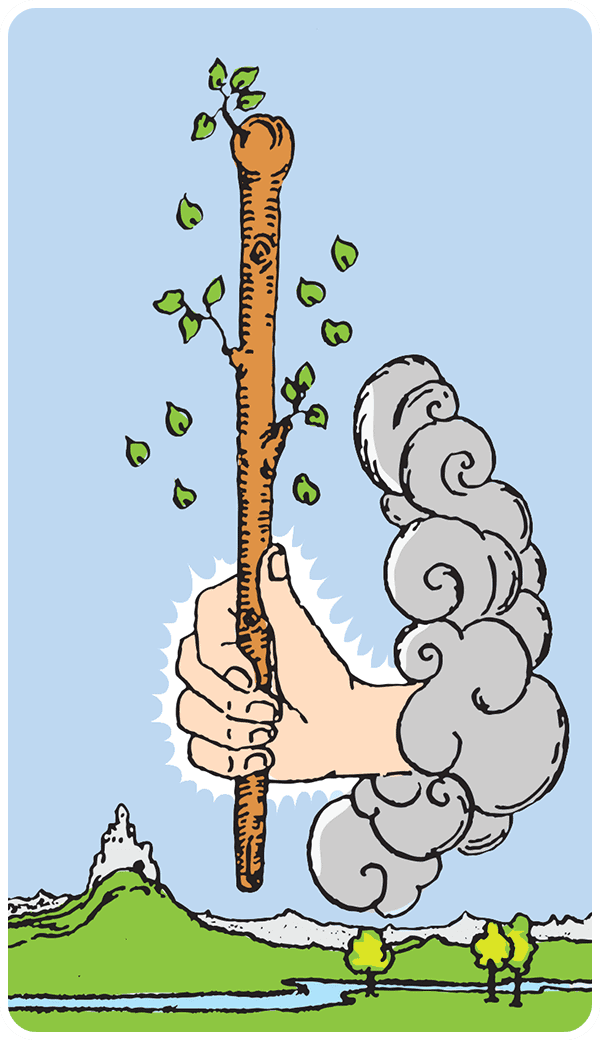
Ace of Wands · plate 1
What the card is actually doing
The Ace of Wands shows up and the querent immediately starts planning. They want to know what project to start, what risk to take, what move to make next. They read the card as permission or instruction — go, act, begin. That's not what the card is doing. The Ace of Wands is not the action. It's the spark before the action, and most people skip past the spark because they think the only part that matters is what you build with it.
Reading Ace of Wands in general
What the suit, the rank, and the image are each doing
Wands is the suit of creative will and directed energy. It governs impulse, desire, the part of you that wants to make something or move toward something before you have a reason. When Wands cards dominate a reading, the question underneath the question is almost always about momentum — whether you have it, whether you trust it, whether you're using it or sitting on it.
Aces are thresholds. They are not outcomes. An Ace is the moment a channel opens and something becomes possible that was not possible the day before. The Ace of Wands is not the project; it's the first flicker of wanting to make the project. It's the moment before you know what you're doing, when the only thing you have is the impulse itself.
Look at the image. A hand extends from a cloud, holding a wooden staff. The staff is alive — leaves sprout from it. The landscape behind it is open, unbuilt. The hand is offering the staff, but no one has taken it yet. The card describes potential in its rawest form: energy available, direction unclear, nothing started.
How the card reads differently depending on what the querent is sitting in
If the querent is stuck — stalled in a job, a relationship, a routine that stopped working months ago — the Ace of Wands names the return of wanting something. Not a specific something. Just the capacity to want again. The card is not telling them what to do. It's confirming that the part of them that generates direction is back online.
If the querent is already in motion — three projects open, two side hustles, a calendar with no margin — the Ace of Wands reads differently. It's not more fuel. It's the arrival of a new impulse they don't have room for yet. The card becomes a flag: this just showed up, and you're going to have to decide whether to follow it or let it pass. The mistake here is assuming every spark requires action. Some sparks are diagnostic. They tell you what you still care about, even if the timing is wrong.
Reversed, the Ace of Wands usually means the spark arrived and got smothered immediately — by doubt, by logistics, by the voice that says 'this isn't practical.' The impulse was real. The shutdown was faster.
The tell that someone is misreading the card on themselves
The tell is when someone pulls the Ace of Wands and immediately asks what they should do with it. They want a plan, a next step, a timeline. That's the misread. The card is not asking you to do anything yet. It's naming the fact that something in you just woke up. If you skip straight to execution, you bypass the part where you figure out whether the impulse is worth following. Most creative dead ends start here — someone mistakes the arrival of energy for a mandate and builds something before they know what they actually want to build.
From the practice
“A card never tells you what to do. It tells you what you're already deciding — and gives you the words to name it.”
A grounded observation
Go back through the last six months and look for the ideas you had in the first thirty seconds of waking up, before you talked yourself out of them. That's what the Ace of Wands is pointing at.
Key themes to watch for
- № 01Theme
Beginnings
- № 02Theme
Inner movement
- № 03Theme
Receptivity
What to do with this reading
Read the upright meaning first, even if you pulled the card reversed. The reversal is a commentary on the upright — not a separate card.
Notice what your body did when you saw Ace of Wands. That reaction is usually closer to the truth than the interpretation.
Write down one sentence: What is this card asking me to stop avoiding? Let the answer be smaller than you expect.
Come back to this card in 48 hours. Most general readings sharpen with a little distance.
Questions answered
Frequently asked
The Ace of Wands in a general reading is all about fresh beginnings and bursts of inspiration. Imagine a match being struck, the flame catching quickly, illuminating a path that was only shadows before. It's a time to seize new opportunities with both hands, to dive headfirst into projects or ideas that excite you. This card suggests a moment where you feel the thrill of potential and the urge to make something happen. Consider what ignites your passion lately and how you might nurture that spark into a full-fledged flame.
When the Ace of Wands appears reversed, the initial spark of inspiration may feel dampened or blocked. It's like trying to light a fire with damp matches—frustration can set in when things don't ignite as planned. You might be feeling a lack of direction or motivation, like your energy is scattered. This reversal invites you to pause and look at what's been stifling your enthusiasm. Is there an expectation or pressure that's holding you back? Finding clarity in the chaos might help focus your energy.
Ace of Wands colors the cards around it. Pay attention to where its themes — creative momentum, will and appetite, the spark that wants to be tended — show up in the next card. That is usually where the story is.
Tarot is observational, not predictive. Ace of Wands describes the conditions in front of you right now and where they tend to lead if nothing changes — not a guarantee of timing.
Repeat cards are the deck underlining a theme. With Ace of Wands, that usually means the question you are asking is the right one — but you have not yet acted on what the card is showing you.
Read next
Related readings
More Wands · General
- Two of Wands — GeneralHow Two of Wands reads in a general context.
- Three of Wands — GeneralHow Three of Wands reads in a general context.
- Four of Wands — GeneralHow Four of Wands reads in a general context.
- Five of Wands — GeneralHow Five of Wands reads in a general context.
- Six of Wands — GeneralHow Six of Wands reads in a general context.
- Seven of Wands — GeneralHow Seven of Wands reads in a general context.
Other Ace of Wands readings
- Love & RelationshipsAce of Wands read for love & relationships.
- Career & WorkAce of Wands read for career & work.
- Money & FinanceAce of Wands read for money & finance.
- Health & WellbeingAce of Wands read for health & wellbeing.
- SpiritualityAce of Wands read for spirituality.
- Yes / No AnswerAce of Wands read for yes / no answer.