Five of Wands in General
The Five of Wands gets read as conflict you need to resolve. It's not. It names the friction that keeps a project or identity from collapsing into itself.
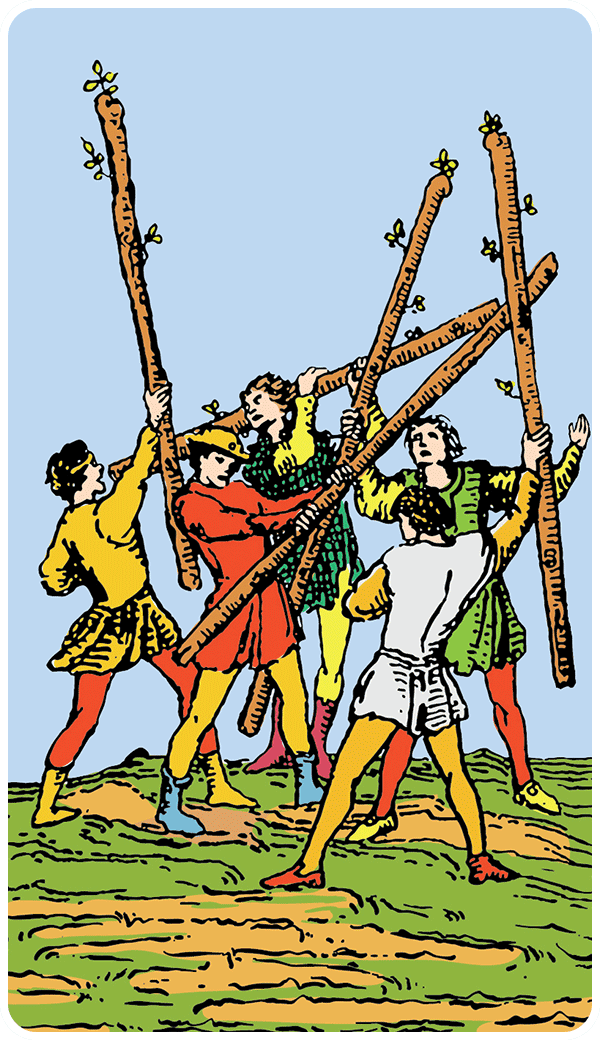
Five of Wands · plate 5
What the card is actually doing
The Five of Wands shows up and people assume they're doing something wrong. Five figures holding staffs, no clear winner, everyone swinging at cross-purposes — it reads like chaos that needs fixing. The querent starts listing conflicts: the coworker who won't align, the friend group that can't agree on plans, the creative project with too many voices. They want to know how to make it stop. That's the misreading. The card is not diagnosing a problem. It's naming a structure.
Reading Five of Wands in general
What the suit, the rank, and the image are each doing
Wands is the suit of will and direction. It governs what you're trying to build, where you're aiming your energy, and how much momentum you have behind the thing you've decided matters. When Wands cards dominate a reading, the question is almost always about drive — whether it's present, whether it's aimed correctly, whether it's being met or blocked.
Fives in tarot describe instability that produces motion. They are not stable like Fours and not resolved like Sixes. A Five is the point where the structure starts to wobble and something has to shift. The Five of Pentacles is material instability; the Five of Swords is relational fracture. Fives name the pressure point.
Now look at the image. Five figures hold staffs upright, each angled differently. They are not fighting in the sense of trying to hurt each other. They are testing. Pushing. Seeing where the other person's staff will give. No one is winning because winning is not the point. The point is that every staff stays in play. This is what competitive friction looks like when it's working as designed.
Why the misreading happens and what the card is actually naming
People read the Five of Wands as conflict because it feels like conflict when you're inside it. You're in a meeting where everyone has a different opinion. You're working on something and three people keep suggesting changes that contradict each other. You're in a friend group where no one can agree on anything. It feels inefficient. It feels like the thing would move faster if everyone would just align.
But here's what tends to happen when alignment arrives too early: the project flattens. The idea loses its edges. The group stops being interesting to be in. The Five of Wands is the card of productive friction — the kind that keeps a thing from collapsing into groupthink or into one person's uncontested vision. When this card shows up, it's naming a moment where multiple wills are in the room and none of them has been ruled out yet. That's not the problem. That's the condition under which the best version of the thing gets built.
The reversed Five of Wands can read two ways. One: the friction has tipped into actual obstruction, where no one is testing ideas anymore — they're just blocking each other. Two: the friction has been suppressed entirely, and now the thing has no resistance, no dialectic, no one willing to say "that won't work." Both produce stagnation, just from opposite directions.
The tell that you're misreading it on yourself
You're misreading the Five of Wands if your first move is to try to eliminate the conflict. If you're the one trying to get everyone to agree, or trying to smooth over the tension, or trying to pick a single direction so the noise stops — check whether you're solving a problem or just trying to make the discomfort go away. The card is not asking you to resolve it. It's asking you to stay in it long enough to let the best idea win on merit, not on who got tired first.
From the practice
“A card never tells you what to do. It tells you what you're already deciding — and gives you the words to name it.”
A grounded observation
Go back through your calendar and look for projects that moved fast because everyone agreed immediately. Now check whether any of them are still running. The ones that lasted are almost always the ones that had a Five of Wands phase.
Key themes to watch for
- № 01Theme
Beginnings
- № 02Theme
Inner movement
- № 03Theme
Receptivity
What to do with this reading
Read the upright meaning first, even if you pulled the card reversed. The reversal is a commentary on the upright — not a separate card.
Notice what your body did when you saw Five of Wands. That reaction is usually closer to the truth than the interpretation.
Write down one sentence: What is this card asking me to stop avoiding? Let the answer be smaller than you expect.
Come back to this card in 48 hours. Most general readings sharpen with a little distance.
Questions answered
Frequently asked
The Five of Wands speaks to a time of discord and competition. It’s as if everyone is talking at once, and no one is truly listening. Whether in a crowd or alone, you might feel like you’re constantly fending off challenges or interruptions. This isn't necessarily a bad thing; it can be a chance to sharpen your skills or clarify your stance. Like kids playing a boisterous game, there’s energy here that can be harnessed. Consider what you can learn from the chaos, and whether there's a way to turn it into a dance rather than a battle.
When reversed, the Five of Wands suggests that the chaos around you is starting to settle, or perhaps you’re withdrawing from the fray entirely. The noise is calming, but beware of unresolved tension sweeping under the rug. It could be a sign that you’re avoiding necessary confrontations or that others are choosing to do so. This lull could be temporary. Take a moment to reflect on whether you're at peace with the resolution or just tired of the fight. Is there unfinished business that needs your attention?
Five of Wands colors the cards around it. Pay attention to where its themes — creative momentum, will and appetite, the spark that wants to be tended — show up in the next card. That is usually where the story is.
Tarot is observational, not predictive. Five of Wands describes the conditions in front of you right now and where they tend to lead if nothing changes — not a guarantee of timing.
Repeat cards are the deck underlining a theme. With Five of Wands, that usually means the question you are asking is the right one — but you have not yet acted on what the card is showing you.
Read next
Related readings
More Wands · General
- Ace of Wands — GeneralHow Ace of Wands reads in a general context.
- Two of Wands — GeneralHow Two of Wands reads in a general context.
- Three of Wands — GeneralHow Three of Wands reads in a general context.
- Four of Wands — GeneralHow Four of Wands reads in a general context.
- Six of Wands — GeneralHow Six of Wands reads in a general context.
- Seven of Wands — GeneralHow Seven of Wands reads in a general context.
Other Five of Wands readings
- Love & RelationshipsFive of Wands read for love & relationships.
- Career & WorkFive of Wands read for career & work.
- Money & FinanceFive of Wands read for money & finance.
- Health & WellbeingFive of Wands read for health & wellbeing.
- SpiritualityFive of Wands read for spirituality.
- Yes / No AnswerFive of Wands read for yes / no answer.