Ten of Swords in Career
The Ten of Swords in career readings gets read as catastrophe. What it actually describes is the moment you stop pretending the situation is salvageable.
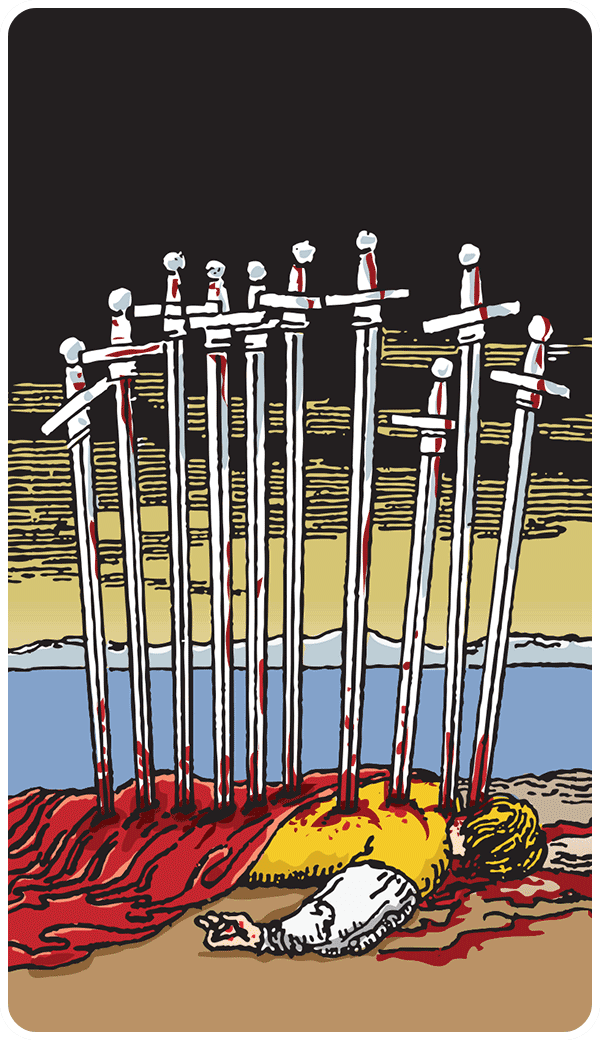
Ten of Swords · plate 10
What the card is actually doing
The Ten of Swords shows up in a career reading and the querent's shoulders drop. They assume the card is telling them they're about to get fired, that the project will fail, that the company is going under. They brace for impact. But the card is not describing something that's coming. It's describing something that already happened — something they've been working around, explaining away, or refusing to name out loud. The Ten of Swords is the moment the pretending stops.
Reading Ten of Swords in career
What the suit, the rank, and the image are each doing
Swords is the suit of thought, narrative, and the stories you tell yourself about what's happening. It governs how you frame a situation, what you're willing to admit, and the point at which your internal explanation breaks down. When Swords cards cluster in a career reading, the real question is almost always about whether the story you're telling yourself matches the situation you're actually in.
Tens in tarot mark completion — the final card in the suit's arc. They describe the point where a cycle has run its course and there is no eleventh card coming. The Ten of Pentacles is material security fully built. The Ten of Cups is relational contentment achieved. The Ten of Swords is the thought structure that has collapsed under its own weight. It is not the collapse itself. It is the recognition that the collapse already occurred.
Now look at the image. A figure lies face-down with ten swords in their back. The sky is dark. The body is still. Most people read this as violence, as betrayal, as something that was done to them. But notice: the figure is not struggling. The scene is quiet. The card describes the end of the fight, not the fight itself. It is the moment after you stop arguing with what is obviously true.
How the card reads for two different situations
If the querent is in a job they know is wrong — one they've been explaining away with 'but the benefits' or 'just six more months' or 'it's not that bad' — the Ten of Swords names the moment they admit it out loud. The job didn't suddenly get worse. The swords have been accumulating for months. The card marks the day they stop performing optimism and let the situation be what it is. What happens next is a different card.
If the querent just got fired or passed over or publicly humiliated, the Ten of Swords is not the event. It is the internal narrative that shattered when the event occurred. They thought they were valued. They thought the work spoke for itself. They thought loyalty mattered. The card describes the belief system that died, not the logistics of what comes after. The person who walks away from a Ten of Swords moment is working with different information than the person who walked in.
The tell that someone is misreading the card on themselves
The misreading sounds like this: 'So everything is going to fall apart.' Or: 'This means I should quit before it gets worse.' The querent is treating the card as a forecast. They are bracing. They are strategizing against a future catastrophe. But if the Ten of Swords is showing up now, the catastrophe is not ahead of you. It already happened. You are standing in it. The question is not how to avoid it. The question is what you are finally willing to admit about the situation you are already in.
From the practice
“A card never tells you what to do. It tells you what you're already deciding — and gives you the words to name it.”
A grounded observation
Go back through your calendar and look for the moment you stopped defending the job in conversation. That is when the Ten of Swords actually landed. The card is just naming what you already know.
Key themes to watch for
- № 01Theme
Creative purpose
- № 02Theme
Heart-led work
- № 03Theme
Right alignment
What to do with this reading
Read the upright meaning first, even if you pulled the card reversed. The reversal is a commentary on the upright — not a separate card.
Notice what your body did when you saw Ten of Swords. That reaction is usually closer to the truth than the interpretation.
Write down one sentence: What is this card asking me to stop avoiding? Let the answer be smaller than you expect.
Come back to this card in 48 hours. Most career readings sharpen with a little distance.
Questions answered
Frequently asked
The Ten of Swords in career contexts often marks an abrupt end—perhaps a job loss, a failed project, or an overwhelming workload that leads to burnout. It’s a card of finality and acknowledgment that something is truly over. This is a challenging moment, but it also clears the slate for new ventures. Consider what this ending reveals about your career path and what opportunities might emerge from this closure. How can this be a turning point for redefining your professional goals?
In a reversed position, the Ten of Swords in career suggests a period of recovery after professional difficulties. You may be gradually emerging from a tough time, like a plant breaking through the soil after a frost. It hints at resilience and the slow rebuilding of confidence and clarity. Reflect on how you can nurture your professional growth and what lessons you’ve learned from recent challenges. How can you apply these insights moving forward?
Ten of Swords colors the cards around it. Pay attention to where its themes — mental clarity, the truth being named, what the mind needs to release — show up in the next card. That is usually where the story is.
Tarot is observational, not predictive. Ten of Swords describes the conditions in front of you right now and where they tend to lead if nothing changes — not a guarantee of timing.
Repeat cards are the deck underlining a theme. With Ten of Swords, that usually means the question you are asking is the right one — but you have not yet acted on what the card is showing you.
Read next
Related readings
More Swords · Career
- Ace of Swords — CareerHow Ace of Swords reads in a career context.
- Two of Swords — CareerHow Two of Swords reads in a career context.
- Three of Swords — CareerHow Three of Swords reads in a career context.
- Four of Swords — CareerHow Four of Swords reads in a career context.
- Five of Swords — CareerHow Five of Swords reads in a career context.
- Six of Swords — CareerHow Six of Swords reads in a career context.
Other Ten of Swords readings
- General MeaningTen of Swords read for general meaning.
- Love & RelationshipsTen of Swords read for love & relationships.
- Money & FinanceTen of Swords read for money & finance.
- Health & WellbeingTen of Swords read for health & wellbeing.
- SpiritualityTen of Swords read for spirituality.
- Yes / No AnswerTen of Swords read for yes / no answer.