Ten of Cups in Yes / No
The Ten of Cups reads as 'yes' in binary questions, but most querents miss what it's actually confirming: not whether something will happen, but whether the relational foundation is sound.
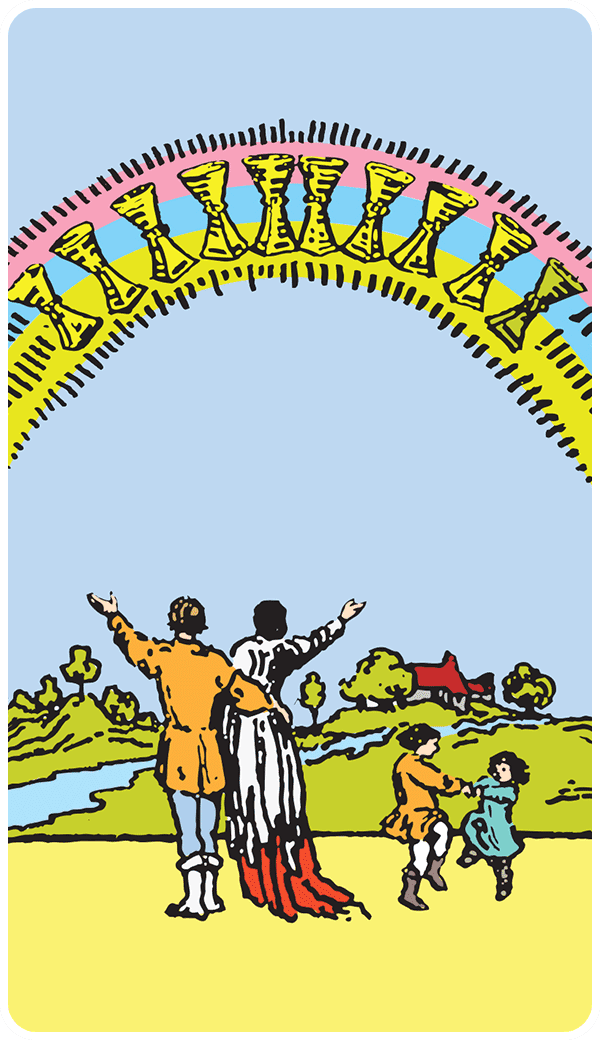
Ten of Cups · plate 10
YES
The Ten of Cups is a yes. But the yes it's giving is almost never the yes the querent thinks they're asking for. Most people pull this card on a question like 'Will this relationship work out?' or 'Should I take this job?' and read it as cosmic confirmation that the thing they want is guaranteed to arrive. That is not what the card does. The Ten of Cups confirms that the emotional infrastructure is in place. It says the bonds are real, the foundation is sound, the relational container can hold what you're about to put in it. Whether you actually build anything in that container is still your job.
Why Ten of Cups reads this way
What the suit, the rank, and the image are doing
Cups governs emotional bonds, relational attachment, and the felt sense of connection between people. It is the suit of how you experience intimacy, trust, and belonging. When a Cups card answers a yes/no question, it is answering about the emotional substrate of the situation — not the logistics, not the outcome, but whether the heart-level conditions are present.
Tens in tarot mark completion of a cycle. They are the fullest expression of their suit's energy. The Ten of Cups specifically describes a relational system that has reached stability. The family under the rainbow. The home that holds everyone. The emotional architecture is built and it works.
The image shows two figures with arms raised, two children playing, a rainbow overhead, and a cottage in the background. Everyone is present. No one is walking away. The card describes a moment when all the people who belong in the frame are in the frame, and the structure they've built together is sound. It is not describing a wish. It is describing a thing that already exists.
The most common misreading in a yes/no context is treating the Ten of Cups as a promise that the relationship will work out, or that the decision will lead to happiness. The card does not promise outcomes. It confirms that the foundation — the relational trust, the emotional safety, the mutual investment — is already there. If the foundation is there, the answer is yes, you can build on this. If the foundation is not there, the card will not show up.
How the answer shifts depending on what you're actually asking
If the question is 'Does this person love me?' or 'Is this bond real?' — the Ten of Cups is an unambiguous yes. The emotional structure exists. The attachment is mutual. You are not imagining it.
If the question is 'Will this work out?' or 'Should I stay?' — the Ten of Cups is still a yes, but it is answering a different question than the one you asked. It is saying the relational foundation is sound, not that the logistics will resolve themselves. You still have to do the work. The card confirms that the work is worth doing because the bond can hold it.
If the question is 'Will I be happy if I do this?' — the Ten of Cups is not answering that question at all. Happiness is not a stable state. The card describes a relational container that functions. Whether you feel happy inside that container on any given Tuesday depends on a hundred other variables the card is not tracking.
Reversed, the Ten of Cups often marks the moment when the structure that looked stable from the outside turns out to have a crack no one was naming. The answer becomes 'no, not like this' — not because the bond is absent, but because the way it is currently configured cannot hold what is being asked of it.
The tell that you are misreading the card on yourself
You pull the Ten of Cups on a yes/no question and feel immediate relief, as though the card has taken responsibility for the outcome. You stop thinking about what you need to do next. You treat the card as permission to be passive. That is the misread. The Ten of Cups confirms the foundation. It does not build the house. If you are waiting for the relationship to fix itself, or for the job to become fulfilling without your input, or for happiness to arrive because the card said yes — you are not reading the card. You are reading your own wish and pinning it to the image of a rainbow.
A grounded observation
Go back through your last three months and look for the moment when you knew the bond was real — not when it felt good, but when you knew it could hold weight. That is what the Ten of Cups is naming. The rest is still on you.
Key themes to watch for
- № 01Theme
Affirmative current
- № 02Theme
Open door
- № 03Theme
Forward motion
What to do with this reading
Read the upright meaning first, even if you pulled the card reversed. The reversal is a commentary on the upright — not a separate card.
Notice what your body did when you saw Ten of Cups. That reaction is usually closer to the truth than the interpretation.
Write down one sentence: What is this card asking me to stop avoiding? Let the answer be smaller than you expect.
Come back to this card in 48 hours. Most yes / no readings sharpen with a little distance.
Questions answered
Frequently asked
The Ten of Cups is a yes. But the yes it's giving is almost never the yes the querent thinks they're asking for. Most people pull this card on a question like 'Will this relationship work out?' or 'Should I take this job?' and read it as cosmic confirmation that the thing they want is guaranteed to arrive. That is not what the card does. The Ten of Cups confirms that the emotional infrastructure is in place. It says the bonds are real, the foundation is sound, the relational container can hold what you're about to put in it. Whether you actually build anything in that container is still your job.
Reversed cards are rarely "bad." Ten of Cups reversed asks you to look at where the same theme is blocked, postponed, or being avoided — usually with more compassion than the upright version.
Ten of Cups colors the cards around it. Pay attention to where its themes — emotional intimacy, felt-sense knowing, where the water level is rising — show up in the next card. That is usually where the story is.
Tarot is observational, not predictive. Ten of Cups describes the conditions in front of you right now and where they tend to lead if nothing changes — not a guarantee of timing.
Repeat cards are the deck underlining a theme. With Ten of Cups, that usually means the question you are asking is the right one — but you have not yet acted on what the card is showing you.
Read next
Related readings
More Cups · Yes / No
- Ace of Cups — Yes / NoHow Ace of Cups reads in a yes / no context.
- Two of Cups — Yes / NoHow Two of Cups reads in a yes / no context.
- Three of Cups — Yes / NoHow Three of Cups reads in a yes / no context.
- Four of Cups — Yes / NoHow Four of Cups reads in a yes / no context.
- Five of Cups — Yes / NoHow Five of Cups reads in a yes / no context.
- Six of Cups — Yes / NoHow Six of Cups reads in a yes / no context.
Other Ten of Cups readings
- General MeaningTen of Cups read for general meaning.
- Love & RelationshipsTen of Cups read for love & relationships.
- Career & WorkTen of Cups read for career & work.
- Money & FinanceTen of Cups read for money & finance.
- Health & WellbeingTen of Cups read for health & wellbeing.
- SpiritualityTen of Cups read for spirituality.