Five of Cups in Yes / No
The Five of Cups in a yes/no reading leans no — but not because the thing is impossible. The card names what you're still holding that blocks the yes from landing.
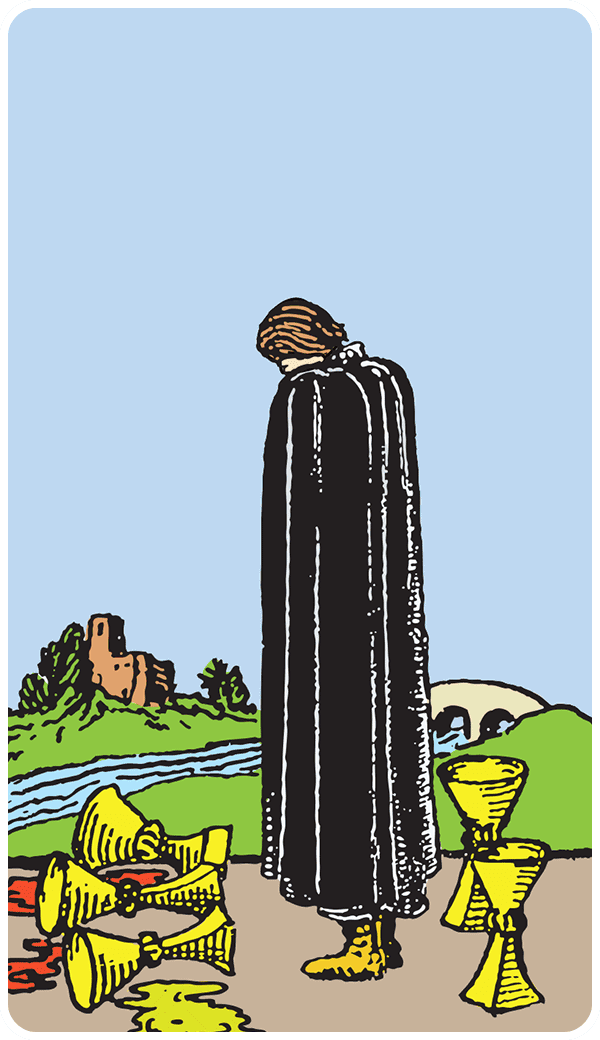
Five of Cups · plate 5
NO
The Five of Cups in a yes/no reading is a no. Not a hard no — a 'not while you're standing like this' no. The card describes someone facing away from what could work, fixed on what didn't. Most querents read this as the universe saying their question is doomed. That's the wrong read. The card is naming the posture that makes the yes unavailable, not the outcome itself.
Why Five of Cups reads this way
What the suit, rank, and image are doing
Cups governs emotional investment — where you've placed your hope, what you're grieving, how you bond to outcomes. The Five is the destabilization point in the suit's arc. Fives in tarot describe friction, imbalance, the moment a structure that was working stops working. The Five of Cups is the card of loss that hasn't been metabolized yet.
Look at the image. A figure in black stands before three spilled cups, head down. Two cups remain upright behind them. They haven't turned around. A bridge crosses water in the background — a way forward exists, but the figure isn't facing it. This is not a card about whether the thing you want is possible. It's a card about whether you can receive it in the state you're in. Right now, the answer is no.
Why the 'no' isn't about the question
The most common misreading in a yes/no context is treating the Five of Cups as a verdict on the external situation. The querent asks 'Will I get the job?' or 'Will they reach out?' and reads the card as 'the job isn't coming' or 'they've moved on.' That flattens what the card is actually describing. The Five of Cups doesn't predict outcomes. It names where your attention is stuck.
Here's what tends to happen when this card shows up. The querent is asking about something new while still emotionally camped out in something old. They want the relationship to work but they're still performing the last breakup in their head. They want the business to take off but they're still narrating the failure from two years ago as proof they don't know what they're doing. The question is forward-facing. The nervous system is backward-facing. The card is pointing at the gap.
In reverse, the Five of Cups can shift toward 'maybe' — the figure is starting to turn around, starting to see the two cups still standing. The loss is still present, but it's no longer the only thing in frame. If the question depends on your ability to show up without performing grief, reversed Five of Cups says you're closer than you were.
The tell that you're misreading it
You're misreading the Five of Cups if you walk away from the reading thinking 'the thing I want isn't going to happen' and you stop there. The card isn't closing a door. It's naming what you're doing in front of the door. The tell is this: if the 'no' feels like a relief, like permission to stay where you are, you're using the card wrong. The Five of Cups is not a pass to keep grieving. It's a flag that says 'this is why the yes can't land yet.'
Go back through your calendar and look for the moment you decided the current question was already answered by the last disappointment. That's the spilled cup you're still staring at. The card will read as a 'yes' the week you stop staring.
A grounded observation
The Five of Cups doesn't predict whether you'll get what you're asking for. It describes whether you're in a position to hold it if it arrives. Right now, you're not.
Key themes to watch for
- № 01Theme
Affirmative current
- № 02Theme
Open door
- № 03Theme
Forward motion
What to do with this reading
Read the upright meaning first, even if you pulled the card reversed. The reversal is a commentary on the upright — not a separate card.
Notice what your body did when you saw Five of Cups. That reaction is usually closer to the truth than the interpretation.
Write down one sentence: What is this card asking me to stop avoiding? Let the answer be smaller than you expect.
Come back to this card in 48 hours. Most yes / no readings sharpen with a little distance.
Questions answered
Frequently asked
The Five of Cups in a yes/no reading is a no. Not a hard no — a 'not while you're standing like this' no. The card describes someone facing away from what could work, fixed on what didn't. Most querents read this as the universe saying their question is doomed. That's the wrong read. The card is naming the posture that makes the yes unavailable, not the outcome itself.
Reversed cards are rarely "bad." Five of Cups reversed asks you to look at where the same theme is blocked, postponed, or being avoided — usually with more compassion than the upright version.
Five of Cups colors the cards around it. Pay attention to where its themes — emotional intimacy, felt-sense knowing, where the water level is rising — show up in the next card. That is usually where the story is.
Tarot is observational, not predictive. Five of Cups describes the conditions in front of you right now and where they tend to lead if nothing changes — not a guarantee of timing.
Repeat cards are the deck underlining a theme. With Five of Cups, that usually means the question you are asking is the right one — but you have not yet acted on what the card is showing you.
Read next
Related readings
More Cups · Yes / No
- Ace of Cups — Yes / NoHow Ace of Cups reads in a yes / no context.
- Two of Cups — Yes / NoHow Two of Cups reads in a yes / no context.
- Three of Cups — Yes / NoHow Three of Cups reads in a yes / no context.
- Four of Cups — Yes / NoHow Four of Cups reads in a yes / no context.
- Six of Cups — Yes / NoHow Six of Cups reads in a yes / no context.
- Seven of Cups — Yes / NoHow Seven of Cups reads in a yes / no context.
Other Five of Cups readings
- General MeaningFive of Cups read for general meaning.
- Love & RelationshipsFive of Cups read for love & relationships.
- Career & WorkFive of Cups read for career & work.
- Money & FinanceFive of Cups read for money & finance.
- Health & WellbeingFive of Cups read for health & wellbeing.
- SpiritualityFive of Cups read for spirituality.