Seven of Cups in Yes / No
The Seven of Cups in a yes/no reading usually means no — not because the outcome is bad, but because you haven't decided what you're actually asking for.
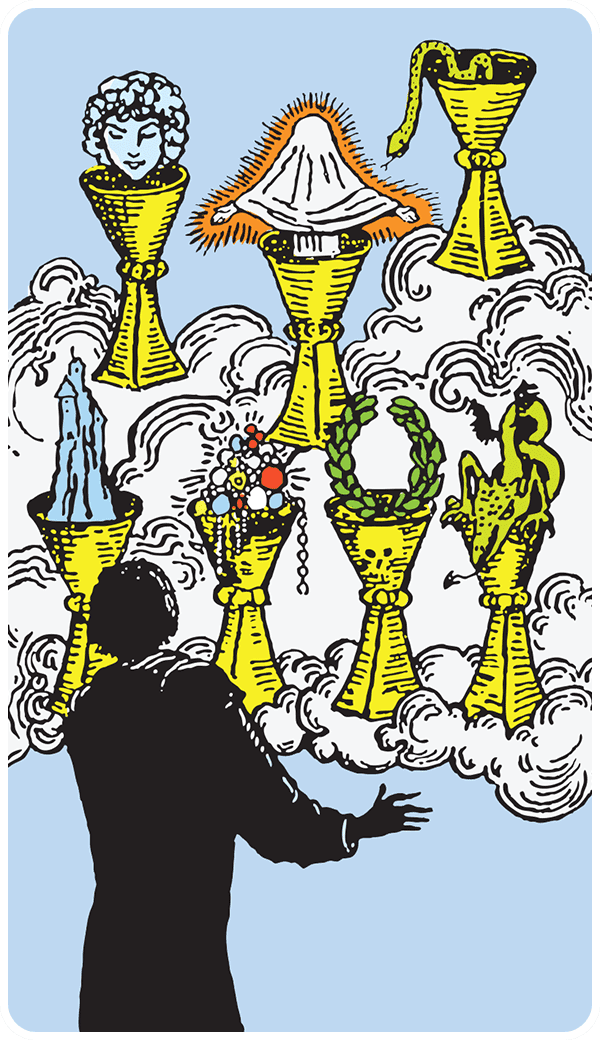
Seven of Cups · plate 7
NO
The Seven of Cups in a yes/no reading leans no. Not because the thing you're asking about won't happen, but because you haven't finished deciding what you want. The card names the moment before commitment, when every option still feels equally possible and equally unreal. Most querents read this as "the universe is keeping my options open" or "I'm being shown multiple paths." What it actually describes is paralysis dressed as abundance. The question you asked has seven different versions in your head, and you're waiting for the cards to pick one for you.
Why Seven of Cups reads this way
What the suit, rank, and image are doing
Cups governs emotional attachment and relational desire — the part of you that bonds to outcomes based on how they feel, not what they cost. Seven is the number of assessment and recalibration, the point in a sequence where you pause to evaluate whether the direction you've been moving is still the direction you want. Sevens ask: is this still worth it? Do I still want this? Have I been chasing the wrong version?
The image shows a figure standing before seven cups, each filled with a different vision: a castle, a jeweled necklace, a wreath, a dragon, a shrouded figure, a snake, a glowing head. The cups float in clouds. The figure is silhouetted, facing away. They are not reaching. They are not choosing. They are staring. This is the card of someone who has turned the question into a fantasy exercise instead of a decision. The reason the answer is no is not that none of the cups are real — it's that the querent hasn't committed to finding out which one is.
When the answer shifts to maybe or yes
The Seven of Cups reads differently depending on whether the querent is asking about an external event or their own choice. If the question is "Will they text me back?" or "Will I get the job?", the answer stays no — the other party is waiting for you to clarify what you actually want from them, and the static is loud enough that they're not moving. If the question is "Should I take this opportunity?" or "Is this the right path?", the answer shifts to maybe, conditional on one move: pick a cup and test it. The card is not telling you which cup is correct. It is telling you that standing in front of all seven is the wrong position.
Reversed, the Seven of Cups can mean yes, but it's a narrow yes. It means the querent has already eliminated the fantasy versions and is now asking about the one option that survived contact with reality. The reversed card says: you've done the assessment work, you know which cup is weight-bearing, the question now is whether you'll act on it. If the querent is still in the "but what if I'm missing something better" loop, reversed doesn't help.
The tell that you're misreading it
The tell is in the phrasing of the question. If you asked a yes/no question but you're already planning to ask three follow-up questions depending on the answer, you are the figure on the card. If you pulled the Seven of Cups and your first thought was "okay but which cup is the real one", you have misread it. The card is not a menu. It is a diagnosis. It is naming the fact that you are treating a binary question as a branching narrative because committing to one answer means losing the fantasy of the other six. The yes/no format is trying to force a choice the Seven of Cups says you have not made yet.
A grounded observation
Go back and look at the last time you asked a yes/no question about this topic. Count how many times you've rephrased it. That number is the tell.
Key themes to watch for
- № 01Theme
Affirmative current
- № 02Theme
Open door
- № 03Theme
Forward motion
What to do with this reading
Read the upright meaning first, even if you pulled the card reversed. The reversal is a commentary on the upright — not a separate card.
Notice what your body did when you saw Seven of Cups. That reaction is usually closer to the truth than the interpretation.
Write down one sentence: What is this card asking me to stop avoiding? Let the answer be smaller than you expect.
Come back to this card in 48 hours. Most yes / no readings sharpen with a little distance.
Questions answered
Frequently asked
The Seven of Cups in a yes/no reading leans no. Not because the thing you're asking about won't happen, but because you haven't finished deciding what you want. The card names the moment before commitment, when every option still feels equally possible and equally unreal. Most querents read this as "the universe is keeping my options open" or "I'm being shown multiple paths." What it actually describes is paralysis dressed as abundance. The question you asked has seven different versions in your head, and you're waiting for the cards to pick one for you.
Reversed cards are rarely "bad." Seven of Cups reversed asks you to look at where the same theme is blocked, postponed, or being avoided — usually with more compassion than the upright version.
Seven of Cups colors the cards around it. Pay attention to where its themes — emotional intimacy, felt-sense knowing, where the water level is rising — show up in the next card. That is usually where the story is.
Tarot is observational, not predictive. Seven of Cups describes the conditions in front of you right now and where they tend to lead if nothing changes — not a guarantee of timing.
Repeat cards are the deck underlining a theme. With Seven of Cups, that usually means the question you are asking is the right one — but you have not yet acted on what the card is showing you.
Read next
Related readings
More Cups · Yes / No
- Ace of Cups — Yes / NoHow Ace of Cups reads in a yes / no context.
- Two of Cups — Yes / NoHow Two of Cups reads in a yes / no context.
- Three of Cups — Yes / NoHow Three of Cups reads in a yes / no context.
- Four of Cups — Yes / NoHow Four of Cups reads in a yes / no context.
- Five of Cups — Yes / NoHow Five of Cups reads in a yes / no context.
- Six of Cups — Yes / NoHow Six of Cups reads in a yes / no context.
Other Seven of Cups readings
- General MeaningSeven of Cups read for general meaning.
- Love & RelationshipsSeven of Cups read for love & relationships.
- Career & WorkSeven of Cups read for career & work.
- Money & FinanceSeven of Cups read for money & finance.
- Health & WellbeingSeven of Cups read for health & wellbeing.
- SpiritualitySeven of Cups read for spirituality.