Ace of Cups in Yes / No
The Ace of Cups reads as yes in a binary spread, but most querents miss what they're actually being told yes to — and mistake threshold for arrival.
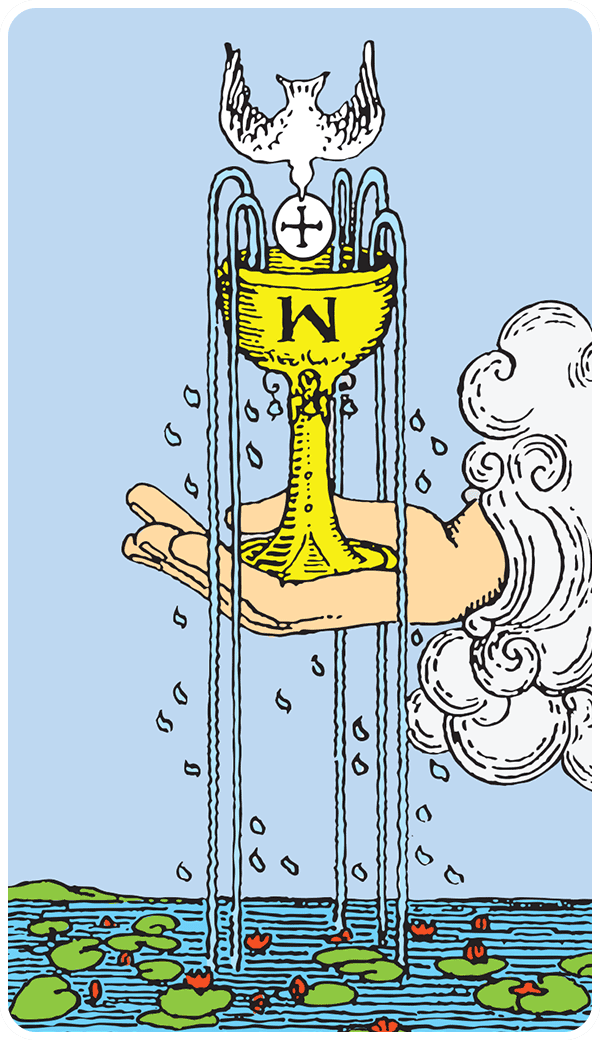
Ace of Cups · plate 1
YES
The Ace of Cups is a yes. But it is not yes to what you think you asked. Most people pull this card on a yes/no question and hear it as confirmation that the thing will happen — the person will text back, the job will come through, the situation will resolve in their favor. That is not what the card is answering. It is saying yes to the opening. Yes, the emotional channel is available again. Yes, you can feel something here. Whether the thing you want actually materializes is a separate question the card is not addressing.
Why Ace of Cups reads this way
What the suit, rank, and image are doing in a binary frame
Cups governs emotional availability and relational capacity. It is the suit of how you bond, how you attach, how feeling moves through you toward another person or situation. The Ace is a threshold card — it describes the moment a door opens, not what walks through it. The image shows a hand holding a cup mid-air, water overflowing, a dove descending. The cup is being offered. It has not been accepted yet. It has not been drunk from. This is the mechanic: the Ace of Cups says the conditions for emotional engagement are now present. It does not say the engagement will happen.
In a yes/no reading, people collapse this into "yes, the thing I want will happen." They are asking "will he call" and they read the Ace of Cups as "he will call." What the card is actually saying is "you are emotionally open enough now that if he calls, you will be able to receive it without shutting down." The yes is to your readiness, not to his behavior. This is why the Ace of Cups shows up so often in readings where the querent feels like the card lied to them three months later. The channel opened. They just wanted a different yes.
How the answer shifts depending on what you are actually asking
If the question is "should I reach out" or "is this worth pursuing," the Ace of Cups is a clean yes. The card is confirming that the emotional bandwidth is there, that you are not forcing it, that the impulse to reach is coming from a real place and not from panic or performance. If the question is "will this person do X" or "will this situation resolve by Y date," the Ace of Cups is a maybe at best. You are asking about someone else's action or an external timeline. The card is answering about your internal state.
Reversed, the Ace of Cups is a no — but the no is still about the channel, not the outcome. Reversed, the cup is spilling. The emotional opening is not available right now. You are still too defended, or too raw, or too busy pretending you don't care. The thing you are asking about may still happen, but you will not be able to let it in if it does. The reversed Ace is the card that says "wait until you can actually feel this before you move on it."
The tell that you are misreading the card on yourself
You pulled the Ace of Cups, read it as yes, and then spent the next two weeks checking your phone. That is the tell. The Ace of Cups does not generate behavior in another person. It does not put events on a calendar. If you are waiting for proof that the card was right, you misread what it said yes to. The card is describing something that already happened inside you — a thaw, a softening, a willingness to feel again that was not there last month. If you cannot name that shift when you look back at the week before you pulled the card, you are not reading the Ace of Cups. You are reading your own hope and pinning it to a image of a cup.
A grounded observation
Go back through your calendar to the week before you asked the question. Look for the moment you stopped bracing. That is what the card was naming.
Key themes to watch for
- № 01Theme
Affirmative current
- № 02Theme
Open door
- № 03Theme
Forward motion
What to do with this reading
Read the upright meaning first, even if you pulled the card reversed. The reversal is a commentary on the upright — not a separate card.
Notice what your body did when you saw Ace of Cups. That reaction is usually closer to the truth than the interpretation.
Write down one sentence: What is this card asking me to stop avoiding? Let the answer be smaller than you expect.
Come back to this card in 48 hours. Most yes / no readings sharpen with a little distance.
Questions answered
Frequently asked
The Ace of Cups is a yes. But it is not yes to what you think you asked. Most people pull this card on a yes/no question and hear it as confirmation that the thing will happen — the person will text back, the job will come through, the situation will resolve in their favor. That is not what the card is answering. It is saying yes to the opening. Yes, the emotional channel is available again. Yes, you can feel something here. Whether the thing you want actually materializes is a separate question the card is not addressing.
Reversed cards are rarely "bad." Ace of Cups reversed asks you to look at where the same theme is blocked, postponed, or being avoided — usually with more compassion than the upright version.
Ace of Cups colors the cards around it. Pay attention to where its themes — emotional intimacy, felt-sense knowing, where the water level is rising — show up in the next card. That is usually where the story is.
Tarot is observational, not predictive. Ace of Cups describes the conditions in front of you right now and where they tend to lead if nothing changes — not a guarantee of timing.
Repeat cards are the deck underlining a theme. With Ace of Cups, that usually means the question you are asking is the right one — but you have not yet acted on what the card is showing you.
Read next
Related readings
More Cups · Yes / No
- Two of Cups — Yes / NoHow Two of Cups reads in a yes / no context.
- Three of Cups — Yes / NoHow Three of Cups reads in a yes / no context.
- Four of Cups — Yes / NoHow Four of Cups reads in a yes / no context.
- Five of Cups — Yes / NoHow Five of Cups reads in a yes / no context.
- Six of Cups — Yes / NoHow Six of Cups reads in a yes / no context.
- Seven of Cups — Yes / NoHow Seven of Cups reads in a yes / no context.
Other Ace of Cups readings
- General MeaningAce of Cups read for general meaning.
- Love & RelationshipsAce of Cups read for love & relationships.
- Career & WorkAce of Cups read for career & work.
- Money & FinanceAce of Cups read for money & finance.
- Health & WellbeingAce of Cups read for health & wellbeing.
- SpiritualityAce of Cups read for spirituality.