Six of Cups in Yes / No
The Six of Cups leans yes in yes/no readings, but only when the question is asking if you should return to something. Here's what the card is actually measuring.
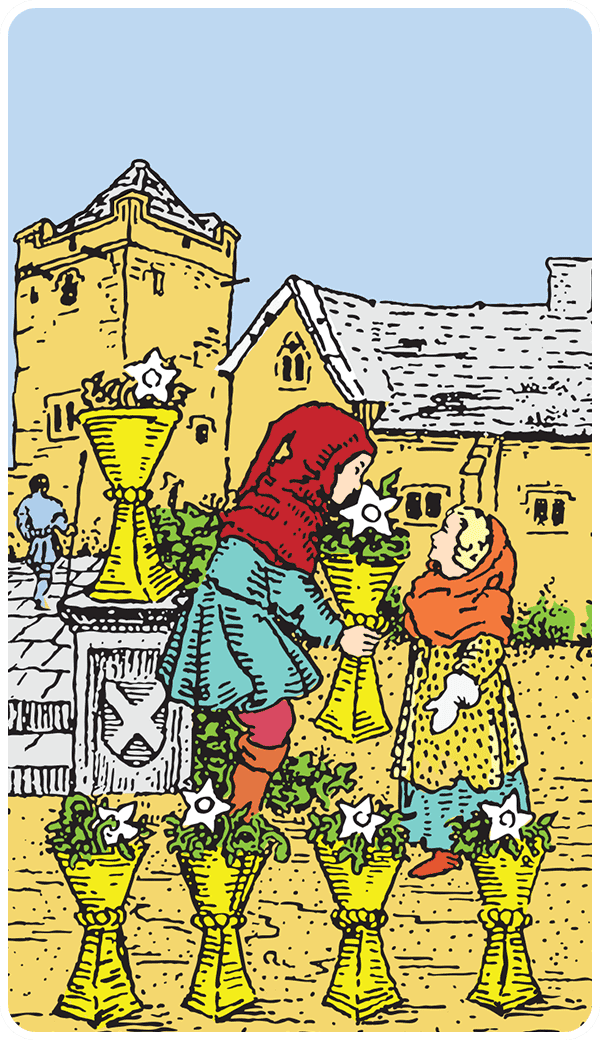
Six of Cups · plate 6
MAYBE
The Six of Cups leans yes, but only if the question is asking whether to return to something—a person, a place, a version of yourself you've been away from. If the question is about moving forward into new territory, the card reads as no, or more accurately, as "you are facing the wrong direction." Most querents miss this. They see cups, they see the children in the garden, they feel the warmth of the image, and they take it as general approval. It is not general approval. It is a card about backward motion, and whether that backward motion is the right move depends entirely on what you are trying to do.
Why Six of Cups reads this way
What the suit, the rank, and the image are doing
Cups governs emotional memory—how you felt then, who made you feel safe, the people and places that still live in your chest as reference points. The Six is the card of equilibrium within a suit, the moment where the energy of that suit is balanced and stable. Six of Cups is emotional memory at rest. It is not longing. It is not grief. It is the past as a place you can still visit without it wounding you.
Look at the image. Two children in a courtyard. One child hands the other a cup filled with flowers. The buildings behind them are old, solid, unchanged. The gesture is tender. The scene is small and enclosed. No one is looking outward. The card describes a return to an earlier emotional state—reconnecting with someone you knew before, revisiting a place that shaped you, or touching a version of yourself you left behind. The yes/no question it answers well is: Should I go back? The question it answers poorly is: Should I try something new?
The most common misreading in yes/no contexts is taking the Six of Cups as a general green light because it feels sweet. It does feel sweet. But sweetness is not the same as forward motion. If you asked whether to take a new job and the Six of Cups appears, the card is not saying yes to the job—it is saying you are thinking about the job because it reminds you of an earlier version of your career, and you need to check whether you are moving toward something or away from the present.
How the answer changes depending on what you are actually asking
If the question is "Should I reach out to my ex?" and the querent has been thinking about them for weeks, replaying old conversations, remembering how it felt before it broke—the Six of Cups reads as yes. Not because the relationship will work, but because the impulse to reach out is coming from a real place and the card is confirming that the emotional channel is still open. What happens after the reach-out is a different reading.
If the question is "Should I move to a new city?" and the querent has been stuck in their hometown for five years, afraid to leave, the Six of Cups reads as no. The card is naming the condition, not endorsing it. It is saying: you are oriented toward the past right now, and a move that requires forward-facing energy will fail if you take it while facing backward. The no is mechanical, not moral.
Reversed, the Six of Cups flips the weight. The past loses its pull. The answer becomes yes if the question is about breaking a pattern, leaving a place that has kept you small, or stopping the loop where you keep returning to the same person hoping for a different outcome. Reversed Six of Cups says: the emotional gravity that was holding you has released.
The tell that someone is misreading the card on themselves
The tell is when someone pulls the Six of Cups, reads it as yes, takes the action, and then spends the next three months feeling like they are trying to recreate something that does not exist anymore. They moved back to their college town and it felt wrong. They got back together with the ex and the dynamic was identical to the breakup. They took the job that reminded them of their first job and realized within a week that they are not the person who wanted that job anymore. The card was accurate. They were facing backward. They just did not check whether backward was the direction the question required.
A grounded observation
Go back through your calendar and look for the moments when you said yes to something because it reminded you of an earlier version of your life. Check whether those yeses moved you forward or kept you in place.
Key themes to watch for
- № 01Theme
Affirmative current
- № 02Theme
Open door
- № 03Theme
Forward motion
What to do with this reading
Read the upright meaning first, even if you pulled the card reversed. The reversal is a commentary on the upright — not a separate card.
Notice what your body did when you saw Six of Cups. That reaction is usually closer to the truth than the interpretation.
Write down one sentence: What is this card asking me to stop avoiding? Let the answer be smaller than you expect.
Come back to this card in 48 hours. Most yes / no readings sharpen with a little distance.
Questions answered
Frequently asked
The Six of Cups leans yes, but only if the question is asking whether to return to something—a person, a place, a version of yourself you've been away from. If the question is about moving forward into new territory, the card reads as no, or more accurately, as "you are facing the wrong direction." Most querents miss this. They see cups, they see the children in the garden, they feel the warmth of the image, and they take it as general approval. It is not general approval. It is a card about backward motion, and whether that backward motion is the right move depends entirely on what you are trying to do.
Reversed cards are rarely "bad." Six of Cups reversed asks you to look at where the same theme is blocked, postponed, or being avoided — usually with more compassion than the upright version.
Six of Cups colors the cards around it. Pay attention to where its themes — emotional intimacy, felt-sense knowing, where the water level is rising — show up in the next card. That is usually where the story is.
Tarot is observational, not predictive. Six of Cups describes the conditions in front of you right now and where they tend to lead if nothing changes — not a guarantee of timing.
Repeat cards are the deck underlining a theme. With Six of Cups, that usually means the question you are asking is the right one — but you have not yet acted on what the card is showing you.
Read next
Related readings
More Cups · Yes / No
- Ace of Cups — Yes / NoHow Ace of Cups reads in a yes / no context.
- Two of Cups — Yes / NoHow Two of Cups reads in a yes / no context.
- Three of Cups — Yes / NoHow Three of Cups reads in a yes / no context.
- Four of Cups — Yes / NoHow Four of Cups reads in a yes / no context.
- Five of Cups — Yes / NoHow Five of Cups reads in a yes / no context.
- Seven of Cups — Yes / NoHow Seven of Cups reads in a yes / no context.
Other Six of Cups readings
- General MeaningSix of Cups read for general meaning.
- Love & RelationshipsSix of Cups read for love & relationships.
- Career & WorkSix of Cups read for career & work.
- Money & FinanceSix of Cups read for money & finance.
- Health & WellbeingSix of Cups read for health & wellbeing.
- SpiritualitySix of Cups read for spirituality.