Seven of Cups in Love
The Seven of Cups in love readings gets read as 'options' or 'confusion.' What it actually names is the moment you're using fantasy to avoid a decision you've already made.
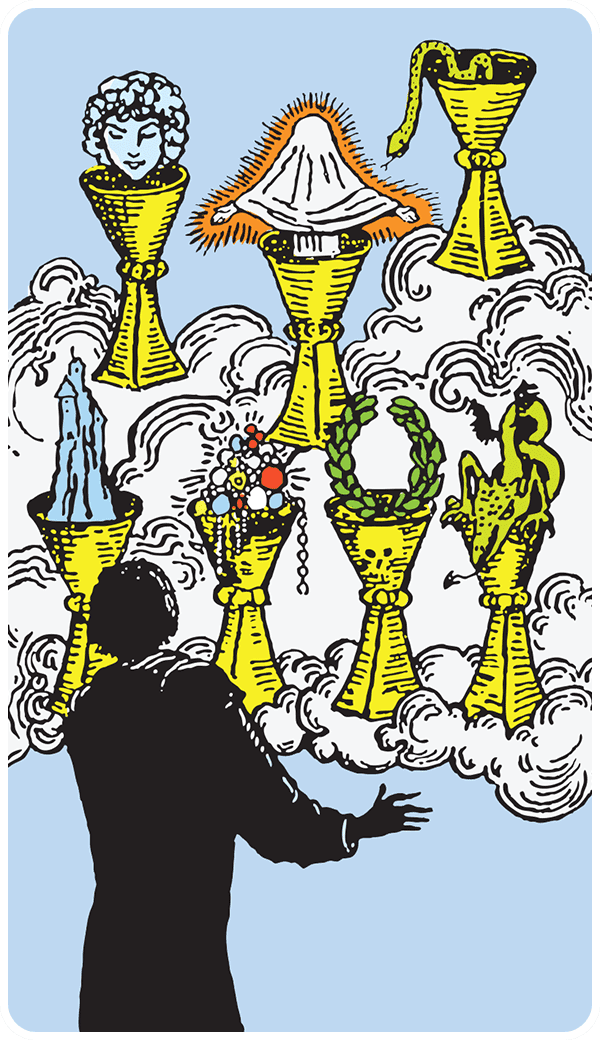
Seven of Cups · plate 7
What the card is actually doing
The Seven of Cups shows up in a love reading and the querent says they're confused. They have multiple people interested. They don't know what they want. They're weighing their options. That is not what the card is describing. The Seven of Cups does not mean you have options. It means you are building fantasies around people or possibilities to avoid the feeling that comes with choosing—or with admitting you've already chosen and are pretending you haven't.
Reading Seven of Cups in love
What the suit, the seven, and the image are doing
Cups governs emotional attachment, relational chemistry, and the part of you that bonds. Sevens in tarot describe a threshold moment where something has proliferated past the point of clarity. The structural integrity is compromised. You have too many threads, too many variables, too many half-commitments, and the next card in the sequence—the Eight—will force a reckoning.
Look at the image. A figure stands before seven cups, each holding a different vision: a castle, a jeweled face, a dragon, a laurel wreath. The cups float in clouds. None of them are real. None of them can be touched. The figure is not choosing between seven real options. The figure is standing in front of seven projections, and the card is naming that the projections are the problem.
The most common misreading in a love context is to treat the Seven of Cups as if it describes an external situation—multiple suitors, or a partner who won't commit, or a choice between two people. That is almost never what is happening. What is happening is that the querent is fantasizing about people or relationships in a way that lets them avoid the discomfort of reality. The person they're obsessing over has not texted back in three weeks, but they're still building a future with them in their head. The ex they left two years ago was difficult and inconsistent, but they've edited the memory into something they're now mourning. The new person seems perfect, but they've only been on two dates and the querent has already written the wedding vows.
How the card reads when the querent is the one being fantasized about versus when they're doing the fantasizing
If the querent is the object of someone else's projection, the Seven of Cups describes the experience of being idealized in a way that has nothing to do with who they actually are. The other person is in love with a version of them that does not exist. This reads as intensity without intimacy. The other person is obsessed, but they don't ask questions. They fill in gaps with their own narrative. When the querent tries to show up as themselves, the other person gets confused or disappointed.
If the querent is doing the fantasizing, the Seven of Cups describes the moment they are using imagination as a substitute for action. They are weighing options that are not actually on the table. They are mentally auditioning people who have not auditioned for the role. They are building elaborate internal narratives about what could happen instead of responding to what is happening.
The tell that someone is misreading the card on themselves
The tell is that they describe the situation as if the confusion is the problem, when the confusion is actually the solution. The confusion is what lets them avoid the next move. If they admitted they already know what they want—or that they already know none of these options are real—they would have to act, or grieve, or let go. The Seven of Cups is not describing a decision you need to make. It is describing the moment you are using indecision as a way to stay in the fantasy a little longer.
From the practice
“A card never tells you what to do. It tells you what you're already deciding — and gives you the words to name it.”
A grounded observation
Go back through your texts with the person you're 'confused' about. Count how many of the last ten moves were yours. If the ratio is eight to two, you are not confused.
Key themes to watch for
- № 01Theme
Vulnerability
- № 02Theme
New chapters
- № 03Theme
Emotional truth
What to do with this reading
Read the upright meaning first, even if you pulled the card reversed. The reversal is a commentary on the upright — not a separate card.
Notice what your body did when you saw Seven of Cups. That reaction is usually closer to the truth than the interpretation.
Write down one sentence: What is this card asking me to stop avoiding? Let the answer be smaller than you expect.
Come back to this card in 48 hours. Most love readings sharpen with a little distance.
Questions answered
Frequently asked
In love, the Seven of Cups suggests a kaleidoscope of possibilities and emotions swirling around you. This might be a time when fantasies and daydreams about romance flood your mind, painting idealized visions of what could be. Yet, beneath these dreams, you may find yourself wondering about the substance of your desires. Are you seeing your partner clearly or projecting an ideal? This card encourages you to explore these dreams but also to seek clarity in your relationships. What truly lies beneath the surface of your heart's longings?
Reversed, the Seven of Cups in love points to a moment of clarity after a period of dreaming or confusion. Perhaps you've been lost in a romantic haze, and now the reality of your situation becomes clearer. This could be a time for recognizing what truly matters in your relationships, cutting through illusions and fantasies. It's an opportunity to focus on what is genuine and real in your love life. Is there a particular truth that seems to be emerging from the fog?
Seven of Cups colors the cards around it. Pay attention to where its themes — emotional intimacy, felt-sense knowing, where the water level is rising — show up in the next card. That is usually where the story is.
Tarot is observational, not predictive. Seven of Cups describes the conditions in front of you right now and where they tend to lead if nothing changes — not a guarantee of timing.
Repeat cards are the deck underlining a theme. With Seven of Cups, that usually means the question you are asking is the right one — but you have not yet acted on what the card is showing you.
Read next
Related readings
More Cups · Love
- Ace of Cups — LoveHow Ace of Cups reads in a love context.
- Two of Cups — LoveHow Two of Cups reads in a love context.
- Three of Cups — LoveHow Three of Cups reads in a love context.
- Four of Cups — LoveHow Four of Cups reads in a love context.
- Five of Cups — LoveHow Five of Cups reads in a love context.
- Six of Cups — LoveHow Six of Cups reads in a love context.
Other Seven of Cups readings
- General MeaningSeven of Cups read for general meaning.
- Career & WorkSeven of Cups read for career & work.
- Money & FinanceSeven of Cups read for money & finance.
- Health & WellbeingSeven of Cups read for health & wellbeing.
- SpiritualitySeven of Cups read for spirituality.
- Yes / No AnswerSeven of Cups read for yes / no answer.