Five of Cups in Love
The Five of Cups in love readings gets misread as 'move on from the past.' What it actually describes is the mechanism of selective attention after loss.
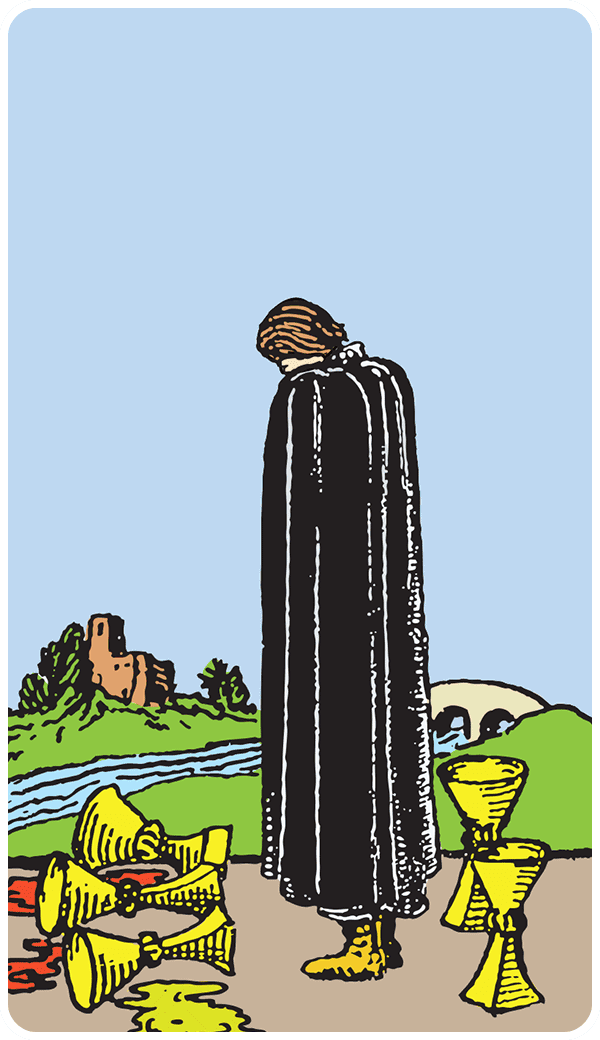
Five of Cups · plate 5
What the card is actually doing
The Five of Cups shows up in a love reading and the querent already knows what they think it means. They've lost something. They're stuck in the past. They need to turn around and see the two cups still standing. The card is telling them to move on. That is not what the card is doing. The Five of Cups describes a specific psychological state — the moment after relational loss when attention locks onto what's gone and cannot yet register what remains. It names the mechanism, not the prescription.
Reading Five of Cups in love
What the suit, the rank, and the image are doing on the card
Cups governs emotional attachment and relational bonding. It is the suit of how you feel toward someone and how that feeling moves or stops moving between you. Fives in tarot describe instability and loss within a suit's domain. The Five of Pentacles is material insecurity. The Five of Swords is relational defeat. The Five of Cups is emotional loss — specifically, the loss of something you were holding in relationship.
Now look at the image. A figure in black stands before three spilled cups. Two cups remain upright behind them. The figure does not turn around. A river runs between them and a bridge in the distance. Most readers stop here and say the card is about dwelling on loss when you should focus on what's left. That reading assumes the figure can turn around and hasn't yet chosen to. But the card does not show choice. It shows a state. The figure is locked in place. Their attention is captured by the spilled cups because that is what grief does — it occupies the entire visual field until it doesn't.
How the card reads for two different querent situations
For someone fresh out of a breakup, the Five of Cups describes the first few weeks when every song is about them, every restaurant reminds you of a date, and you cannot yet imagine wanting someone else. The card is not saying you're doing it wrong. It is naming where you are. The two cups behind you are not accessible yet. You are not refusing to see them. You cannot see them. The card confirms that this is the predictable psychological response to relational loss, not a moral failing.
For someone six months out who is still checking their ex's Instagram three times a day, the Five of Cups reads differently. Now the state has calcified into a pattern. The attention is no longer involuntary; it is being fed. The card here describes someone who has built an identity around the loss and is maintaining it. The two standing cups are a job offer in another city, a friend who keeps suggesting you meet their colleague, the moment last week when you felt fine for four hours and then talked yourself back into sadness because fine felt like betrayal.
The tell that someone is misreading the card on themselves
The most common misread is treating the Five of Cups as an instruction to stop grieving and be grateful for what's left. If you are reading the card this way and then feeling guilty that you can't just turn around, you are misreading it. The card does not contain a should. It describes a state that has a natural duration. The error is trying to skip the state or performing gratitude before the attention has actually released. Go back through your calendar. If the loss was two weeks ago and you're spending four hours a day on it, that's the Five of Cups working as designed. If the loss was two years ago and you're still spending four hours a day on it, the card is naming a maintenance pattern you are now choosing.
From the practice
“A card never tells you what to do. It tells you what you're already deciding — and gives you the words to name it.”
A grounded observation
The two cups behind you become visible when your nervous system stops scanning for threat in the past. You cannot force that moment. You can stop preventing it.
Key themes to watch for
- № 01Theme
Vulnerability
- № 02Theme
New chapters
- № 03Theme
Emotional truth
What to do with this reading
Read the upright meaning first, even if you pulled the card reversed. The reversal is a commentary on the upright — not a separate card.
Notice what your body did when you saw Five of Cups. That reaction is usually closer to the truth than the interpretation.
Write down one sentence: What is this card asking me to stop avoiding? Let the answer be smaller than you expect.
Come back to this card in 48 hours. Most love readings sharpen with a little distance.
Questions answered
Frequently asked
In love, the Five of Cups can indicate a focus on past disappointments. It's as if you're revisiting old letters, looking at what went wrong instead of what went right. This card suggests that you might be holding onto grief or regret from past relationships, coloring your current interactions. Reminding yourself of the lessons learned might be more useful than reliving the loss. Consider what lessons you've gathered and how they might serve you now. Could there be unexplored potential in the connections you currently have?
Reversed, the Five of Cups in love points to a shift away from past sorrows. Imagine a gentle breeze that clears away lingering clouds, allowing you to see your partner or potential partners in a new light. This card suggests that you are ready to release old heartbreaks and open your heart to new possibilities. It might be a time to appreciate what you have rather than what you've lost. How might embracing gratitude change your experience of love?
Five of Cups colors the cards around it. Pay attention to where its themes — emotional intimacy, felt-sense knowing, where the water level is rising — show up in the next card. That is usually where the story is.
Tarot is observational, not predictive. Five of Cups describes the conditions in front of you right now and where they tend to lead if nothing changes — not a guarantee of timing.
Repeat cards are the deck underlining a theme. With Five of Cups, that usually means the question you are asking is the right one — but you have not yet acted on what the card is showing you.
Read next
Related readings
More Cups · Love
- Ace of Cups — LoveHow Ace of Cups reads in a love context.
- Two of Cups — LoveHow Two of Cups reads in a love context.
- Three of Cups — LoveHow Three of Cups reads in a love context.
- Four of Cups — LoveHow Four of Cups reads in a love context.
- Six of Cups — LoveHow Six of Cups reads in a love context.
- Seven of Cups — LoveHow Seven of Cups reads in a love context.
Other Five of Cups readings
- General MeaningFive of Cups read for general meaning.
- Career & WorkFive of Cups read for career & work.
- Money & FinanceFive of Cups read for money & finance.
- Health & WellbeingFive of Cups read for health & wellbeing.
- SpiritualityFive of Cups read for spirituality.
- Yes / No AnswerFive of Cups read for yes / no answer.