Ace of Cups in Love
The Ace of Cups gets read as 'someone is coming' in love readings. That's not what it describes. Here's what the card is actually doing.
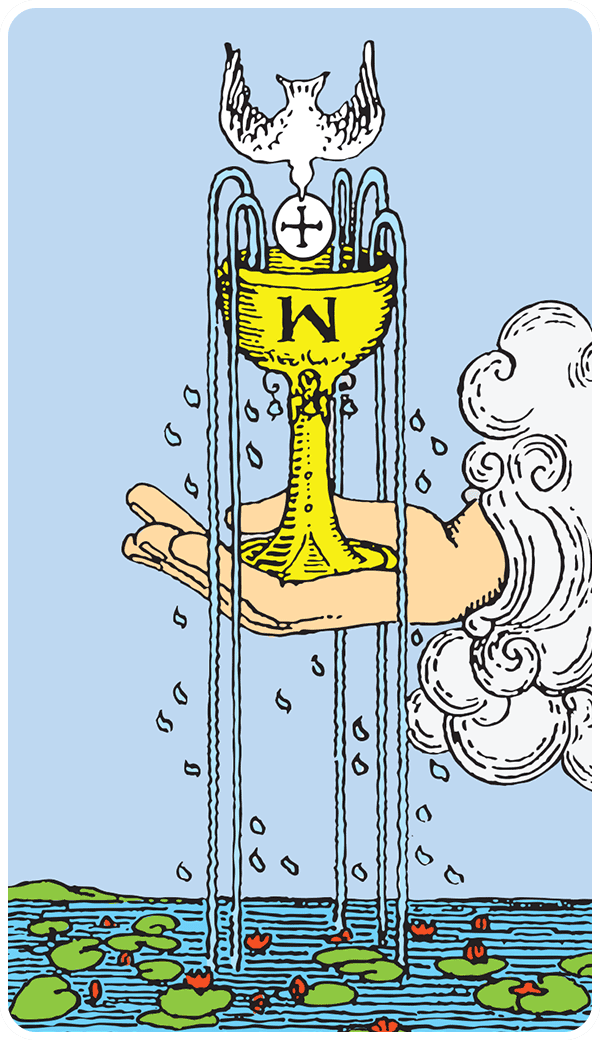
Ace of Cups · plate 1
What the card is actually doing
The Ace of Cups shows up in a love reading and the querent's face changes. They lean in. They want me to confirm what they already think it means: someone is coming. A new person. A new relationship. The thing they've been waiting for is finally on the calendar.
That is not what the card is saying. The gap between what people want the Ace of Cups to mean and what it actually describes is the single most consistent misreading I see at my table.
Reading Ace of Cups in love
What the suit, rank, and image are doing — and why people get it wrong
Cups is the emotional and relational suit. It governs how you feel, who you feel it toward, and how feeling moves between you and another person. Aces are thresholds, not arrivals. An Ace is the moment a door opens — the precondition for something, not the something itself. The Ace of Pentacles is not money in your account; it is the opportunity for a new material chapter if you act on it.
Look at the image. A hand emerges from a cloud, holding a cup. Water overflows in five streams. A dove descends toward it. The cup is being offered. It has not been accepted. It has not been drunk from. It is suspended mid-air, extended toward you, waiting. The Ace of Cups is the moment the emotional channel opens. The heart becomes available again. Something can now move through you that was not moving through you before. Whether anyone is on the other end of that channel is a separate question, answered by separate cards.
The misreading is understandable. Cups feels like love, Ace feels like new, and most people come to tarot when they are lonely or stuck or freshly out of something. The brain reaches for the most pleasant possible meaning and stops there.
How it reads for someone grieving versus someone guarded
For the querent who is still grieving the last relationship, the Ace of Cups describes the first morning they wake up and don't immediately think about the person who left. They stopped crying about the last person. They had a dream about an ex and woke up not devastated. They noticed someone attractive on the train and felt curious instead of empty. The channel opened. No one walked through it yet.
For the querent who has been guarded for years — the one who stopped dating, who turned down invitations, who decided it was easier to stay closed — the Ace of Cups describes the moment the defensiveness lifts. Not because they decided to lift it, but because something shifted underneath. They went to a wedding and didn't have to leave early. A friend said something tender and they didn't deflect. They felt something move in their chest that wasn't anxiety. The card names the thaw, not the relationship that follows.
The tell that someone is misreading it on themselves
Three months after the reading, they feel betrayed by the card. No one arrived. They decide tarot doesn't work, or that they did something wrong and blocked the love that was supposedly coming. In almost every one of those cases, something did happen in that three-month window. The channel opened. They just didn't recognize it as the thing the card was describing because they were watching the door for a person instead of watching their own chest for the shift.
From the practice
“A card never tells you what to do. It tells you what you're already deciding — and gives you the words to name it.”
A grounded observation
Go back through your calendar and look for the moment you stopped bracing. That was the Ace. What you did with the opening is a different card.
Key themes to watch for
- № 01Theme
Vulnerability
- № 02Theme
New chapters
- № 03Theme
Emotional truth
What to do with this reading
Read the upright meaning first, even if you pulled the card reversed. The reversal is a commentary on the upright — not a separate card.
Notice what your body did when you saw Ace of Cups. That reaction is usually closer to the truth than the interpretation.
Write down one sentence: What is this card asking me to stop avoiding? Let the answer be smaller than you expect.
Come back to this card in 48 hours. Most love readings sharpen with a little distance.
Questions answered
Frequently asked
In love, the Ace of Cups upright signifies the beginning of an emotionally rich phase. Whether you're in a relationship or single, it suggests a time ripe with potential for deepening connections or meeting someone new who stirs your heart. It's like the first chapter of a captivating love story. This card invites you to embrace vulnerability and openness, allowing love to flow naturally. Notice the small gestures and shared moments that build the foundation of a meaningful bond.
Reversed, the Ace of Cups in love might feel like an emotional disconnect or a relationship that's not fulfilling its potential. There could be unspoken feelings or unresolved issues creating distance. It’s not necessarily a sign of endings but a call to address what might be blocking emotional intimacy. Consider what isn’t being expressed and where your emotional needs aren't being met. This card suggests a time to pause and reflect on the emotional currents in your relationship.
Ace of Cups colors the cards around it. Pay attention to where its themes — emotional intimacy, felt-sense knowing, where the water level is rising — show up in the next card. That is usually where the story is.
Tarot is observational, not predictive. Ace of Cups describes the conditions in front of you right now and where they tend to lead if nothing changes — not a guarantee of timing.
Repeat cards are the deck underlining a theme. With Ace of Cups, that usually means the question you are asking is the right one — but you have not yet acted on what the card is showing you.
Read next
Related readings
More Cups · Love
- Two of Cups — LoveHow Two of Cups reads in a love context.
- Three of Cups — LoveHow Three of Cups reads in a love context.
- Four of Cups — LoveHow Four of Cups reads in a love context.
- Five of Cups — LoveHow Five of Cups reads in a love context.
- Six of Cups — LoveHow Six of Cups reads in a love context.
- Seven of Cups — LoveHow Seven of Cups reads in a love context.
Other Ace of Cups readings
- General MeaningAce of Cups read for general meaning.
- Career & WorkAce of Cups read for career & work.
- Money & FinanceAce of Cups read for money & finance.
- Health & WellbeingAce of Cups read for health & wellbeing.
- SpiritualityAce of Cups read for spirituality.
- Yes / No AnswerAce of Cups read for yes / no answer.