Queen of Cups in Yes / No
The Queen of Cups leans yes when your question requires emotional intelligence, no when you're asking from avoidance. Here's how to read the difference.
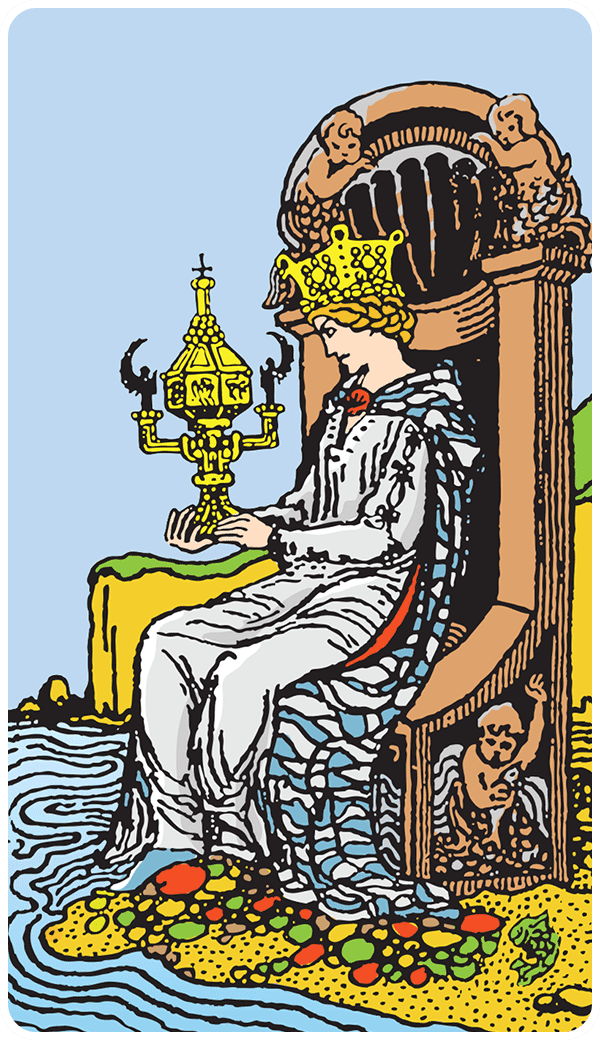
Queen of Cups · plate queen
YES
The Queen of Cups leans yes — but only when the question being asked requires emotional fluency to answer correctly. Most people read this card as permission to follow their feelings, which is exactly backward. The Queen isn't feeling her way through a decision. She's reading the emotional field around the decision and responding to what's actually there, not what she wishes were there. When someone pulls this card for a yes/no question and hears it as blanket permission, they've mistaken receptivity for indulgence.
Why Queen of Cups reads this way
What the suit, rank, and image are doing on the card
Cups governs emotional truth — not sentiment, not mood, but the part of the psyche that registers what is real between people and within yourself. The Queen of Cups is the court card of emotional discernment. She holds a closed cup and gazes at it. She is not drinking. She is not pouring. She is attending. The image shows someone who can sit with feeling without being swept by it, who can name what she's sensing in a room or a relationship without needing to fix it or flee from it. That capacity — to feel accurately and hold it steady — is what the card describes.
In a yes/no reading, most querents hear this card as "follow your heart," which collapses the Queen's skill into platitude. The Queen doesn't follow her heart. She listens to it, checks it against the external field, and then decides. The misreading happens because people want permission to do what they already want to do. The Queen of Cups feels like permission. It isn't. It's a card that says the question you're asking will be answered correctly only if you stop performing certainty and actually feel what's true.
How the answer changes depending on what you're asking
If the question is "Should I reach out to this person?" and you've been drafting texts in your head for three days, the Queen of Cups reads as yes — but only if reaching out is an act of clarity, not an act of hope. The card says the emotional truth between you is readable. If you can name what you actually want from the conversation and whether the other person has ever shown the capacity to meet it, reach out. If you're reaching out because silence feels unbearable and you're hoping contact will resolve the unbearability, the answer flips to no. The Queen doesn't move to escape discomfort. She moves when the move is clean.
If the question is "Should I leave this job / relationship / city?" and you've been numb for months, the card reads as maybe — which in a yes/no spread is closer to no. The Queen of Cups requires access to your emotional data. If you've been overriding your feelings to function, you don't have the information the card is asking you to consult. The answer isn't available yet. The yes/no question is premature. You're being told to stop and feel first, then ask again.
The tell that you're misreading the card
You pulled the Queen of Cups, heard it as yes, acted, and then spent the next week justifying the action to yourself. That's the tell. The Queen doesn't generate doubt. When you're reading the emotional field correctly and moving from that read, the action feels quiet. You don't need to explain it. You don't need to rehearse why it was right. If you're still arguing with yourself three days later, you didn't consult the Queen — you consulted what you wanted her to say and then moved anyway. The card was describing a capacity you don't have access to yet, not permission to proceed without it.
A grounded observation
Go back through your calendar and find the last time you made a decision that didn't require a justification narrative afterward. That's what the Queen of Cups feels like when you're actually listening.
Key themes to watch for
- № 01Theme
Affirmative current
- № 02Theme
Open door
- № 03Theme
Forward motion
What to do with this reading
Read the upright meaning first, even if you pulled the card reversed. The reversal is a commentary on the upright — not a separate card.
Notice what your body did when you saw Queen of Cups. That reaction is usually closer to the truth than the interpretation.
Write down one sentence: What is this card asking me to stop avoiding? Let the answer be smaller than you expect.
Come back to this card in 48 hours. Most yes / no readings sharpen with a little distance.
Questions answered
Frequently asked
The Queen of Cups leans yes — but only when the question being asked requires emotional fluency to answer correctly. Most people read this card as permission to follow their feelings, which is exactly backward. The Queen isn't feeling her way through a decision. She's reading the emotional field around the decision and responding to what's actually there, not what she wishes were there. When someone pulls this card for a yes/no question and hears it as blanket permission, they've mistaken receptivity for indulgence.
Reversed cards are rarely "bad." Queen of Cups reversed asks you to look at where the same theme is blocked, postponed, or being avoided — usually with more compassion than the upright version.
Queen of Cups colors the cards around it. Pay attention to where its themes — emotional intimacy, felt-sense knowing, where the water level is rising — show up in the next card. That is usually where the story is.
Tarot is observational, not predictive. Queen of Cups describes the conditions in front of you right now and where they tend to lead if nothing changes — not a guarantee of timing.
Repeat cards are the deck underlining a theme. With Queen of Cups, that usually means the question you are asking is the right one — but you have not yet acted on what the card is showing you.
Read next
Related readings
More Cups · Yes / No
- Ace of Cups — Yes / NoHow Ace of Cups reads in a yes / no context.
- Two of Cups — Yes / NoHow Two of Cups reads in a yes / no context.
- Three of Cups — Yes / NoHow Three of Cups reads in a yes / no context.
- Four of Cups — Yes / NoHow Four of Cups reads in a yes / no context.
- Five of Cups — Yes / NoHow Five of Cups reads in a yes / no context.
- Six of Cups — Yes / NoHow Six of Cups reads in a yes / no context.
Other Queen of Cups readings
- General MeaningQueen of Cups read for general meaning.
- Love & RelationshipsQueen of Cups read for love & relationships.
- Career & WorkQueen of Cups read for career & work.
- Money & FinanceQueen of Cups read for money & finance.
- Health & WellbeingQueen of Cups read for health & wellbeing.
- SpiritualityQueen of Cups read for spirituality.