Page of Cups in Yes / No
The Page of Cups in a yes/no reading leans 'maybe' — not because the outcome is uncertain, but because the question is being asked too early.
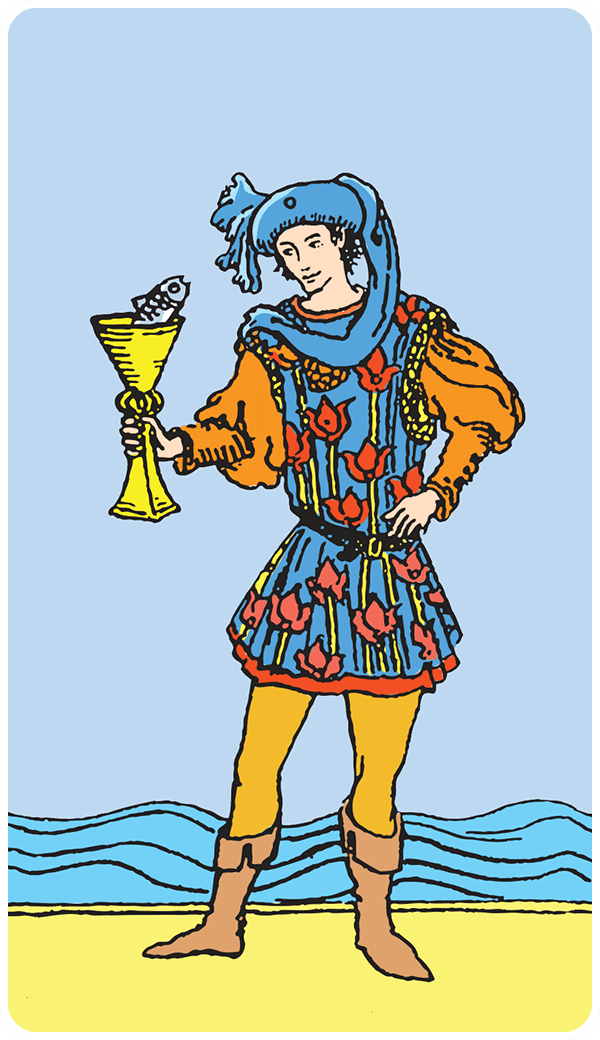
Page of Cups · plate page
MAYBE
The Page of Cups in a yes/no reading leans 'maybe' — not because the outcome is uncertain, but because the question is being asked too early. Most querents read this as a soft yes with a waiting period attached. What the card is actually saying is that the emotional infrastructure for a clear answer isn't built yet. You're asking about the harvest when the seed just went in the ground.
Why Page of Cups reads this way
What the suit, rank, and image are doing
Cups governs emotional capacity, relational chemistry, and the part of you that registers feeling as information. It's the suit of how you bond, how you soften, how you know when something matters. Pages in tarot are messengers and beginners — they mark the earliest stage of a suit's development. The Page of Cups is not emotional maturity; it's emotional curiosity. It's the first flutter of interest, the first time you let yourself wonder if something could be different, the first signal that a feeling is trying to form.
Look at the image: a young figure in ornate clothing holds a cup. A fish emerges from the cup, suspended mid-air, looking back at the Page. The Page is surprised. They weren't expecting anything to be in there. This is the mechanical heart of the card — it describes the moment a feeling announces itself before you know what to do with it. The fish is real, but it hasn't been named yet. It hasn't been decided on. The Page is still looking at it.
In a yes/no reading, people read this card as "yes, but you have to be patient." That misses the point. The card isn't describing a delay in the outcome. It's describing the stage you're in: you don't have enough information yet because the feeling or situation is too new. The yes/no frame is premature. You're asking a binary question about something that hasn't declared its shape.
How the card reads for two different querent situations
If the querent is asking about something they want to pursue — a relationship, a creative project, a move — the Page of Cups reads as "the interest is real, but you're still in the opening-the-door phase." The answer isn't no. The answer is: you won't know what this actually is for another few weeks. The card says keep the channel open and stop trying to lock it down.
If the querent is asking about something they're trying to get a read on — will this person commit, will this opportunity land, will this risk pay off — the Page of Cups reads as "they're interested, but they don't know what they're interested in yet." This is the card that shows up when someone is texting you every day but won't make plans. The feeling is present. The follow-through is not. If you need a yes/no answer right now, treat this as a no. If you can hold the ambiguity for a month, it might clarify into something.
The tell that someone is misreading the card
The tell is when the querent hears "maybe" and immediately starts performing certainty to force it into a yes. They double down. They push. They try to mature the Page of Cups by sheer will. That doesn't work. Pages ripen on their own schedule or they don't ripen at all. If you're asking yes/no and you pull the Page of Cups, the question you actually need to ask is: what would I do differently if I knew I wouldn't have a clear answer for six weeks? That's the question the card is built to answer.
A grounded observation
Go back through your texts or journal entries from the last time you were in the early days of something. Notice how many times you tried to get the other person — or yourself — to commit before the feeling had a shape. The Page of Cups is that feeling, not the commitment.
Key themes to watch for
- № 01Theme
Affirmative current
- № 02Theme
Open door
- № 03Theme
Forward motion
What to do with this reading
Read the upright meaning first, even if you pulled the card reversed. The reversal is a commentary on the upright — not a separate card.
Notice what your body did when you saw Page of Cups. That reaction is usually closer to the truth than the interpretation.
Write down one sentence: What is this card asking me to stop avoiding? Let the answer be smaller than you expect.
Come back to this card in 48 hours. Most yes / no readings sharpen with a little distance.
Questions answered
Frequently asked
The Page of Cups in a yes/no reading leans 'maybe' — not because the outcome is uncertain, but because the question is being asked too early. Most querents read this as a soft yes with a waiting period attached. What the card is actually saying is that the emotional infrastructure for a clear answer isn't built yet. You're asking about the harvest when the seed just went in the ground.
Reversed cards are rarely "bad." Page of Cups reversed asks you to look at where the same theme is blocked, postponed, or being avoided — usually with more compassion than the upright version.
Page of Cups colors the cards around it. Pay attention to where its themes — emotional intimacy, felt-sense knowing, where the water level is rising — show up in the next card. That is usually where the story is.
Tarot is observational, not predictive. Page of Cups describes the conditions in front of you right now and where they tend to lead if nothing changes — not a guarantee of timing.
Repeat cards are the deck underlining a theme. With Page of Cups, that usually means the question you are asking is the right one — but you have not yet acted on what the card is showing you.
Read next
Related readings
More Cups · Yes / No
- Ace of Cups — Yes / NoHow Ace of Cups reads in a yes / no context.
- Two of Cups — Yes / NoHow Two of Cups reads in a yes / no context.
- Three of Cups — Yes / NoHow Three of Cups reads in a yes / no context.
- Four of Cups — Yes / NoHow Four of Cups reads in a yes / no context.
- Five of Cups — Yes / NoHow Five of Cups reads in a yes / no context.
- Six of Cups — Yes / NoHow Six of Cups reads in a yes / no context.
Other Page of Cups readings
- General MeaningPage of Cups read for general meaning.
- Love & RelationshipsPage of Cups read for love & relationships.
- Career & WorkPage of Cups read for career & work.
- Money & FinancePage of Cups read for money & finance.
- Health & WellbeingPage of Cups read for health & wellbeing.
- SpiritualityPage of Cups read for spirituality.