Nine of Swords in Career
The Nine of Swords in career readings names anxiety that's already running, not a warning about what's coming. Here's what the card is actually doing.
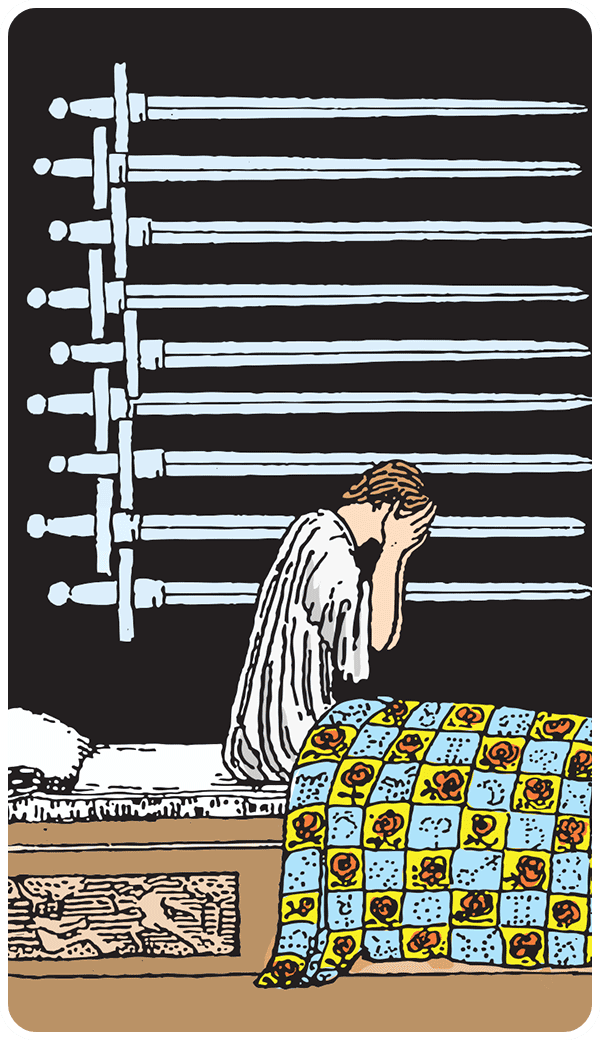
Nine of Swords · plate 9
What the card is actually doing
The Nine of Swords shows up in a career reading and the querent assumes the worst is confirmed. They think the card is telling them they're about to get fired, that the project will fail, that the risk they're considering is doomed. That is not what the card does. The Nine of Swords does not predict disaster. It names the loop you are already in — the 3 a.m. spiral, the catastrophizing, the part of your brain that rehearses failure on repeat. The card is about the thinking, not the outcome.
Reading Nine of Swords in career
What the suit, the rank, and the image are doing
Swords is the suit of thought, language, and the stories you tell yourself about what is happening. It governs analysis, judgment, the part of you that names and categorizes and decides what something means. When Swords cards dominate a reading, the question is almost always about how you are thinking about the situation, not what is objectively true about it.
Nines in tarot mark the final stage before completion — the last push, the accumulated weight, the moment right before resolution. The Nine of Swords specifically describes thought at its most exhausting: repetitive, recursive, unproductive. It is the mind eating itself.
Look at the image. A figure sits upright in bed, head in hands. Nine swords hang on the wall behind them. They are not being attacked. The swords are not moving. The figure is alone with their thoughts in the middle of the night, running the same fears on loop. This is the mechanical answer. The Nine of Swords is the card of rumination. It describes anxiety that has detached from useful planning and become its own weather system.
The most common misreading in a career context is treating the card as confirmation that the thing you're worried about will happen. If you're afraid you'll lose your job, the Nine of Swords feels like the deck is agreeing with you. It is not. It is naming the fact that you are afraid, which is a different statement.
How the card reads for two different situations
If you're in a job you hate and the Nine of Swords shows up, the card is not saying "stay" or "leave." It is saying: you have been thinking about this so hard for so long that you can no longer tell the difference between real risk and imagined catastrophe. Every option feels like failure because you've rehearsed failure in every direction. The card is naming decision paralysis, not the decision itself.
If you're about to launch something — a business, a pitch, a project — and the Nine of Swords appears, the card is not saying the thing will fail. It is saying: you are spending more time imagining failure than preparing for success. The mental rehearsal has become the work, and the work is not getting done. What you are avoiding by worrying is the next concrete step.
The tell that you're misreading the card
You're misreading the Nine of Swords if you treat it as evidence. If the card shows up and you say, "See, I knew it was a bad idea," you have mistaken the map for the territory. The card is not commenting on the quality of the idea. It is commenting on the quality of your thinking about the idea.
The other tell: you pull the card, feel validated in your anxiety, and then do nothing. The Nine of Swords is not permission to stay in the spiral. It is the deck holding up a mirror and saying: this is what you are doing right now. You can stop.
From the practice
“A card never tells you what to do. It tells you what you're already deciding — and gives you the words to name it.”
A grounded observation
Go back through the last two weeks and count how many hours you spent actively working on the thing versus how many hours you spent worrying about the thing. That ratio is what the card is naming.
Key themes to watch for
- № 01Theme
Creative purpose
- № 02Theme
Heart-led work
- № 03Theme
Right alignment
What to do with this reading
Read the upright meaning first, even if you pulled the card reversed. The reversal is a commentary on the upright — not a separate card.
Notice what your body did when you saw Nine of Swords. That reaction is usually closer to the truth than the interpretation.
Write down one sentence: What is this card asking me to stop avoiding? Let the answer be smaller than you expect.
Come back to this card in 48 hours. Most career readings sharpen with a little distance.
Questions answered
Frequently asked
The Nine of Swords in a career context shines a light on worries about your professional path. It may feel like stress over deadlines, concerns about job security, or the pressure of expectations keeping you up at night. This card suggests that while these fears are real, they might be magnified by stress. Take a moment to assess if these are fears you can address directly or if they're whispering doubts that need quieting. The invitation here is to reflect on what truly weighs on your mind and consider small, manageable steps toward resolution.
In career matters, the reversed Nine of Swords suggests a shift from despair to hope. It's the calm after a storm of workplace stress or anxiety. Perhaps you’ve recently resolved a conflict or found a solution to an ongoing problem. This card indicates a period of recovery and learning from past mistakes. But it also serves as a reminder not to slip back into old habits. Consider what strategies helped lift you out of worry and how they might continue to be useful. The card hints at resilience built through recent trials.
Nine of Swords colors the cards around it. Pay attention to where its themes — mental clarity, the truth being named, what the mind needs to release — show up in the next card. That is usually where the story is.
Tarot is observational, not predictive. Nine of Swords describes the conditions in front of you right now and where they tend to lead if nothing changes — not a guarantee of timing.
Repeat cards are the deck underlining a theme. With Nine of Swords, that usually means the question you are asking is the right one — but you have not yet acted on what the card is showing you.
Read next
Related readings
More Swords · Career
- Ace of Swords — CareerHow Ace of Swords reads in a career context.
- Two of Swords — CareerHow Two of Swords reads in a career context.
- Three of Swords — CareerHow Three of Swords reads in a career context.
- Four of Swords — CareerHow Four of Swords reads in a career context.
- Five of Swords — CareerHow Five of Swords reads in a career context.
- Six of Swords — CareerHow Six of Swords reads in a career context.
Other Nine of Swords readings
- General MeaningNine of Swords read for general meaning.
- Love & RelationshipsNine of Swords read for love & relationships.
- Money & FinanceNine of Swords read for money & finance.
- Health & WellbeingNine of Swords read for health & wellbeing.
- SpiritualityNine of Swords read for spirituality.
- Yes / No AnswerNine of Swords read for yes / no answer.