Nine of Cups in Yes / No
The Nine of Cups reads as yes in a yes/no question, but only when the querent already has what they need. Here's what the card is actually measuring.
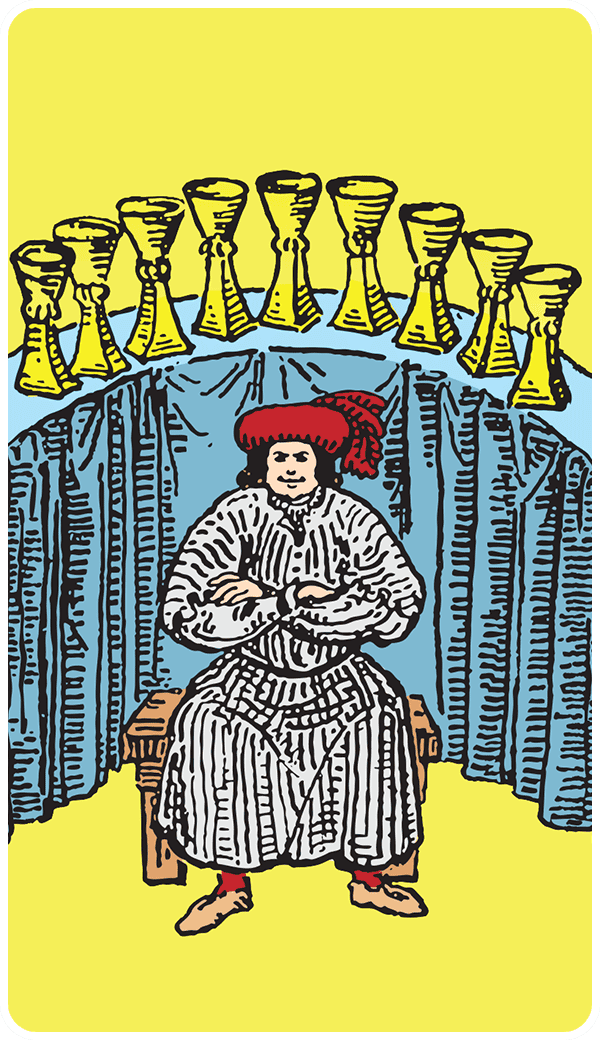
Nine of Cups · plate 9
YES
The Nine of Cups is a yes. But it's a yes with a condition most people miss: the card only confirms what you already have the resources to complete. If you're asking whether something external will arrive to solve the question, the answer flips. The Nine of Cups describes satisfaction that comes from internal alignment, not from a door opening. When people read it as a blanket yes, they're waiting for permission that was never required.
Why Nine of Cups reads this way
What the suit, rank, and image are doing
Cups governs emotional states, relational bonds, and the part of the psyche that registers fulfillment as a felt sense in the body. It's not the suit of action or material result — it's the suit of how something lands internally. The Nine is the penultimate card in the suit, the moment before completion where all the cups are gathered and full. It describes a state of having enough. Not everything, but enough.
Look at the image. A figure sits with arms crossed, nine cups arranged in an arc behind them. The posture is satisfied, almost smug. The cups are already there. They are not being handed to the figure. They are not arriving in the mail. The figure is surrounded by what they have already accumulated, and the card names the moment they recognize it as sufficient.
The most common misreading in a yes/no context is treating this card as a promise that the thing you want is coming. It is not. The Nine of Cups says the resources for a yes are already in place. If you're asking "will I get the job," and the Nine of Cups appears, the card is not saying the offer is in the mail. It's saying you already have the skill set, the network, the presentation — the yes depends on whether you act on what you already hold. If you're waiting for something external to shift the answer from no to yes, you're misreading the card.
How the answer changes depending on what you're asking
If the question is "should I proceed with this," and you already have clarity, resources, and internal alignment, the Nine of Cups is an unambiguous yes. The card confirms that the emotional and relational conditions are met. You are not waiting on anyone else's approval. You are not missing a piece.
If the question is "will they reach out," or "will the funding come through," or "will this external condition change," the Nine of Cups does not answer that. It answers whether you are emotionally positioned to handle the outcome, not whether the outcome will shift. In those cases, the card reads more like a maybe — yes if you stop waiting, no if you're counting on someone else to move first.
Reversed, the Nine of Cups describes the gap between what you have and what you think you need. The cups are still there, but the figure has turned away from them. The answer is no if you're asking from a place of lack. It's yes if you're asking whether you've been ignoring what's already available.
The tell that you're misreading the card
If you pull the Nine of Cups as a yes and then spend the next two weeks checking your phone, refreshing your email, or asking follow-up questions about timing, you misread it. The card does not describe waiting. It describes recognizing that the condition for yes is already true. If the yes requires someone else to act first, the Nine of Cups is the wrong card to be reading as confirmation. Go back and look at what you actually asked, and whether the question was about your state or someone else's decision.
A grounded observation
The Nine of Cups will show up in a yes/no reading the week you stop asking the question. Not because the external situation changed, but because you finally registered that you already had what you needed to proceed.
Key themes to watch for
- № 01Theme
Affirmative current
- № 02Theme
Open door
- № 03Theme
Forward motion
What to do with this reading
Read the upright meaning first, even if you pulled the card reversed. The reversal is a commentary on the upright — not a separate card.
Notice what your body did when you saw Nine of Cups. That reaction is usually closer to the truth than the interpretation.
Write down one sentence: What is this card asking me to stop avoiding? Let the answer be smaller than you expect.
Come back to this card in 48 hours. Most yes / no readings sharpen with a little distance.
Questions answered
Frequently asked
The Nine of Cups is a yes. But it's a yes with a condition most people miss: the card only confirms what you already have the resources to complete. If you're asking whether something external will arrive to solve the question, the answer flips. The Nine of Cups describes satisfaction that comes from internal alignment, not from a door opening. When people read it as a blanket yes, they're waiting for permission that was never required.
Reversed cards are rarely "bad." Nine of Cups reversed asks you to look at where the same theme is blocked, postponed, or being avoided — usually with more compassion than the upright version.
Nine of Cups colors the cards around it. Pay attention to where its themes — emotional intimacy, felt-sense knowing, where the water level is rising — show up in the next card. That is usually where the story is.
Tarot is observational, not predictive. Nine of Cups describes the conditions in front of you right now and where they tend to lead if nothing changes — not a guarantee of timing.
Repeat cards are the deck underlining a theme. With Nine of Cups, that usually means the question you are asking is the right one — but you have not yet acted on what the card is showing you.
Read next
Related readings
More Cups · Yes / No
- Ace of Cups — Yes / NoHow Ace of Cups reads in a yes / no context.
- Two of Cups — Yes / NoHow Two of Cups reads in a yes / no context.
- Three of Cups — Yes / NoHow Three of Cups reads in a yes / no context.
- Four of Cups — Yes / NoHow Four of Cups reads in a yes / no context.
- Five of Cups — Yes / NoHow Five of Cups reads in a yes / no context.
- Six of Cups — Yes / NoHow Six of Cups reads in a yes / no context.
Other Nine of Cups readings
- General MeaningNine of Cups read for general meaning.
- Love & RelationshipsNine of Cups read for love & relationships.
- Career & WorkNine of Cups read for career & work.
- Money & FinanceNine of Cups read for money & finance.
- Health & WellbeingNine of Cups read for health & wellbeing.
- SpiritualityNine of Cups read for spirituality.