Knight of Swords in Career
The Knight of Swords in career readings gets read as ambition and speed. What it actually describes is the moment you stop consulting and start cutting.
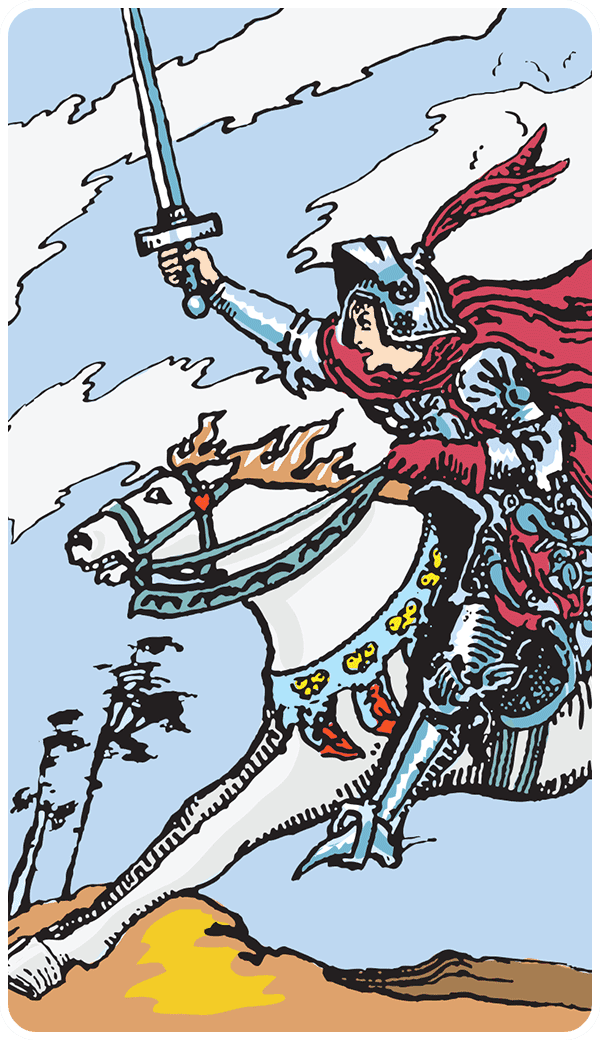
Knight of Swords · plate knight
What the card is actually doing
The Knight of Swords shows up in a career reading and the querent already knows what they think it means. They've decided it's about momentum, about finally making the move they've been planning, about speed and confidence and forward motion. They want me to confirm that the promotion is coming or the launch will go well or the job offer is imminent. That is not what the card is describing. The Knight of Swords is not about success. It is about the specific mental state that precedes a high-speed decision — and whether that state is appropriate for the situation you are actually in.
Reading Knight of Swords in career
What the suit, the rank, and the image are each doing
Swords is the suit of thought, analysis, and the cut of a decision. It governs how you think through a problem, what logic you apply, and how you separate signal from noise. When Swords cards dominate a reading, the question is almost always about clarity, strategy, or the moment a choice has to be made even when the data is incomplete.
Knights in tarot are movement cards. They describe a mode of action that is already in motion — not the plan, not the outcome, but the manner in which energy is currently moving through a situation. The Knight of Pentacles moves slowly and tests the ground. The Knight of Cups moves toward feeling. The Knight of Swords moves fast, in a straight line, with the sword forward.
Now look at the image. A figure on horseback charges forward at full speed. The sword is raised. The clouds are turbulent. The horse's front legs are off the ground. There is no hesitation in the posture, no looking back, no consulting. The decision has already been made and the body is executing it. This is the mechanical answer to what the card is. The Knight of Swords describes the moment you stop deliberating and commit to a single course of action at speed, often before all the information is in.
How the card reads differently depending on what the querent is actually doing
If the querent has been stuck in analysis paralysis — circling the same decision for months, gathering more data, asking for more opinions, waiting for certainty that will not come — the Knight of Swords reads as the necessary cut. It is the moment they finally pick a direction and move. The card is not promising the direction is correct. It is naming the shift from thinking to doing, and in that context the shift is overdue. The turbulence is acceptable because staying still was worse.
If the querent is already moving fast — already committed, already executing, already in the middle of a launch or a confrontation or a job change — the Knight of Swords reads as a warning about what is not being considered. It describes the blind spot that speed creates. The card is naming the thing you are about to crash into because you did not slow down long enough to see it. In this context, the Knight of Swords is not advice. It is a description of what is already happening, and the turbulence is the cost.
The tell that someone is misreading the card on themselves
The tell is when the querent reads the Knight of Swords and immediately starts talking about what they are going to do next week. They have turned the card into a green light. They have decided it means their plan is correct and the universe is endorsing it. That is not what the card does. The Knight of Swords does not evaluate your plan. It describes the mental state you are in while executing it — the speed, the certainty, the lack of peripheral vision. If you are reading the card and your first instinct is to move faster, you are misreading it. The card is naming the speed, not recommending it.
From the practice
“A card never tells you what to do. It tells you what you're already deciding — and gives you the words to name it.”
A grounded observation
Go back through your calendar and look at the last time you made a decision in under 48 hours. Notice what you did not ask, who you did not consult, and what information you decided you did not need. That is what the Knight of Swords describes.
Key themes to watch for
- № 01Theme
Creative purpose
- № 02Theme
Heart-led work
- № 03Theme
Right alignment
What to do with this reading
Read the upright meaning first, even if you pulled the card reversed. The reversal is a commentary on the upright — not a separate card.
Notice what your body did when you saw Knight of Swords. That reaction is usually closer to the truth than the interpretation.
Write down one sentence: What is this card asking me to stop avoiding? Let the answer be smaller than you expect.
Come back to this card in 48 hours. Most career readings sharpen with a little distance.
Questions answered
Frequently asked
The Knight of Swords in a career context signals a period of dynamic action and strategic initiatives. You might be feeling particularly driven, with clear goals and a plan to achieve them. This is a time to harness your intellectual prowess and decisively tackle challenges. However, in the rush to succeed, details might be overlooked. Consider the broader implications of your actions, ensuring that your ambition is aligned with long-term objectives. Notice how your focus and determination are shaping your professional path.
Reversed, the Knight of Swords in career matters suggests a scattergun approach, where efforts might be misdirected. There could be a sense of restlessness or urgency that lacks clear purpose. You might be chasing goals without a solid plan, leading to potential missteps. This card invites you to reassess your strategies and priorities, ensuring that your actions are purposeful rather than reactive. Allow yourself the time to plan carefully, bringing focus to your ambitions.
Knight of Swords colors the cards around it. Pay attention to where its themes — mental clarity, the truth being named, what the mind needs to release — show up in the next card. That is usually where the story is.
Tarot is observational, not predictive. Knight of Swords describes the conditions in front of you right now and where they tend to lead if nothing changes — not a guarantee of timing.
Repeat cards are the deck underlining a theme. With Knight of Swords, that usually means the question you are asking is the right one — but you have not yet acted on what the card is showing you.
Read next
Related readings
More Swords · Career
- Ace of Swords — CareerHow Ace of Swords reads in a career context.
- Two of Swords — CareerHow Two of Swords reads in a career context.
- Three of Swords — CareerHow Three of Swords reads in a career context.
- Four of Swords — CareerHow Four of Swords reads in a career context.
- Five of Swords — CareerHow Five of Swords reads in a career context.
- Six of Swords — CareerHow Six of Swords reads in a career context.
Other Knight of Swords readings
- General MeaningKnight of Swords read for general meaning.
- Love & RelationshipsKnight of Swords read for love & relationships.
- Money & FinanceKnight of Swords read for money & finance.
- Health & WellbeingKnight of Swords read for health & wellbeing.
- SpiritualityKnight of Swords read for spirituality.
- Yes / No AnswerKnight of Swords read for yes / no answer.