Knight of Cups in Yes / No
The Knight of Cups leans yes in yes/no readings, but only when the question allows for idealization. Here's what the card is actually measuring.
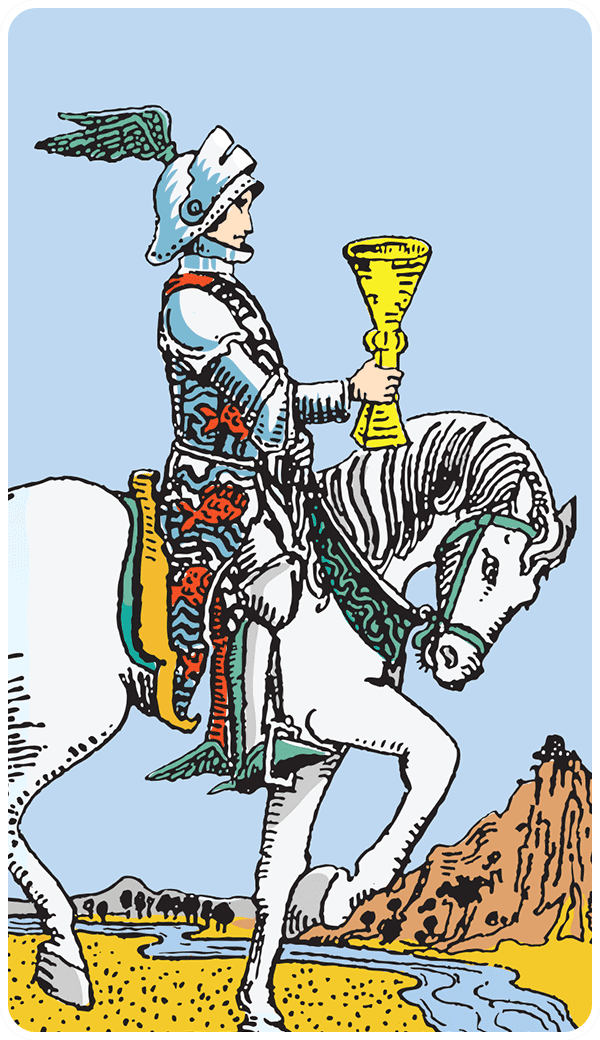
Knight of Cups · plate knight
YES
The Knight of Cups leans yes, but it is a yes wrapped in gauze. The card does not describe momentum or certainty. It describes the moment someone decides they want something enough to move toward it — before they've checked whether the thing they want is actually there. In a yes/no reading, this card answers the question 'will I feel compelled to act?' not 'will the thing work out?' Most querents hear yes and stop listening. That's the misread.
Why Knight of Cups reads this way
What the suit, rank, and image are doing on the card
Cups governs emotional reality — how you feel, what you're drawn to, what registers as meaningful or tender or worth protecting. Knights are motion cards. They describe someone in the act of moving toward something, carrying the energy of their suit with them. The Knight of Cups is emotional motion: pursuit driven by feeling, not by strategy or evidence.
Look at the image. A knight on a white horse, holding a cup, moving slowly across flat land. He is not charging. He is not racing toward a visible destination. He is proceeding as if the destination is guaranteed, as if the cup he carries contains something precious that only he can see. The horse's gait is a walk, not a gallop. This is someone moving because the feeling of moving feels right, not because the map says to.
In a yes/no reading, people want this card to mean 'yes, the thing you want is coming.' What it actually says is 'yes, you will move toward it.' Whether it meets you halfway is not on this card. The Knight of Cups measures your willingness to idealize and pursue. It does not measure the solidity of what you're pursuing.
How the answer changes depending on what you're asking
If the question is 'should I reach out to this person?' or 'will I feel ready to try again?' — the answer is yes. The card describes emotional readiness, the interior green light that says 'I can handle this now.' It is often correct in those cases because the question is about your own state, not about another person's response.
If the question is 'will this person come back?' or 'will this job offer come through?' — the answer is maybe, leaning no. The Knight of Cups describes your hope and your willingness to move toward the thing. It does not describe the thing moving toward you. I have watched this card show up for querents who spent six months writing letters to someone who never wrote back. The card was not wrong. They did pursue. The pursuit just didn't land.
Reversed, the Knight of Cups often means the emotional momentum has stalled or soured. The querent wanted to want it, and now they don't. The answer becomes no, but it's a no that comes from inside the querent, not from external blockage.
The tell that you're misreading it on yourself
You drew the Knight of Cups, read it as yes, and then spent three weeks imagining how the other person will respond instead of noticing whether they've responded. You built the outcome in your head and started living in it before anything actually moved. That's the tell. The Knight of Cups gives you permission to feel and to move. It does not give you a guarantee that the feeling is mutual or that the movement will be met. If you are using this card to avoid checking the evidence, you are misreading it.
A grounded observation
Go back through your texts and see whether you initiated every conversation in the last month. That's the gap between what the Knight of Cups describes and what you wanted it to mean.
Key themes to watch for
- № 01Theme
Affirmative current
- № 02Theme
Open door
- № 03Theme
Forward motion
What to do with this reading
Read the upright meaning first, even if you pulled the card reversed. The reversal is a commentary on the upright — not a separate card.
Notice what your body did when you saw Knight of Cups. That reaction is usually closer to the truth than the interpretation.
Write down one sentence: What is this card asking me to stop avoiding? Let the answer be smaller than you expect.
Come back to this card in 48 hours. Most yes / no readings sharpen with a little distance.
Questions answered
Frequently asked
The Knight of Cups leans yes, but it is a yes wrapped in gauze. The card does not describe momentum or certainty. It describes the moment someone decides they want something enough to move toward it — before they've checked whether the thing they want is actually there. In a yes/no reading, this card answers the question 'will I feel compelled to act?' not 'will the thing work out?' Most querents hear yes and stop listening. That's the misread.
Reversed cards are rarely "bad." Knight of Cups reversed asks you to look at where the same theme is blocked, postponed, or being avoided — usually with more compassion than the upright version.
Knight of Cups colors the cards around it. Pay attention to where its themes — emotional intimacy, felt-sense knowing, where the water level is rising — show up in the next card. That is usually where the story is.
Tarot is observational, not predictive. Knight of Cups describes the conditions in front of you right now and where they tend to lead if nothing changes — not a guarantee of timing.
Repeat cards are the deck underlining a theme. With Knight of Cups, that usually means the question you are asking is the right one — but you have not yet acted on what the card is showing you.
Read next
Related readings
More Cups · Yes / No
- Ace of Cups — Yes / NoHow Ace of Cups reads in a yes / no context.
- Two of Cups — Yes / NoHow Two of Cups reads in a yes / no context.
- Three of Cups — Yes / NoHow Three of Cups reads in a yes / no context.
- Four of Cups — Yes / NoHow Four of Cups reads in a yes / no context.
- Five of Cups — Yes / NoHow Five of Cups reads in a yes / no context.
- Six of Cups — Yes / NoHow Six of Cups reads in a yes / no context.
Other Knight of Cups readings
- General MeaningKnight of Cups read for general meaning.
- Love & RelationshipsKnight of Cups read for love & relationships.
- Career & WorkKnight of Cups read for career & work.
- Money & FinanceKnight of Cups read for money & finance.
- Health & WellbeingKnight of Cups read for health & wellbeing.
- SpiritualityKnight of Cups read for spirituality.