King of Cups in Yes / No
The King of Cups in yes/no readings leans yes—but only if you're asking from clarity, not need. Here's what the card is actually measuring.
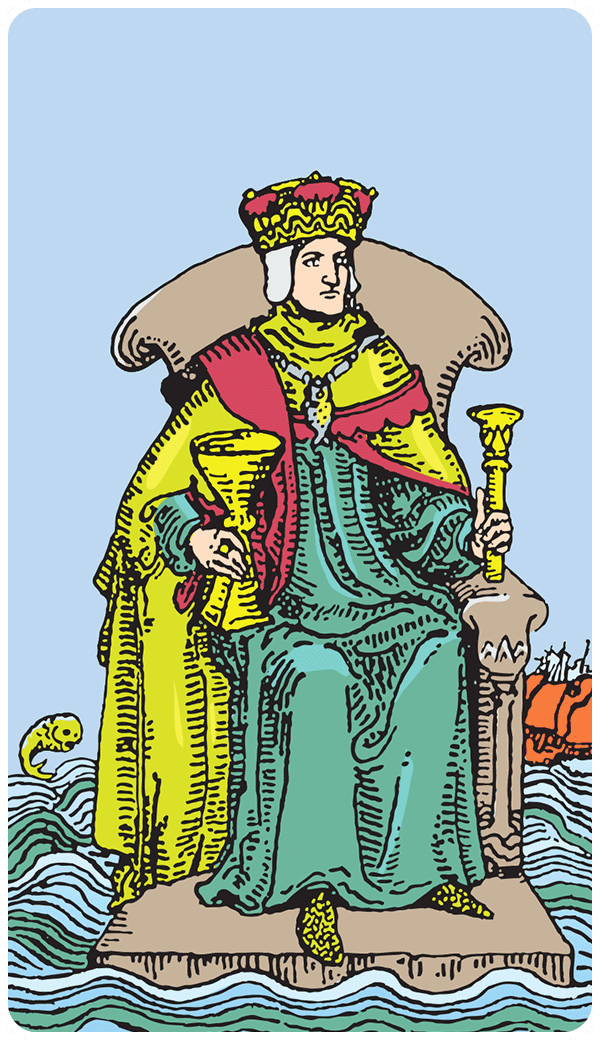
King of Cups · plate king
MAYBE
The King of Cups leans yes, but it is not answering the question you asked. It is answering the question behind the question: are you asking from a centered place or from a place of emotional desperation? Most people pull this card hoping for permission. What they get instead is a mirror. The King of Cups says yes when the querent has already done the emotional work to hold the answer steady. It says no—or more accurately, not yet—when the question itself is a plea for someone else to regulate what the querent hasn't regulated in themselves.
Why King of Cups reads this way
What the suit, rank, and image are doing
Cups governs feeling, attachment, and the relational channel between self and other. It is the suit of how emotion moves through you and whether that movement destabilizes or clarifies. Kings in tarot are figures of mastery and containment. They have lived the full arc of their suit and learned how to hold its energy without being ruled by it. The King of Pentacles has built something that lasts. The King of Swords has sharpened discernment into a tool. The King of Cups has learned to feel everything and be moved by none of it.
Look at the image. A figure sits on a throne in the middle of choppy water. The sea is turbulent. The throne does not move. He holds the cup but does not drink from it. He is not repressing emotion—the water is right there, he is surrounded by it—but he is not swept by it either. This is the mechanical center of the card: emotional steadiness in the presence of emotional weather. The King of Cups describes the ability to feel what you feel and still choose what you do.
The most common misreading in a yes/no context is to treat this card as a green light because it "feels good." It does not feel good. It feels calm. Calm is not the same as encouragement. The King of Cups is not telling you the outcome will be pleasant. It is asking whether you can hold your center if the outcome is not what you want.
How the card reads for two different querent situations
If the querent is asking a yes/no question and they have already spent weeks or months processing their feelings about it—if they have cried, journaled, talked it through, and arrived at a place where they can genuinely accept either answer—the King of Cups reads as yes. The card is confirming that they are in the right emotional position to move forward. The steadiness is there. The question has been earned.
If the querent is asking because they are anxious, because they need the universe to tell them what to do, because they are hoping tarot will override the part of them that already knows the answer is no—the King of Cups reads as not yet. The card is not punishing them. It is showing them what is missing. You cannot ask a clean yes/no question from an emotionally flooded place. The answer you get will be the answer your nervous system needs in that moment, not the answer that serves you three months from now.
The tell that someone is misreading the card on themselves
The tell is relief. If you pull the King of Cups in a yes/no reading and your first feeling is relief—"Oh good, I can do the thing"—you have misread it. Relief means you were holding tension. The King of Cups does not arrive to release tension. It arrives to name whether you have already released it. If you feel relief, the card is actually asking you to go back and do more emotional work before you act. If you feel nothing in particular—if the answer lands neutral, like of course—then the King of Cups has confirmed what you already knew.
A grounded observation
Go back through your texts or journal entries from the week before you asked the question. If you were still trying to convince yourself of the answer, the King of Cups is a no. If you had stopped trying to convince yourself, it's a yes.
Key themes to watch for
- № 01Theme
Affirmative current
- № 02Theme
Open door
- № 03Theme
Forward motion
What to do with this reading
Read the upright meaning first, even if you pulled the card reversed. The reversal is a commentary on the upright — not a separate card.
Notice what your body did when you saw King of Cups. That reaction is usually closer to the truth than the interpretation.
Write down one sentence: What is this card asking me to stop avoiding? Let the answer be smaller than you expect.
Come back to this card in 48 hours. Most yes / no readings sharpen with a little distance.
Questions answered
Frequently asked
The King of Cups leans yes, but it is not answering the question you asked. It is answering the question behind the question: are you asking from a centered place or from a place of emotional desperation? Most people pull this card hoping for permission. What they get instead is a mirror. The King of Cups says yes when the querent has already done the emotional work to hold the answer steady. It says no—or more accurately, not yet—when the question itself is a plea for someone else to regulate what the querent hasn't regulated in themselves.
Reversed cards are rarely "bad." King of Cups reversed asks you to look at where the same theme is blocked, postponed, or being avoided — usually with more compassion than the upright version.
King of Cups colors the cards around it. Pay attention to where its themes — emotional intimacy, felt-sense knowing, where the water level is rising — show up in the next card. That is usually where the story is.
Tarot is observational, not predictive. King of Cups describes the conditions in front of you right now and where they tend to lead if nothing changes — not a guarantee of timing.
Repeat cards are the deck underlining a theme. With King of Cups, that usually means the question you are asking is the right one — but you have not yet acted on what the card is showing you.
Read next
Related readings
More Cups · Yes / No
- Ace of Cups — Yes / NoHow Ace of Cups reads in a yes / no context.
- Two of Cups — Yes / NoHow Two of Cups reads in a yes / no context.
- Three of Cups — Yes / NoHow Three of Cups reads in a yes / no context.
- Four of Cups — Yes / NoHow Four of Cups reads in a yes / no context.
- Five of Cups — Yes / NoHow Five of Cups reads in a yes / no context.
- Six of Cups — Yes / NoHow Six of Cups reads in a yes / no context.
Other King of Cups readings
- General MeaningKing of Cups read for general meaning.
- Love & RelationshipsKing of Cups read for love & relationships.
- Career & WorkKing of Cups read for career & work.
- Money & FinanceKing of Cups read for money & finance.
- Health & WellbeingKing of Cups read for health & wellbeing.
- SpiritualityKing of Cups read for spirituality.