Eight of Cups in Yes / No
The Eight of Cups in a yes/no reading leans no — but only if you're asking about staying. Here's what the card is actually measuring.
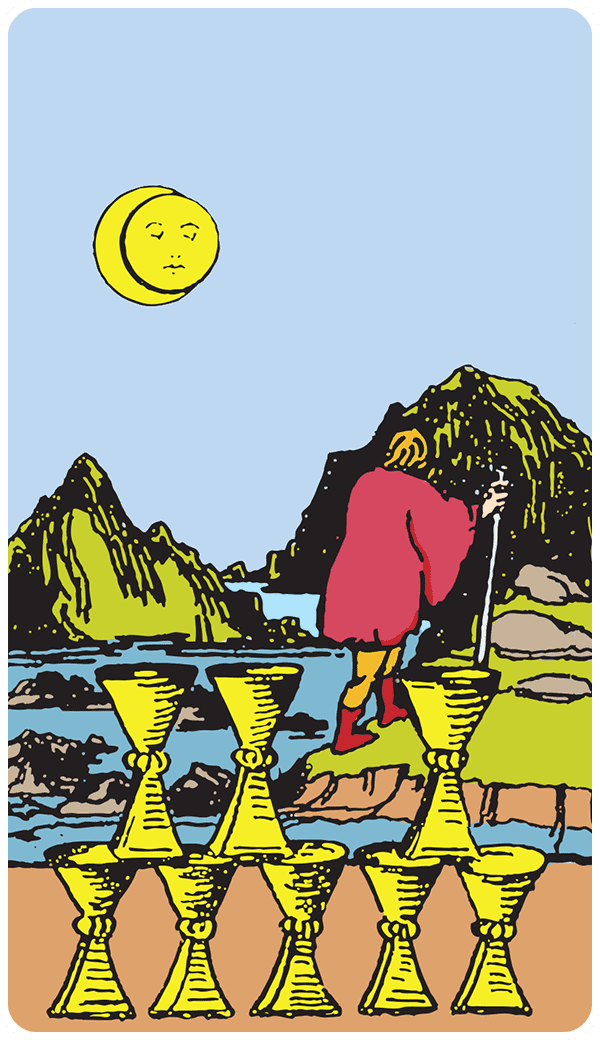
Eight of Cups · plate 8
NO
The Eight of Cups in a yes/no reading leans no. But that answer only holds if the question you're asking is some version of "should I stay." If you're asking "should I leave," the card flips to yes. The confusion happens because people treat the Eight of Cups as a mood card — sadness, disappointment, walking away from something that didn't work out. They read it as emotional and therefore subjective. It is not. The Eight of Cups describes a specific mechanical state: the moment you realize the thing you're asking about has already stopped feeding you, and continuing to invest in it is now a choice you're making against evidence.
Why Eight of Cups reads this way
What the suit, rank, and image are doing
Cups governs emotional investment — where you place your care, what you bond to, what you keep returning to because it once felt nourishing. The Eight is the rank of accumulation and assessment. You have built something, gathered something, invested time and feeling into something, and now you are standing in front of what you built, looking at it. The image shows a figure walking away from eight stacked cups toward a mountain range. The cups are intact. Nothing is broken. The figure is not running. This is not crisis. This is the moment after you finally admit that what you have is not what you need, and that staying will cost you more than leaving.
The most common misreading in a yes/no context is treating the Eight of Cups as a veto — the card that says "no, don't do the thing, you'll regret it." People see the figure walking away and read it as loss, as failure, as the card warning them not to make a mistake. That is backwards. The Eight of Cups is not the mistake. The Eight of Cups is the correction. The card is describing the moment you stop pretending the eight cups are enough. If you are asking "should I stay in this job / relationship / city / plan," and the Eight of Cups shows up, the card is answering a question you did not ask out loud: "Am I still here because it's working, or because I'm afraid to admit it stopped working six months ago?"
How the card reads for two different querent situations
If the querent is asking about pursuing something new — "should I apply for this job, should I ask this person out, should I start this project" — and the Eight of Cups appears, the answer is maybe, but only if the new thing is a genuine departure from the pattern the querent has been repeating. The card is not commenting on the new opportunity. It is commenting on whether the querent has actually finished with the old one. If they are still emotionally tethered to the last job, the last person, the last plan, the Eight of Cups is saying: not yet. You will bring the old cups with you.
If the querent is asking about leaving something — "should I quit, should I end this, should I move" — the Eight of Cups is a clean yes, with one condition: the querent has to mean it. The card does not appear for people who are testing the idea of leaving. It appears for people who have already left internally and are now asking permission to make it external. The tell is in the phrasing. If the question is "should I leave," the Eight of Cups says yes. If the question is "is it okay to leave," the querent is still negotiating with guilt, and the card is naming that negotiation, not resolving it.
The tell that someone is misreading the card on themselves
The querent reads the Eight of Cups as the card telling them they are being too negative, too quick to give up, not grateful enough for what they have. They treat the figure walking away as the problem, not the solution. The tell is when they start defending the eight cups. "It's not that bad." "Other people have it worse." "Maybe I'm just not trying hard enough." The Eight of Cups does not ask you to try harder. It asks you to notice that you have already been trying, and that the trying has not changed the outcome. The card is not a judgment. It is a measurement. When it shows up in a yes/no reading, it is measuring whether the thing you are asking about is still alive, or whether you are standing next to something that stopped moving and calling it a relationship.
A grounded observation
Go back through your calendar and look for the moment you stopped talking about the thing you're asking about with excitement and started talking about it with proof that it's fine. That is when the Eight of Cups became true.
Key themes to watch for
- № 01Theme
Affirmative current
- № 02Theme
Open door
- № 03Theme
Forward motion
What to do with this reading
Read the upright meaning first, even if you pulled the card reversed. The reversal is a commentary on the upright — not a separate card.
Notice what your body did when you saw Eight of Cups. That reaction is usually closer to the truth than the interpretation.
Write down one sentence: What is this card asking me to stop avoiding? Let the answer be smaller than you expect.
Come back to this card in 48 hours. Most yes / no readings sharpen with a little distance.
Questions answered
Frequently asked
The Eight of Cups in a yes/no reading leans no. But that answer only holds if the question you're asking is some version of "should I stay." If you're asking "should I leave," the card flips to yes. The confusion happens because people treat the Eight of Cups as a mood card — sadness, disappointment, walking away from something that didn't work out. They read it as emotional and therefore subjective. It is not. The Eight of Cups describes a specific mechanical state: the moment you realize the thing you're asking about has already stopped feeding you, and continuing to invest in it is now a choice you're making against evidence.
Reversed cards are rarely "bad." Eight of Cups reversed asks you to look at where the same theme is blocked, postponed, or being avoided — usually with more compassion than the upright version.
Eight of Cups colors the cards around it. Pay attention to where its themes — emotional intimacy, felt-sense knowing, where the water level is rising — show up in the next card. That is usually where the story is.
Tarot is observational, not predictive. Eight of Cups describes the conditions in front of you right now and where they tend to lead if nothing changes — not a guarantee of timing.
Repeat cards are the deck underlining a theme. With Eight of Cups, that usually means the question you are asking is the right one — but you have not yet acted on what the card is showing you.
Read next
Related readings
More Cups · Yes / No
- Ace of Cups — Yes / NoHow Ace of Cups reads in a yes / no context.
- Two of Cups — Yes / NoHow Two of Cups reads in a yes / no context.
- Three of Cups — Yes / NoHow Three of Cups reads in a yes / no context.
- Four of Cups — Yes / NoHow Four of Cups reads in a yes / no context.
- Five of Cups — Yes / NoHow Five of Cups reads in a yes / no context.
- Six of Cups — Yes / NoHow Six of Cups reads in a yes / no context.
Other Eight of Cups readings
- General MeaningEight of Cups read for general meaning.
- Love & RelationshipsEight of Cups read for love & relationships.
- Career & WorkEight of Cups read for career & work.
- Money & FinanceEight of Cups read for money & finance.
- Health & WellbeingEight of Cups read for health & wellbeing.
- SpiritualityEight of Cups read for spirituality.