Three of Cups in Money
The Three of Cups in a finance reading gets read as shared abundance, but it's naming a specific relational dynamic around money — not the money itself.
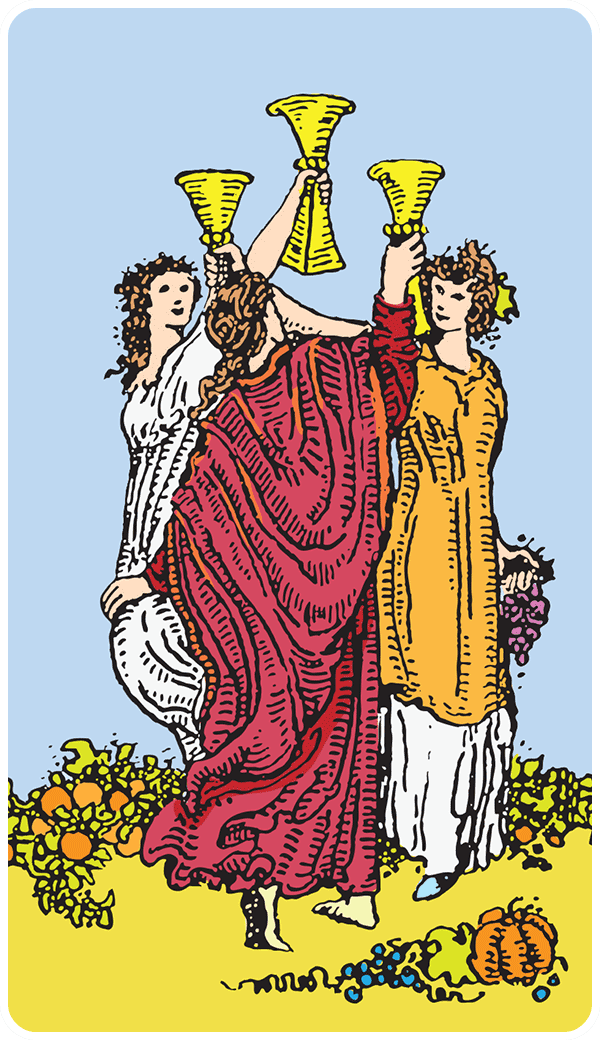
Three of Cups · plate 3
What the card is actually doing
The Three of Cups shows up in a finance reading and the querent assumes it means money is coming through celebration, collaboration, or group success. They think it's describing a bonus from a team project, a profitable partnership, or shared resources flowing easily. That's not what the card is doing. The Three of Cups describes the emotional structure around money — who you're emotionally invested in financially, and how that investment is shaping your material decisions — not the state of your account.
Reading Three of Cups in money
What the suit, the rank, and the image are each doing
Cups governs emotional investment, attachment, and where your heart has a stake. In a finance reading, Cups cards don't describe cash flow or material strategy — they describe what you feel about the money, who the money connects you to, and how emotional bonding is driving financial choices. When Cups dominate a money question, the real question is always relational.
Threes in tarot describe a triangle. Two forces have met, and a third element has emerged from that meeting — a collaboration, a complication, a shared outcome that wouldn't exist if either party were alone. Threes are inherently social. They describe what gets created when you stop operating solo.
The image shows three figures raising cups in a toast. They're celebrating something together. The mood is joy, but the structure is mutual — all three are participating, all three have a stake, all three are holding something. This is the card's mechanical claim: your financial situation is currently tied to a group dynamic, and the emotional experience of that dynamic is pleasant enough that you're not examining the material terms.
How this reads for two different querent situations
If the querent is asking whether a business partnership or joint financial venture will work, the Three of Cups is naming the part that's already working — the relational chemistry, the shared enthusiasm, the fact that everyone likes each other. What it's not naming is whether the financial structure underneath that chemistry is sound. I've watched this card show up for a querent six weeks before they realized their business partner had been covering expenses out of pocket because the revenue model didn't work. The friendship was real. The celebration was real. The business was not profitable.
If the querent is asking about their own spending or financial state, the Three of Cups usually points to money flowing out through social ties — group dinners, shared trips, covering a friend's rent, buying rounds. The querent feels good about it in the moment because the emotional return is high. But when they look at their account three months later, they can't explain where the money went. It dissolved into the group.
The tell that someone is misreading the card on themselves
The tell is when the querent describes their financial situation as "abundant" or "supported" but can't name a single concrete number. They say the collaboration is going well, but they haven't looked at the shared expenses spreadsheet. They say they feel generous, but they haven't checked whether they can afford to be. The Three of Cups makes the emotional experience feel like evidence of financial health, and it almost never is. The card is naming what you're enjoying, not what you're building.
From the practice
“A card never tells you what to do. It tells you what you're already deciding — and gives you the words to name it.”
A grounded observation
Go back through your bank statement and highlight every transaction that involved another person. If the total surprises you, the Three of Cups was describing that gap.
Key themes to watch for
- № 01Theme
Non-material wealth
- № 02Theme
Generosity
- № 03Theme
Values check
What to do with this reading
Read the upright meaning first, even if you pulled the card reversed. The reversal is a commentary on the upright — not a separate card.
Notice what your body did when you saw Three of Cups. That reaction is usually closer to the truth than the interpretation.
Write down one sentence: What is this card asking me to stop avoiding? Let the answer be smaller than you expect.
Come back to this card in 48 hours. Most money readings sharpen with a little distance.
Questions answered
Frequently asked
Financially, the Three of Cups suggests stability through community support. It could mean pooling resources with others for a common goal or benefiting from shared knowledge. This card emphasizes the positive impact of collaborative efforts on your financial situation. Reflect on how you can leverage your network to enhance your financial well-being. It's an invitation to explore opportunities where shared financial interests can yield fruitful outcomes.
Reversed, the Three of Cups might indicate financial strain due to overspending on social activities or peer pressure. It's a reminder to reassess where your money is going and whether it truly supports your priorities. Consider setting boundaries on shared expenses and focusing more on personal financial goals. Reflect on the balance between enjoying social life and maintaining financial health.
Three of Cups colors the cards around it. Pay attention to where its themes — emotional intimacy, felt-sense knowing, where the water level is rising — show up in the next card. That is usually where the story is.
Tarot is observational, not predictive. Three of Cups describes the conditions in front of you right now and where they tend to lead if nothing changes — not a guarantee of timing.
Repeat cards are the deck underlining a theme. With Three of Cups, that usually means the question you are asking is the right one — but you have not yet acted on what the card is showing you.
Read next
Related readings
More Cups · Money
- Ace of Cups — MoneyHow Ace of Cups reads in a money context.
- Two of Cups — MoneyHow Two of Cups reads in a money context.
- Four of Cups — MoneyHow Four of Cups reads in a money context.
- Five of Cups — MoneyHow Five of Cups reads in a money context.
- Six of Cups — MoneyHow Six of Cups reads in a money context.
- Seven of Cups — MoneyHow Seven of Cups reads in a money context.
Other Three of Cups readings
- General MeaningThree of Cups read for general meaning.
- Love & RelationshipsThree of Cups read for love & relationships.
- Career & WorkThree of Cups read for career & work.
- Health & WellbeingThree of Cups read for health & wellbeing.
- SpiritualityThree of Cups read for spirituality.
- Yes / No AnswerThree of Cups read for yes / no answer.