Ace of Cups in Money
The Ace of Cups in a money reading does not mean abundance is coming. It names the moment your relationship to money becomes emotionally available again.
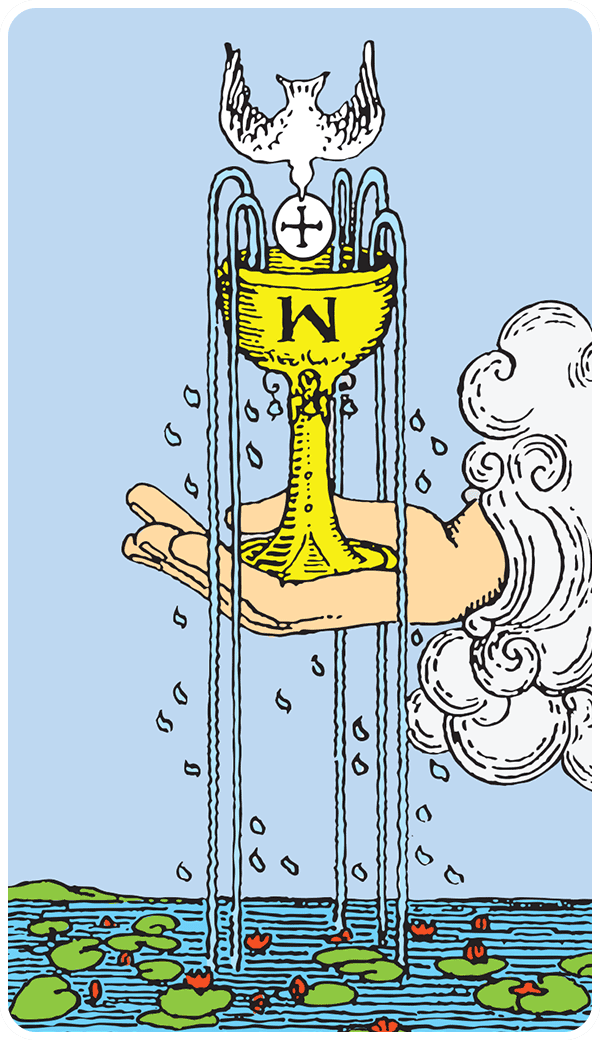
Ace of Cups · plate 1
What the card is actually doing
The Ace of Cups shows up in a finance reading and the querent wants me to tell them money is coming. They think Cups means flow, Ace means new, and together it adds up to abundance arriving. That is not what the card is describing. The Ace of Cups is the emotional suit. It governs feeling, attachment, and the part of you that bonds or recoils. When it lands in a money reading, it is not describing money. It is describing your heart's relationship to money — and whether that relationship just became available again after a long closure.
Reading Ace of Cups in money
What the suit, rank, and image are doing — and the misreading
Cups is the suit of emotional capacity. It tracks how you feel about something, whether you can let something in, whether the channel between you and a thing is open or defended. In a finance context, Cups cards describe your psychological relationship to money — the shame, the hope, the fear of losing it, the fantasy of what having it would solve. They do not describe the money itself.
Aces are thresholds. They mark the moment a door opens, not what walks through it. The Ace of Pentacles is the material threshold — an actual opportunity for income or resource. The Ace of Cups is the emotional threshold. It names the moment you stop being numb or defended or dissociated about money and become capable of feeling something new about it.
Look at the image. A hand holds a cup. Water overflows. The cup is being offered, not accepted. It is suspended mid-air. This is not money arriving. This is the precondition for being able to receive money without immediately sabotaging it, spending it to soothe something, or refusing to look at the account because looking hurts too much.
The most common misreading is treating this card as a financial promise. It is not. It is an emotional event that may eventually affect your finances if you act on it.
How it reads for two different querent situations
For someone who has been financially numb — avoiding their bank account, not opening bills, operating in a fog of low-grade panic — the Ace of Cups is the morning they wake up and feel capable of looking at the number. The defensiveness drops. They can think about money without their chest tightening. The card does not fix the number. It names the moment they can face it.
For someone who has been chasing money as a solution to an emotional problem — working compulsively, convinced that the next promotion will make them feel secure, using income as proof of worth — the Ace of Cups is the moment they feel the emptiness under the chase. The channel opens to grief or longing or the thing they were trying to solve by earning. The card does not tell them to quit their job. It tells them the emotional truth just became available, and what they do with their work will now be informed by that truth instead of running from it.
Reversed, the card often describes the emotional channel closing prematurely. The querent had a moment of clarity about their financial situation — saw the pattern, felt the feeling — and then shut it down because it was too much. The cup tips over. The water spills out before it can be integrated.
The tell that someone is misreading it on themselves
The tell is when someone pulls the Ace of Cups in a money reading and immediately starts planning what they'll do with the windfall. They are waiting for something external to arrive. They are not asking what internal shift just became possible. If you find yourself thinking "this means money is coming," go back and ask what you just became capable of feeling about money that you were not capable of feeling last month. That is the card's actual subject.
From the practice
“A card never tells you what to do. It tells you what you're already deciding — and gives you the words to name it.”
A grounded observation
Go back through your calendar and look for the day you stopped avoiding your bank account, or the day you cried about money for the first time in years. That day was the Ace of Cups. What you did next is a different card.
Key themes to watch for
- № 01Theme
Non-material wealth
- № 02Theme
Generosity
- № 03Theme
Values check
What to do with this reading
Read the upright meaning first, even if you pulled the card reversed. The reversal is a commentary on the upright — not a separate card.
Notice what your body did when you saw Ace of Cups. That reaction is usually closer to the truth than the interpretation.
Write down one sentence: What is this card asking me to stop avoiding? Let the answer be smaller than you expect.
Come back to this card in 48 hours. Most money readings sharpen with a little distance.
Questions answered
Frequently asked
The upright Ace of Cups in finances hints at a period of emotional satisfaction rather than material gain. You might find joy in sharing resources or investing in things that bring happiness rather than just profit. This card suggests that emotional rewards are as important as financial ones. Consider how your spending habits reflect your values and what truly enriches your life. It may be a time to appreciate the non-material abundance you have.
Reversed, the Ace of Cups might suggest financial worries are affecting your emotional well-being. Perhaps there's a feeling of lack or dissatisfaction with your current financial situation. This card invites you to reflect on your relationship with money and how it influences your emotions. It might be time to reassess what financial security really means to you and how you can find peace in non-material aspects.
Ace of Cups colors the cards around it. Pay attention to where its themes — emotional intimacy, felt-sense knowing, where the water level is rising — show up in the next card. That is usually where the story is.
Tarot is observational, not predictive. Ace of Cups describes the conditions in front of you right now and where they tend to lead if nothing changes — not a guarantee of timing.
Repeat cards are the deck underlining a theme. With Ace of Cups, that usually means the question you are asking is the right one — but you have not yet acted on what the card is showing you.
Read next
Related readings
More Cups · Money
- Two of Cups — MoneyHow Two of Cups reads in a money context.
- Three of Cups — MoneyHow Three of Cups reads in a money context.
- Four of Cups — MoneyHow Four of Cups reads in a money context.
- Five of Cups — MoneyHow Five of Cups reads in a money context.
- Six of Cups — MoneyHow Six of Cups reads in a money context.
- Seven of Cups — MoneyHow Seven of Cups reads in a money context.
Other Ace of Cups readings
- General MeaningAce of Cups read for general meaning.
- Love & RelationshipsAce of Cups read for love & relationships.
- Career & WorkAce of Cups read for career & work.
- Health & WellbeingAce of Cups read for health & wellbeing.
- SpiritualityAce of Cups read for spirituality.
- Yes / No AnswerAce of Cups read for yes / no answer.