Six of Cups in Money
The Six of Cups in money readings gets read as windfall or gift. What it actually names is a financial pattern you learned young and are still running.
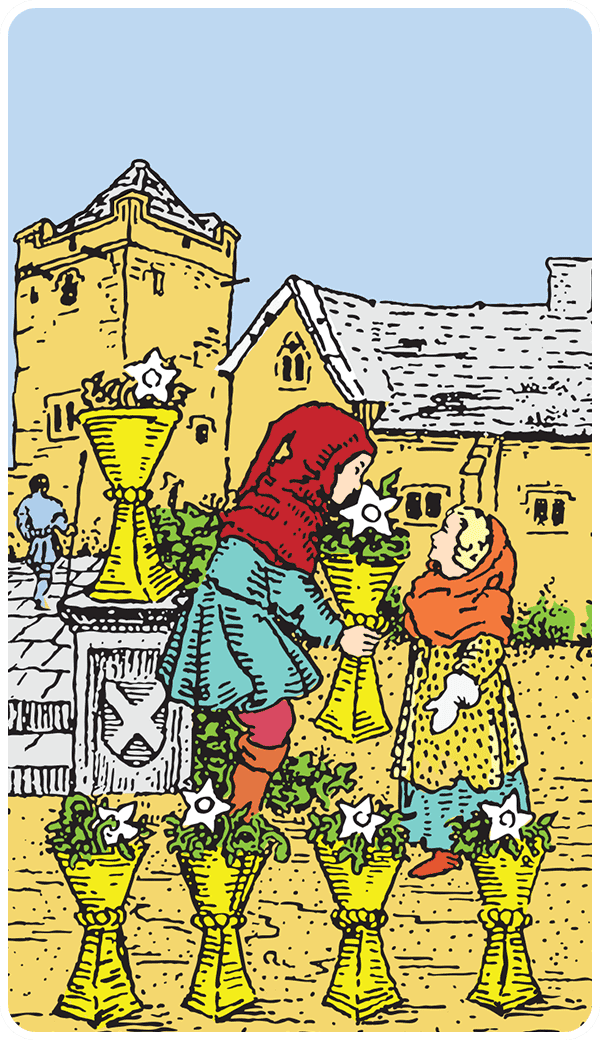
Six of Cups · plate 6
What the card is actually doing
The Six of Cups shows up in a finance reading and the querent says: someone's going to help me. An inheritance. A loan from family. Money from the past. Something I'm owed is finally coming back. That is almost never what the card is describing. What the Six of Cups actually names is the money script you learned as a child — the one you are still performing, right now, in your adult financial life.
Reading Six of Cups in money
What the suit, the rank, and the image are doing — and the consistent misreading
Cups governs emotion, attachment, and relational exchange. In a finance reading, Cups cards describe how you feel about money, not what money is doing. They point to the emotional charge around spending, receiving, owing, or withholding. When Cups dominates a money question, the real question is usually about worth, safety, or what you believe you deserve.
Sixes in tarot describe established patterns. They are not new beginnings and they are not conclusions. A Six names something that has settled into a rhythm — a dynamic that repeats because it has become structural. The Six of Pentacles is an established exchange. The Six of Swords is a repeating escape route. Sixes are maintenance cards. They show what is being sustained.
Now look at the image. Two children in a courtyard. One child hands the other a cup filled with flowers. The buildings around them are old. The exchange feels nostalgic, innocent, safe. There is no negotiation happening. The child receiving does not ask; the child giving does not hesitate. This is the financial dynamic you learned before you had language for it.
The consistent misreading is literal: someone from my past will send money. An old debt will be repaid. A family member will step in. Most of the time, no one sends anything. What actually happens is the querent realizes they are still operating inside the money story their household taught them when they were seven.
How the card reads for two different querent situations
For the querent who grew up with financial security, the Six of Cups often describes the assumption that help will arrive if things get bad. They overspend or under-save because some part of them believes the safety net is structural. They are not consciously expecting a bailout, but their behavior reveals the belief. The card is naming the pattern, not promising rescue.
For the querent who grew up with financial instability, the Six of Cups describes the opposite reflex: they give too much. They loan money they cannot afford to lose. They pick up the check. They send cash to a sibling who never pays them back. The childhood lesson was that love is demonstrated through financial sacrifice, and they are still proving it. The card is not saying this is noble. It is saying this is what you learned, and it is costing you now.
The tell that someone is misreading the card on themselves
The tell is this: they are waiting for someone else to fix it. They pulled the Six of Cups in a money reading and decided it means relief is coming from outside. They stop acting. They stop applying for the second job. They stop making the call. They treat the card as permission to stay passive because the card "said" someone would help. That is not what passivity in a Six of Cups reading produces. What it produces is more of the same dynamic, because the dynamic is the point. The card is not describing a future event. It is describing the money story you are inside right now, and whether you are ready to see it.
From the practice
“A card never tells you what to do. It tells you what you're already deciding — and gives you the words to name it.”
A grounded observation
Go back through your bank statements from the last six months and look for the repeating transaction — the one that makes you feel like a child again. That is what the Six of Cups is pointing at.
Key themes to watch for
- № 01Theme
Non-material wealth
- № 02Theme
Generosity
- № 03Theme
Values check
What to do with this reading
Read the upright meaning first, even if you pulled the card reversed. The reversal is a commentary on the upright — not a separate card.
Notice what your body did when you saw Six of Cups. That reaction is usually closer to the truth than the interpretation.
Write down one sentence: What is this card asking me to stop avoiding? Let the answer be smaller than you expect.
Come back to this card in 48 hours. Most money readings sharpen with a little distance.
Questions answered
Frequently asked
Financially, the Six of Cups encourages a thoughtful reflection on past spending and saving habits. It may remind you of a time when money was managed with simplicity. Consider revisiting tried-and-true strategies from your past that served you well. This card invites you to find a balance between nostalgia and practicality in your financial planning.
Reversed, the Six of Cups warns against financial decisions rooted in nostalgia or sentimentality. Perhaps there’s an inclination to spend in ways that echo the past, which might not serve your current financial situation. Take a moment to assess whether these habits are beneficial or if they need adjustment.
Six of Cups colors the cards around it. Pay attention to where its themes — emotional intimacy, felt-sense knowing, where the water level is rising — show up in the next card. That is usually where the story is.
Tarot is observational, not predictive. Six of Cups describes the conditions in front of you right now and where they tend to lead if nothing changes — not a guarantee of timing.
Repeat cards are the deck underlining a theme. With Six of Cups, that usually means the question you are asking is the right one — but you have not yet acted on what the card is showing you.
Read next
Related readings
More Cups · Money
- Ace of Cups — MoneyHow Ace of Cups reads in a money context.
- Two of Cups — MoneyHow Two of Cups reads in a money context.
- Three of Cups — MoneyHow Three of Cups reads in a money context.
- Four of Cups — MoneyHow Four of Cups reads in a money context.
- Five of Cups — MoneyHow Five of Cups reads in a money context.
- Seven of Cups — MoneyHow Seven of Cups reads in a money context.
Other Six of Cups readings
- General MeaningSix of Cups read for general meaning.
- Love & RelationshipsSix of Cups read for love & relationships.
- Career & WorkSix of Cups read for career & work.
- Health & WellbeingSix of Cups read for health & wellbeing.
- SpiritualitySix of Cups read for spirituality.
- Yes / No AnswerSix of Cups read for yes / no answer.