The High Priestess in Yes / No
The High Priestess in a yes/no reading almost always means 'not yet' — not because the answer is no, but because you're asking before you have the information.
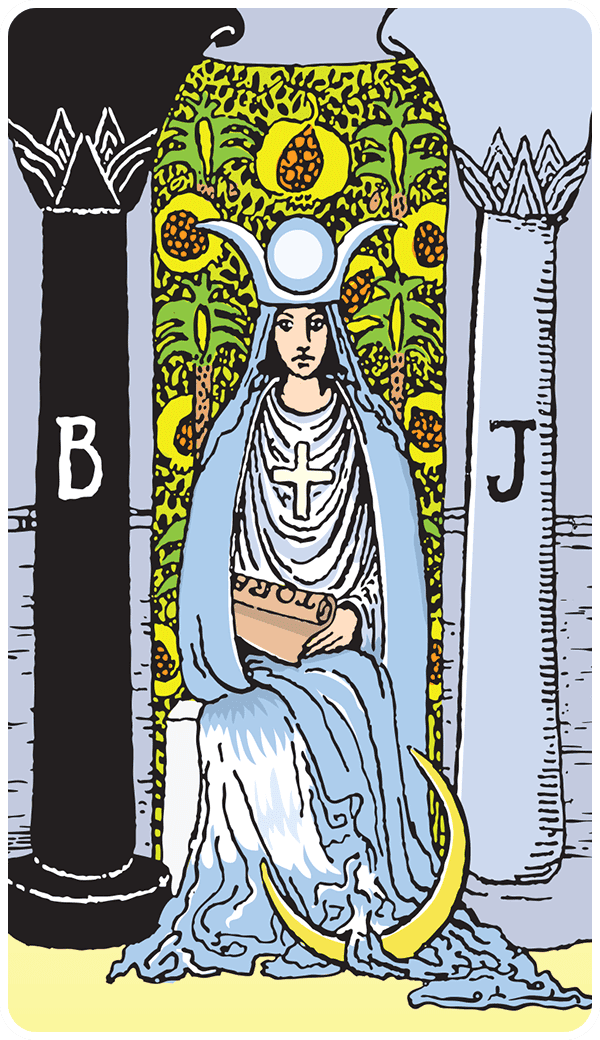
The High Priestess · plate 2
MAYBE
The High Priestess in a yes/no reading is a 'maybe' that leans toward 'wait.' Not because the outcome is uncertain, but because you are asking the question before you have access to what you actually need to know. Most people read this card as mysterious withholding — the universe keeping secrets, the answer hidden behind a veil. That is not what is happening. The High Priestess marks the moment when the information exists but has not yet surfaced into conscious awareness. You are standing in front of a door you cannot see through, and the card is saying: you will know when to open it, but that moment is not now.
Why The High Priestess reads this way
What the card's structure is doing and why people misread it as 'cryptic'
The High Priestess is Major Arcana II, which means she governs a fundamental psychological process, not a passing mood. She sits between two pillars — one black, one white — with a veil of pomegranates behind her. She holds a scroll partially concealed in her lap. The moon is at her feet. Everything in the image describes the threshold between the conscious and unconscious mind. She is not keeping the scroll from you. She is holding it in the place where it lives until your conscious mind is ready to read it.
The common misreading treats this as mystical obstruction. People think the card means 'the answer is unknowable' or 'trust your intuition' in the vague sense of guessing harder. What the card actually describes is pre-conscious knowledge — the answer is forming, but it has not yet moved from the back of your mind to the front. When someone asks 'Should I take this job?' and pulls the High Priestess, the honest read is: you already have a feeling about this job, but you have not yet let yourself consciously name it. The card is not telling you to wait for a sign. It is telling you that you are not done gathering what you need to know.
How the card reads differently depending on what the querent already knows
If the querent has been deliberating for weeks and keeps asking the same question in different ways, the High Priestess reads as: you are stalling because you already know the answer and you do not like it. The information is there. You are choosing not to look at it directly. In this case, the 'maybe' is a procedural truth — you have not made the decision — but the card is naming the delay as a symptom, not a virtue.
If the querent is asking about something that genuinely has not played out yet — 'Will they text me back?' or 'Will I get the callback?' — the High Priestess reads as: the other person has not decided, or the decision has not been made, and you asking the question five times will not speed the process. The answer exists in potential but not in form. The card is accurate. It is describing a literal 'not yet.' Reversed, the High Priestess tends to mean the information has surfaced and you are ignoring it, or you are demanding certainty in a situation that will only clarify through action, not more reflection.
The tell that someone is misreading the card on themselves
The tell is when someone pulls the High Priestess and immediately asks the question again, or pulls three clarifiers trying to force the card into a binary. If you are doing that, you are not listening to what the card said. It said: this is not a yes-or-no moment. You are trying to skip a step. The other tell is when someone treats the card as permission to wait indefinitely. The High Priestess does not mean 'never act.' It means 'you will know when you know, and that moment has a feeling to it.' If you have been sitting with a question for six months and still feel nothing, the problem is not that the answer has not arrived. The problem is that you are afraid of it.
A grounded observation
Go back through your last ten big decisions and notice the ones where you knew the answer weeks before you admitted it to yourself. That lag is what the High Priestess is naming.
Key themes to watch for
- № 01Theme
Affirmative current
- № 02Theme
Open door
- № 03Theme
Forward motion
What to do with this reading
Read the upright meaning first, even if you pulled the card reversed. The reversal is a commentary on the upright — not a separate card.
Notice what your body did when you saw The High Priestess. That reaction is usually closer to the truth than the interpretation.
Write down one sentence: What is this card asking me to stop avoiding? Let the answer be smaller than you expect.
Come back to this card in 48 hours. Most yes / no readings sharpen with a little distance.
Questions answered
Frequently asked
The High Priestess in a yes/no reading is a 'maybe' that leans toward 'wait.' Not because the outcome is uncertain, but because you are asking the question before you have access to what you actually need to know. Most people read this card as mysterious withholding — the universe keeping secrets, the answer hidden behind a veil. That is not what is happening. The High Priestess marks the moment when the information exists but has not yet surfaced into conscious awareness. You are standing in front of a door you cannot see through, and the card is saying: you will know when to open it, but that moment is not now.
Reversed cards are rarely "bad." The High Priestess reversed asks you to look at where the same theme is blocked, postponed, or being avoided — usually with more compassion than the upright version.
The High Priestess colors the cards around it. Pay attention to where its themes — archetype, pattern, invitation — show up in the next card. That is usually where the story is.
Tarot is observational, not predictive. The High Priestess describes the conditions in front of you right now and where they tend to lead if nothing changes — not a guarantee of timing.
Repeat cards are the deck underlining a theme. With The High Priestess, that usually means the question you are asking is the right one — but you have not yet acted on what the card is showing you.
Read next
Related readings
Other The High Priestess readings
- General MeaningThe High Priestess read for general meaning.
- Love & RelationshipsThe High Priestess read for love & relationships.
- Career & WorkThe High Priestess read for career & work.
- Money & FinanceThe High Priestess read for money & finance.
- Health & WellbeingThe High Priestess read for health & wellbeing.
- SpiritualityThe High Priestess read for spirituality.