The High Priestess in Love
The High Priestess in love readings gets read as 'trust your intuition.' What she's actually doing is naming the information you already have but won't act on.
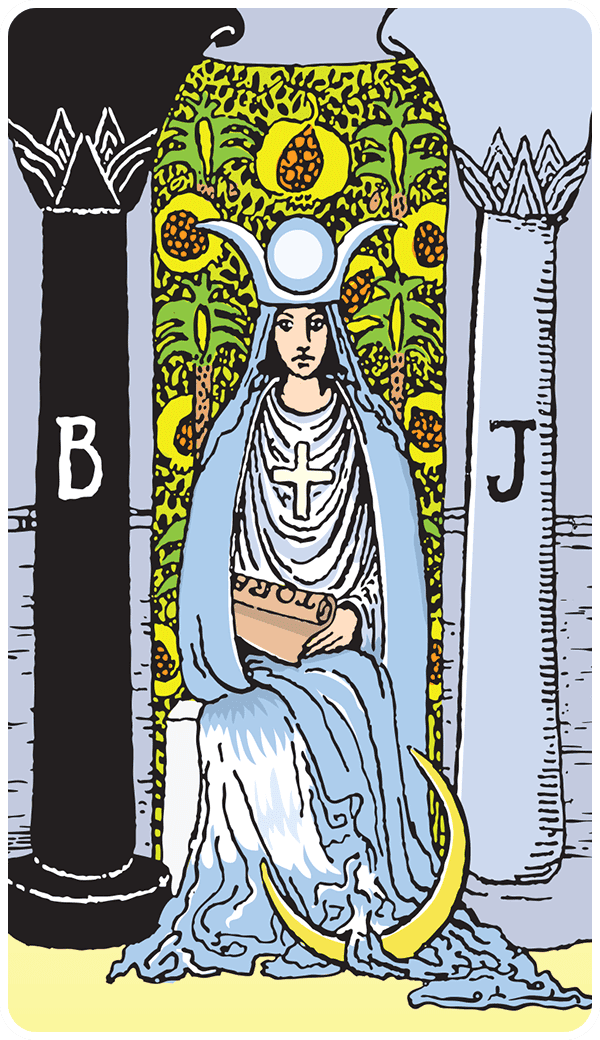
The High Priestess · plate 2
What the card is actually doing
The High Priestess shows up in a love reading and the querent nods knowingly. They think the card is telling them to trust their intuition, to wait for a sign, to listen to their inner voice. They leave the reading feeling validated in their uncertainty. That is the opposite of what the card is doing. The High Priestess does not tell you to wait for information. She names the information you already have and are refusing to use.
Reading The High Priestess in love
What the card is and what it gets misread as
The High Priestess is Major Arcana, which means she describes a psychic structure, not a passing mood. She sits between two pillars — one black, one white — with a veil behind her. She holds a scroll partially concealed in her lap. The pomegranates on the veil are seeds of knowledge. The moon at her feet is the unconscious. She is the keeper of what is known but not spoken.
In a love reading, she does not mean "trust your gut." She means: you already know. The information is already in the room. You have been watching this person's behavior for weeks or months. You have noticed the pattern. You have registered what they do when they say they'll call, what happens when you need them, how they describe their ex, what time they text. The High Priestess is the card that names the scroll you are holding and not reading.
The misreading happens because people want permission to keep waiting. They want the card to mean "the truth will reveal itself in time." But the High Priestess does not reveal. She reflects. She is the mirror that shows you what you have been looking at and calling a mystery.
How the card reads for two different querent situations
For someone early in dating, the High Priestess shows up when they are explaining away behavior they have already clocked as a problem. He said he's not looking for anything serious, but they think he might change his mind. She cancels plans last-minute, but they think she's just busy. The card is not saying "wait and see." It is saying: you saw. You already have the data. The question is whether you will act on it.
For someone in an established relationship, the High Priestess tends to appear when there is a conversation they are not having. They know their partner is unhappy. They know the sex has changed. They know something shifted after the move, after the job loss, after the comment at dinner three months ago that neither of them addressed. The card does not mean "give them space to open up." It means: you are both holding the same knowledge and pretending you aren't.
The tell that someone is misreading the card on themselves
The tell is when someone reads the High Priestess and feels relieved. If the card makes you feel like you have permission to stay in uncertainty, you are reading it backward. The High Priestess is not comfort. She is confrontation. She is the friend who says, "You already know what this is."
If you pull this card and your next thought is "I just need more time to figure out how I feel," go back and look at what you have been watching instead of naming. The priestess does not wait. She sits with the scroll and does not pretend it is blank.
From the practice
“A card never tells you what to do. It tells you what you're already deciding — and gives you the words to name it.”
A grounded observation
Look at the last three times you explained their behavior to a friend. If you used the word "but" in every explanation, you already have your answer.
Key themes to watch for
- № 01Theme
Vulnerability
- № 02Theme
New chapters
- № 03Theme
Emotional truth
What to do with this reading
Read the upright meaning first, even if you pulled the card reversed. The reversal is a commentary on the upright — not a separate card.
Notice what your body did when you saw The High Priestess. That reaction is usually closer to the truth than the interpretation.
Write down one sentence: What is this card asking me to stop avoiding? Let the answer be smaller than you expect.
Come back to this card in 48 hours. Most love readings sharpen with a little distance.
Questions answered
Frequently asked
In matters of the heart, The High Priestess invites you to explore the depths of your emotional landscape. This card suggests a relationship where much is felt but not necessarily spoken. Secrets or unspoken understandings might play a role. It's a period to trust your instincts about a partner's feelings or intentions. Sometimes, silence can say more than words. The invitation is to reflect on what you truly sense about your connection, allowing intuition to guide your understanding of love's complexities.
In love, a reversed High Priestess can indicate misunderstandings or a lack of clarity between partners. You might feel out of sync, as if you're missing the cues that used to be so clear. Trust issues could be surfacing, perhaps due to secrets or hidden feelings. It's as if the intuitive link is frayed. The card suggests taking note of where communication might be failing and what feelings are being suppressed. Consider what truths are being overlooked or avoided in your relationship.
The High Priestess colors the cards around it. Pay attention to where its themes — archetype, pattern, invitation — show up in the next card. That is usually where the story is.
Tarot is observational, not predictive. The High Priestess describes the conditions in front of you right now and where they tend to lead if nothing changes — not a guarantee of timing.
Repeat cards are the deck underlining a theme. With The High Priestess, that usually means the question you are asking is the right one — but you have not yet acted on what the card is showing you.
Read next
Related readings
Other The High Priestess readings
- General MeaningThe High Priestess read for general meaning.
- Career & WorkThe High Priestess read for career & work.
- Money & FinanceThe High Priestess read for money & finance.
- Health & WellbeingThe High Priestess read for health & wellbeing.
- SpiritualityThe High Priestess read for spirituality.
- Yes / No AnswerThe High Priestess read for yes / no answer.