The High Priestess in Money
The High Priestess in a finance reading is not telling you to wait for intuition. Here's what the card is actually describing about information access.
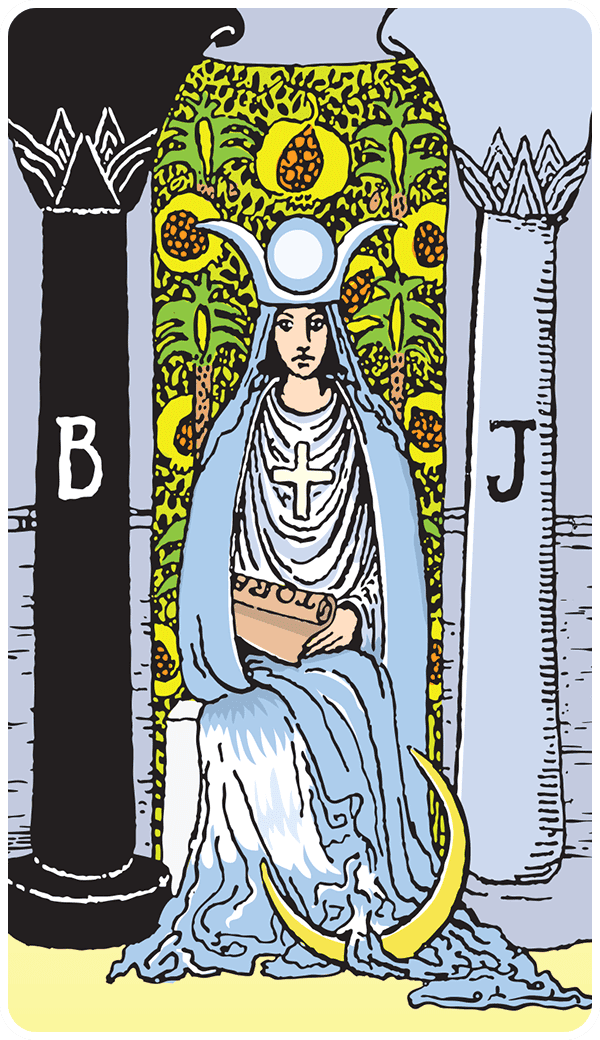
The High Priestess · plate 2
What the card is actually doing
The High Priestess shows up in a finance reading and the querent hears: trust your intuition, wait for the right moment, the answer will come to you. They treat the card as permission to not act. They sit on a decision for three months because "it doesn't feel right yet" and call that discernment. That is not what the card is doing. The High Priestess is not about mystical knowing. It is about information asymmetry — what you can see that others cannot, or what is being kept from you that you need.
Reading The High Priestess in money
What the Major rank and the image are describing
The High Priestess is Major Arcana, which means the card points to a structural dynamic, not a transaction. Majors describe the architecture of a situation — the underlying pattern that shapes how events unfold. When a Major shows up in a finance reading, the question is not "should I buy this stock" but "what is the actual structure I am operating inside."
Look at the image. She sits between two pillars, one black and one white. Behind her is a veil covered in pomegranates. She holds a scroll partially concealed in her lap. She is not moving. She is not offering the scroll. She is the gatekeeper to something hidden. The card describes a threshold where access to information is controlled. Either you are the one holding the information, or you are the one being kept from it. The most common misreading in a finance context is treating this as "listen to your gut." The querent decides the card means their hesitation is wisdom, that some inner voice will tell them when to act. They confuse anxiety with intuition and call the paralysis discernment. What the card is actually naming is an information problem. Something relevant is not visible yet. Either the data you need has not been disclosed, or you are sitting on knowledge that would change the decision if others had it.
How the card reads for two different situations
If you are the investor or the person allocating resources, the High Priestess describes your edge. You have access to something — a relationship, a dataset, a pattern you have seen before — that is not priced into the consensus view yet. The card is not telling you to wait. It is telling you that your advantage is informational, and the question is whether you act on it before it becomes public. The scroll is in your lap. What you do with it is a choice.
If you are the employee, the borrower, the person on the outside of the decision, the card describes what is being withheld. The terms you were not shown. The clause buried on page seven. The meeting that happened without you. The High Priestess here is diagnostic. It says: you are operating with incomplete information, and someone is benefiting from that incompleteness. The move is not to wait for intuition. The move is to ask better questions and to assume that what you are being told is a curated version.
The tell that you are misreading the card on yourself
You have been "sitting with" a financial decision for weeks. You tell yourself you are waiting for clarity, waiting to feel aligned, waiting for the universe to send a sign. Meanwhile, the opportunity cost compounds. You are not weighing information; you are avoiding the discomfort of committing. The High Priestess becomes an excuse for inaction, a way to dress up fear as spiritual process. If the card shows up and your response is to do nothing, you are misreading it. The card names an information gap. Your job is to close it or to act despite it, not to wait for the gap to resolve itself.
From the practice
“A card never tells you what to do. It tells you what you're already deciding — and gives you the words to name it.”
A grounded observation
Go back through the last financial decision you delayed. Write down what information you told yourself you were waiting for. Now write down whether that information ever actually arrived, or whether you just eventually got tired of waiting.
Key themes to watch for
- № 01Theme
Non-material wealth
- № 02Theme
Generosity
- № 03Theme
Values check
What to do with this reading
Read the upright meaning first, even if you pulled the card reversed. The reversal is a commentary on the upright — not a separate card.
Notice what your body did when you saw The High Priestess. That reaction is usually closer to the truth than the interpretation.
Write down one sentence: What is this card asking me to stop avoiding? Let the answer be smaller than you expect.
Come back to this card in 48 hours. Most money readings sharpen with a little distance.
Questions answered
Frequently asked
In finances, The High Priestess suggests a need for discretion and careful consideration. There may be more to your financial situation than meets the eye. It's a time to trust your instincts about investments or spending. Listen to the subtle signals that might guide you toward better financial decisions. The card points to the value of patience and observation over hasty actions. Reflect on the unspoken aspects of your financial life and consider what your intuition is telling you.
Reversed, this card in finance hints that you might not be seeing the full picture. There could be overlooked details or hidden expenses affecting your financial health. It's a signal to pause and review your financial strategies carefully. Consider where you might be ignoring warning signs or being overly secretive about money matters. Acknowledge any financial uncertainties you may have been avoiding.
The High Priestess colors the cards around it. Pay attention to where its themes — archetype, pattern, invitation — show up in the next card. That is usually where the story is.
Tarot is observational, not predictive. The High Priestess describes the conditions in front of you right now and where they tend to lead if nothing changes — not a guarantee of timing.
Repeat cards are the deck underlining a theme. With The High Priestess, that usually means the question you are asking is the right one — but you have not yet acted on what the card is showing you.
Read next
Related readings
Other The High Priestess readings
- General MeaningThe High Priestess read for general meaning.
- Love & RelationshipsThe High Priestess read for love & relationships.
- Career & WorkThe High Priestess read for career & work.
- Health & WellbeingThe High Priestess read for health & wellbeing.
- SpiritualityThe High Priestess read for spirituality.
- Yes / No AnswerThe High Priestess read for yes / no answer.