The Hierophant in Love
The Hierophant gets read as 'traditional commitment is coming' when it's actually naming the social scaffolding already shaping the relationship.
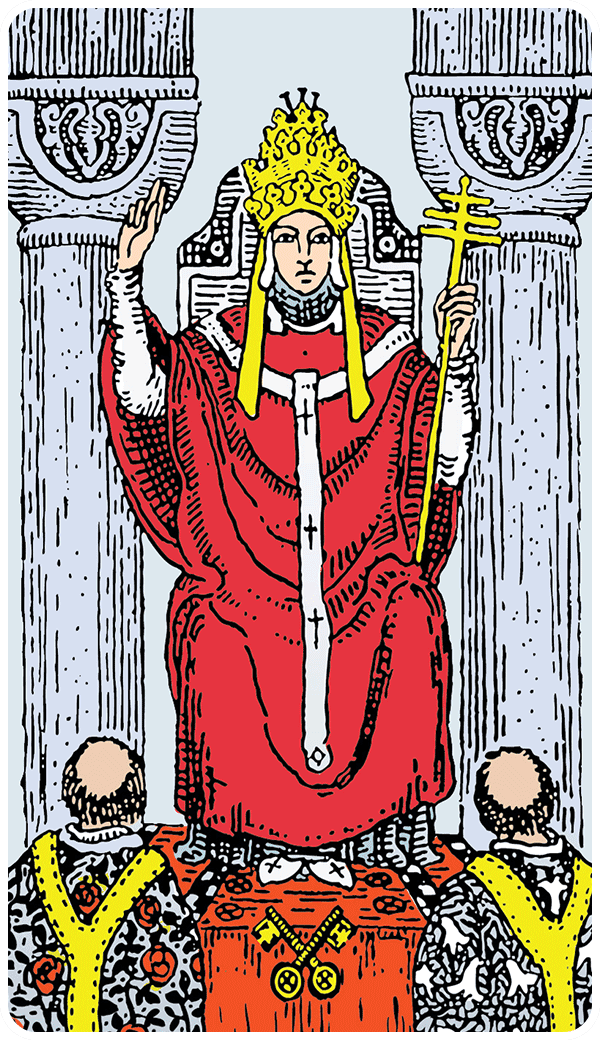
The Hierophant · plate 5
What the card is actually doing
The Hierophant shows up in a love reading and the querent immediately decides it means marriage. Engagement. Meeting the parents. Finally getting the commitment they've been asking for. The card becomes a promise, and when the promise doesn't arrive on schedule, they blame the reading.
That's not what the card is doing. The Hierophant doesn't predict traditional milestones. It names the external structures — social, familial, cultural, institutional — that are already active in the relationship dynamic. The question is not whether those structures will arrive. The question is how much power you're giving them.
Reading The Hierophant in love
What the card is actually pointing to
The Hierophant is Major Arcana, which means it governs a large-scale organizing principle in the querent's life, not a passing mood or a single event. This is not a card about what happens next week. It's a card about what framework you're operating inside.
The image shows a religious figure seated between two pillars, holding a staff, with two acolytes kneeling before him. Keys rest at his feet. The setup is formal, hierarchical, and explicitly about transmission: someone who holds knowledge is passing it to someone who receives it according to established rules. The pillars frame the scene. The keys suggest access is controlled.
In a love reading, this card names the moment when the relationship stops being a private two-person experience and starts interfacing with external authority. Your parents' opinion of them. Their friends' verdict on you. Whether you're moving at the pace your social circle considers normal. Whether the relationship looks legible to the people whose approval you didn't realize you were seeking. The Hierophant is the card of the shoulds.
The most common misreading is treating it as a green light for commitment when it's actually describing the pressure to commit — or the pressure to commit in a specific, socially recognizable way. The querent hears 'traditional relationship' and thinks the card is endorsing it. The card is not endorsing anything. It is naming the fact that tradition is in the room.
How it reads for two different querents
For someone who wants the traditional milestone and isn't getting it, the Hierophant describes the gap between what they think a relationship should look like at this stage and what is actually happening. The frustration isn't about the other person; it's about the mismatch between the lived reality and the received script. The card is asking: whose timeline are you on?
For someone who feels suffocated by expectations — family pressure to settle down, friends asking when they're moving in together, a partner who keeps referencing 'the next step' — the Hierophant describes exactly that pressure. It's the card of the external voice that has started narrating your private relationship. When this card shows up for that querent, the question becomes: which parts of this are yours and which parts are you performing?
Reversed, the Hierophant often marks active resistance to those structures. Refusing to introduce them to your family. Avoiding the marriage conversation. Deliberately keeping the relationship outside the social frame. Sometimes that refusal is healthy boundary-setting. Sometimes it's avoidance dressed up as independence.
The tell that someone is misreading it
The tell is when the querent treats the card as a prediction instead of a diagnostic. 'The Hierophant means we're getting engaged' is a misread. 'The Hierophant means I've been measuring this relationship against my parents' marriage and feeling like we're failing' is accurate. If you're waiting for the card to make something happen, you've missed it. The Hierophant describes what's already shaping your decisions.
From the practice
“A card never tells you what to do. It tells you what you're already deciding — and gives you the words to name it.”
A grounded observation
Go back through the last three months of the relationship and count how many decisions were made because of what you actually wanted versus what you thought you were supposed to want. That count is what the card is about.
Key themes to watch for
- № 01Theme
Vulnerability
- № 02Theme
New chapters
- № 03Theme
Emotional truth
What to do with this reading
Read the upright meaning first, even if you pulled the card reversed. The reversal is a commentary on the upright — not a separate card.
Notice what your body did when you saw The Hierophant. That reaction is usually closer to the truth than the interpretation.
Write down one sentence: What is this card asking me to stop avoiding? Let the answer be smaller than you expect.
Come back to this card in 48 hours. Most love readings sharpen with a little distance.
Questions answered
Frequently asked
In love, The Hierophant suggests a relationship grounded in shared beliefs and values. This could be a time of deepening bonds through understanding and mutual respect. If you're single, you might find yourself drawn to someone who shares your outlook on life. This card invites you to consider what traditional elements you value in a partnership. It could be a strong foundation for building something lasting, with a focus on mutual goals and shared understanding.
Reversed, The Hierophant in love can indicate tension arising from conflicting values or expectations. Perhaps you're feeling constrained by traditional roles or expectations within a relationship. This is a moment to question whether those norms are truly serving you. It might be time to have an honest conversation about what each of you wants and values, allowing for more freedom and authenticity in your connections.
The Hierophant colors the cards around it. Pay attention to where its themes — archetype, pattern, invitation — show up in the next card. That is usually where the story is.
Tarot is observational, not predictive. The Hierophant describes the conditions in front of you right now and where they tend to lead if nothing changes — not a guarantee of timing.
Repeat cards are the deck underlining a theme. With The Hierophant, that usually means the question you are asking is the right one — but you have not yet acted on what the card is showing you.
Read next
Related readings
Other The Hierophant readings
- General MeaningThe Hierophant read for general meaning.
- Career & WorkThe Hierophant read for career & work.
- Money & FinanceThe Hierophant read for money & finance.
- Health & WellbeingThe Hierophant read for health & wellbeing.
- SpiritualityThe Hierophant read for spirituality.
- Yes / No AnswerThe Hierophant read for yes / no answer.