The Hierophant in Money
The Hierophant in money readings gets read as 'follow tradition' or 'get advice.' What it actually names is the institutional framework already shaping your access.
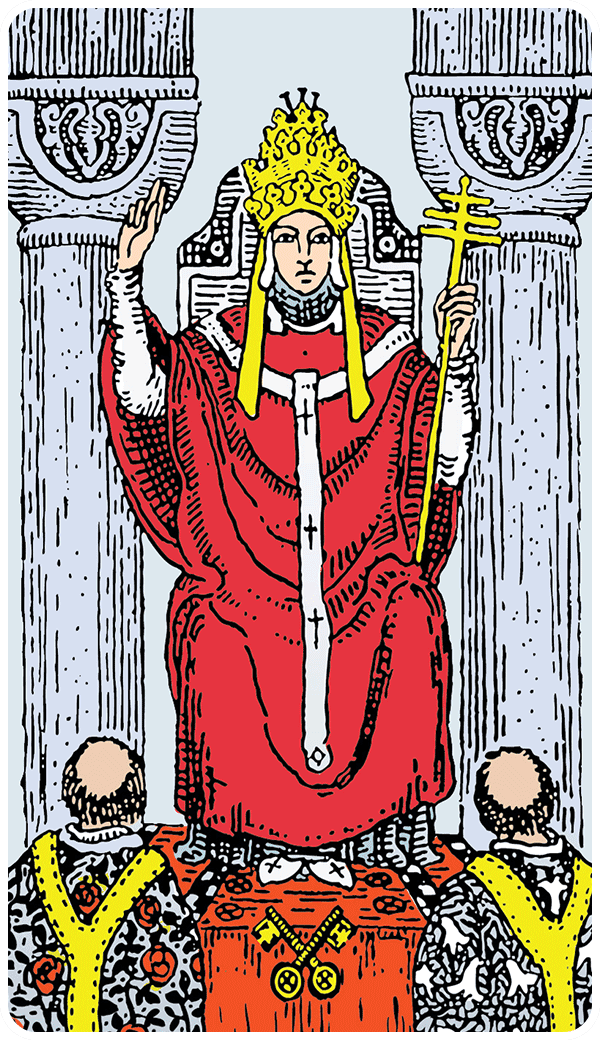
The Hierophant · plate 5
What the card is actually doing
The Hierophant shows up in a finance reading and the querent hears it as permission to ask for help. They think it means consult an expert, follow the conventional path, get a financial advisor. That reading misses what the card is actually pointing at. The Hierophant is not advice about what to do. It is a description of what is already structuring the situation — the institutional framework, the credentialing system, the gatekeeper dynamic that determines who gets access and on what terms.
Reading The Hierophant in money
What the Major Arcana rank and the image are doing
The Hierophant is Major Arcana, which means it names a structural force, not a choice you make. Major cards describe the architecture of a situation — the large-scale pattern or system that precedes your involvement and will persist after you leave. When a Major shows up in a finance reading, you are not looking at your personal spending habits or investment decisions. You are looking at the framework those decisions happen inside.
The figure on the card sits between two pillars, holding keys, with acolytes kneeling before him. He is the institutional authority. He controls access to the knowledge, the credentials, the approval process. The pillars mark a threshold. The keys unlock it. The acolytes are positioned as supplicants. This is not a card about learning. It is a card about gatekeeping — about the system that decides who is allowed in and what you have to perform to get there.
The most common misreading in finance contexts is to hear this as 'follow traditional financial advice' or 'stick to what's proven.' That flattens the card into a platitude. What the Hierophant actually describes is the moment you realize your financial situation is shaped by institutional rules you did not write. You need a certain credit score to access a loan. You need a W-2 to prove income for a mortgage. You need an accredited investor status to enter certain markets. The card names the structure, not your compliance with it.
How the card reads for two different querent situations
For someone applying for a mortgage or business loan, the Hierophant describes the credentialing process itself. You are not being evaluated on your actual capacity to repay. You are being evaluated on whether your financial profile matches the institutional template. The card is not telling you to 'do it the right way.' It is naming the fact that there is a right way, that someone else defined it, and that your access depends on performing it correctly. The question becomes: can you shape your presentation to match what the gatekeeper needs to see?
For someone trying to access family money or an inheritance, the Hierophant reads differently. Here it describes the formal structure around the transfer — the trust, the estate lawyer, the conditions attached to the money. It is not your money yet, even if it is 'yours.' Someone else controls the keys. The card names the power dynamic. It tells you that informal conversations will not move the situation. The structure has to be navigated on its terms.
The tell that someone is misreading the card on themselves
The tell is when the querent hears the Hierophant and immediately starts talking about what financial advice they should follow or what conventional path they should take. That is a misreading. The card is not advice. It is a mirror. If the Hierophant is present, you are already inside an institutional framework. The question is not whether to follow the rules. The question is: do you see the rules for what they are, and can you work the system without pretending it is neutral?
From the practice
“A card never tells you what to do. It tells you what you're already deciding — and gives you the words to name it.”
A grounded observation
Go back through your last three financial rejections or approvals. Notice which ones hinged on meeting an institutional standard versus demonstrating actual capacity. That is what the Hierophant is naming.
Key themes to watch for
- № 01Theme
Non-material wealth
- № 02Theme
Generosity
- № 03Theme
Values check
What to do with this reading
Read the upright meaning first, even if you pulled the card reversed. The reversal is a commentary on the upright — not a separate card.
Notice what your body did when you saw The Hierophant. That reaction is usually closer to the truth than the interpretation.
Write down one sentence: What is this card asking me to stop avoiding? Let the answer be smaller than you expect.
Come back to this card in 48 hours. Most money readings sharpen with a little distance.
Questions answered
Frequently asked
Financially, The Hierophant suggests stability through conventional means. It's a time to rely on tried-and-true methods for managing your money. Look to traditional advice and established financial practices to guide your decisions. This card encourages a focus on security and long-term planning, suggesting that conservative strategies might serve you well now.
Reversed, The Hierophant in finances might indicate a need to reassess traditional financial advice. Are there outdated practices holding you back? Consider exploring new methods or seeking unconventional wisdom to improve your financial situation. This card invites you to think critically about which financial traditions truly benefit you.
The Hierophant colors the cards around it. Pay attention to where its themes — archetype, pattern, invitation — show up in the next card. That is usually where the story is.
Tarot is observational, not predictive. The Hierophant describes the conditions in front of you right now and where they tend to lead if nothing changes — not a guarantee of timing.
Repeat cards are the deck underlining a theme. With The Hierophant, that usually means the question you are asking is the right one — but you have not yet acted on what the card is showing you.
Read next
Related readings
Other The Hierophant readings
- General MeaningThe Hierophant read for general meaning.
- Love & RelationshipsThe Hierophant read for love & relationships.
- Career & WorkThe Hierophant read for career & work.
- Health & WellbeingThe Hierophant read for health & wellbeing.
- SpiritualityThe Hierophant read for spirituality.
- Yes / No AnswerThe Hierophant read for yes / no answer.