The Hierophant in General
The Hierophant gets read as tradition or conformity. What it actually describes is the moment you realize you need a structure that already works.
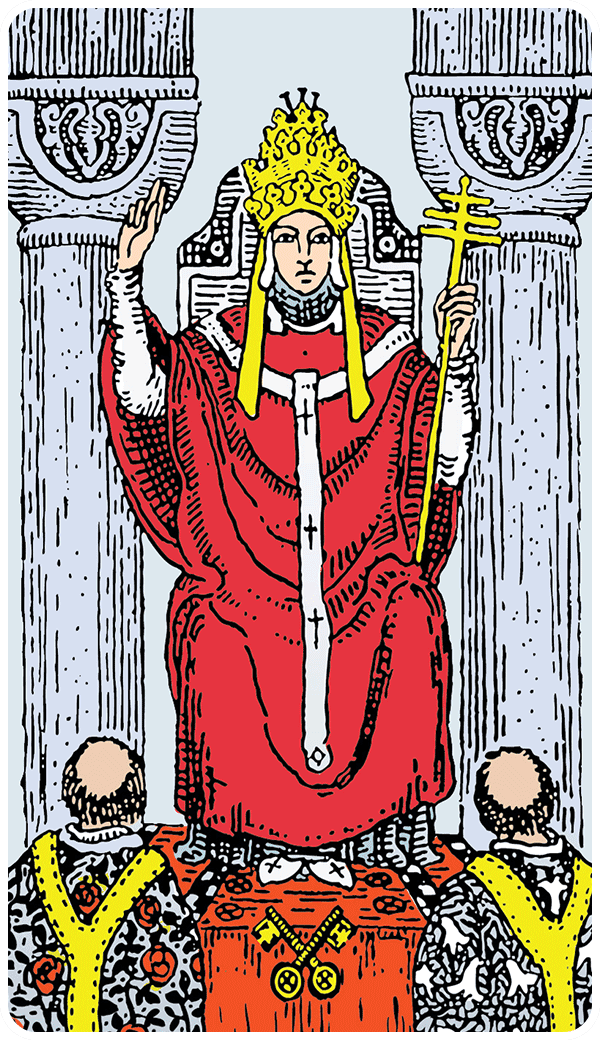
The Hierophant · plate 5
What the card is actually doing
The Hierophant shows up in a general reading and the querent's shoulders drop. They think the card is telling them to follow the rules, to be conventional, to stop wanting what they want and get in line. That is not what the card is doing. The Hierophant describes the moment you stop trying to invent the entire system yourself and admit you need transmission — a teacher, a method, a container that has been tested by someone other than you.
Reading The Hierophant in general
What the rank, the image, and the setting are each doing
The Hierophant is Major Arcana, which means it names a developmental threshold, not a circumstantial event. Major cards describe the internal work required to move from one chapter of psychological coherence to the next. The Hierophant is the card of structured learning. It is the moment you realize that figuring it out alone is taking too long, costing too much, or producing results you can't replicate.
Look at the image. A religious figure sits between two pillars, holding a staff, wearing ceremonial robes. Two acolytes kneel before him. Keys rest at his feet. This is not a scene of oppression. It is a scene of voluntary approach. The acolytes came to him. The keys are available, but they require instruction to use. The Hierophant holds a role: he is the one who knows how the lock works because he has opened it before.
The most common misreading treats the card as a personality judgment — you are being too rigid, too traditional, too afraid to break the mold. That is the Hierophant as viewed from the outside by someone who resents structure. The card does not describe a type of person. It describes a type of need. The need for a proven method when improvisation has stopped working.
How the card reads for two different situations
For someone starting a new practice — a creative discipline, a spiritual path, a professional skill set — the Hierophant says: find the teacher. Stop Googling. Stop piecing it together from seven different YouTube channels and Reddit threads. Go to the person who has done the thing 4,000 times and learn their sequence. The card is not about obedience. It is about efficiency. Transmission is faster than trial and error.
For someone already inside an institution — a job with strict protocols, a religious community, a long-term relationship with established patterns — the Hierophant reads differently. Here it names the moment you recognize that the structure itself is doing something for you. You have been complaining about the rigidity, but the rigidity is also why the thing hasn't collapsed. The card asks: what would you actually do if there were no rules? The querent who cannot answer that question is not ready to leave.
The tell that someone is misreading the card on themselves
The tell is this: the querent says the card means they need to conform, and then they list all the ways they are already conforming and it still feels wrong. They think the Hierophant is criticizing them for not submitting hard enough. That is backward. The Hierophant does not show up to shame you into compliance. It shows up when you are trying to build something sustainable and you keep hitting the same ceiling because you are missing a foundational piece of knowledge. The card is not about suppressing yourself. It is about recognizing that some problems have already been solved and the solution is sitting in a book you have not read yet.
From the practice
“A card never tells you what to do. It tells you what you're already deciding — and gives you the words to name it.”
A grounded observation
Go back through your last six months and look for the thing you kept restarting from scratch. That is where the Hierophant is pointing. Someone has already walked that path. Go find them.
Key themes to watch for
- № 01Theme
Beginnings
- № 02Theme
Inner movement
- № 03Theme
Receptivity
What to do with this reading
Read the upright meaning first, even if you pulled the card reversed. The reversal is a commentary on the upright — not a separate card.
Notice what your body did when you saw The Hierophant. That reaction is usually closer to the truth than the interpretation.
Write down one sentence: What is this card asking me to stop avoiding? Let the answer be smaller than you expect.
Come back to this card in 48 hours. Most general readings sharpen with a little distance.
Questions answered
Frequently asked
The Hierophant speaks to the value of tradition and established methods. You might find comfort in rituals or established practices, whether that's a family tradition or a time-honored approach to a problem. This card suggests a time to learn from those who have walked the path before you, perhaps through seeking mentorship or studying established teachings. Consider the ways in which structure can provide a solid foundation. It's a moment to reflect on the wisdom that comes from shared experiences and collective knowledge.
When reversed, The Hierophant questions the role of tradition in your life. Are you adhering to rules that no longer serve you? This could be a time to challenge the status quo and seek your own path. Maybe it's time to break free from outdated conventions that stifle your growth. Reflect on where you might need to carve out a new direction, one that aligns with your personal values rather than inherited ones.
The Hierophant colors the cards around it. Pay attention to where its themes — archetype, pattern, invitation — show up in the next card. That is usually where the story is.
Tarot is observational, not predictive. The Hierophant describes the conditions in front of you right now and where they tend to lead if nothing changes — not a guarantee of timing.
Repeat cards are the deck underlining a theme. With The Hierophant, that usually means the question you are asking is the right one — but you have not yet acted on what the card is showing you.
Read next
Related readings
Other The Hierophant readings
- Love & RelationshipsThe Hierophant read for love & relationships.
- Career & WorkThe Hierophant read for career & work.
- Money & FinanceThe Hierophant read for money & finance.
- Health & WellbeingThe Hierophant read for health & wellbeing.
- SpiritualityThe Hierophant read for spirituality.
- Yes / No AnswerThe Hierophant read for yes / no answer.