The Emperor in Yes / No
The Emperor reads as yes when the question requires discipline or authority. Here's what the card is actually measuring in a binary reading.
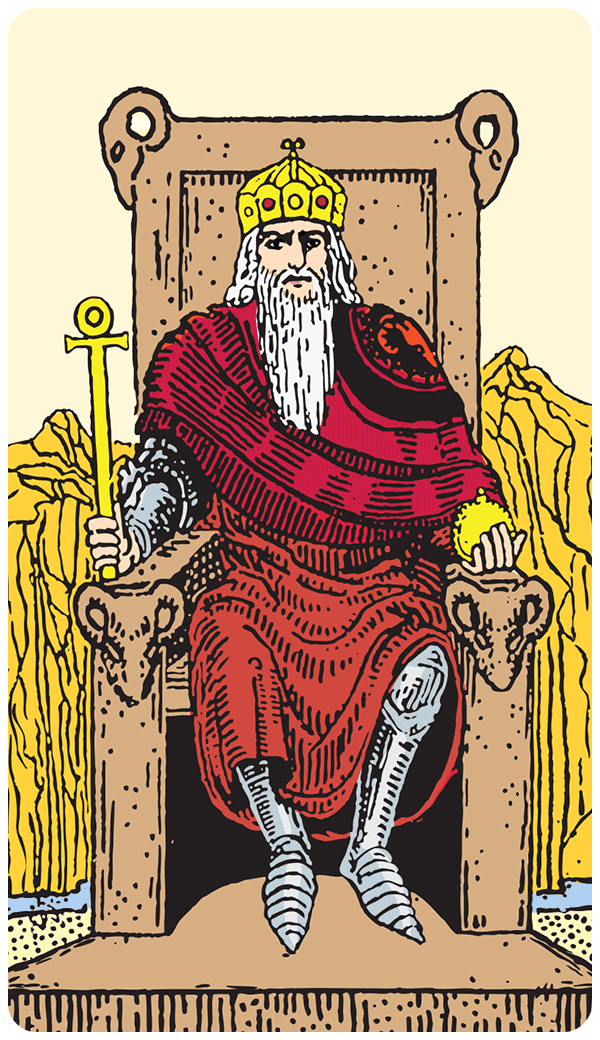
The Emperor · plate 4
YES
The Emperor is a yes. Not because the card promises success, but because it describes the conditions under which yes becomes available: you have a plan, you know what the plan requires, and you are willing to enforce the structure the plan needs to work. The card reads as no when the question is asking for permission to avoid those conditions — when what you actually want is for the outcome to arrive without the scaffolding.
Why The Emperor reads this way
What the card is measuring in a yes/no context
The Emperor is Major Arcana IV, the archetype of structure, authority, and enforced order. The figure sits on a stone throne, holding a scepter and an orb. Mountains rise behind him. The throne is not comfortable. The posture is not relaxed. This is the card of the person who builds the system, names the rules, and holds the line when the rules get tested. In a yes/no reading, the Emperor is not evaluating whether you want the thing. It is evaluating whether you are willing to do what the thing requires — and whether the thing you are asking about is the kind of question that responds to structure in the first place.
The most common misreading is treating the Emperor as a guarantee. The querent pulls the card, sees the throne and the scepter, and reads it as "I have the power, so yes." That is not what the card is saying. The Emperor describes the frame, not the outcome. If the question is "Will I get the promotion?" and the Emperor appears, the card is saying: the promotion is available to the person who builds the case, documents the work, and presents the argument in the language leadership understands. Whether you are that person is a separate question. The card is a yes if you are willing to be that person. It is a no if you are hoping the promotion arrives because you deserve it.
When the answer flips
The Emperor reads differently depending on what kind of question is being asked. If the question is logistical — "Should I sign the lease?" "Should I take the job?" "Should I commit to the timeline?" — the card leans yes, because those are questions that benefit from structure and clarity. The Emperor rewards decisions that can be planned, executed, and held to. If the question is emotional or relational — "Should I reach out to them?" "Will they forgive me?" "Is this love real?" — the card leans no, because those questions do not resolve through control. The Emperor cannot enforce attachment. It cannot legislate tenderness. When the card appears in an emotional yes/no reading, it is usually naming the thing the querent is trying to do: manage the other person's response, script the reconciliation, force the feeling into a predictable shape. That approach does not work, and the card is saying so.
Reversed, the Emperor often reads as a no that the querent already knows. The structure is not holding. The plan has a hole in it. The authority being invoked is not real authority — it is the appearance of control in a situation that is not actually controllable. If you pull the reversed Emperor in a yes/no reading and your first thought is relief, the card is correct. You were looking for permission to stop pretending you could force this.
The tell that you are misreading the card on yourself
If you pulled the Emperor as a yes and you immediately start imagining how the outcome will feel, you are misreading it. The card is not describing a feeling. It is describing a set of actions. Go back through the question and list what would need to happen between now and yes. If the list includes steps you do not want to take, the card is not a yes for you. If the list includes steps that depend on another person changing, the card is not a yes at all. The Emperor measures your willingness to build and hold the structure. It does not measure whether the structure will be comfortable.
A grounded observation
The next time you ask a yes/no question, notice whether you are asking for an outcome or asking for permission to skip the work the outcome requires. The Emperor will tell you the difference.
Key themes to watch for
- № 01Theme
Affirmative current
- № 02Theme
Open door
- № 03Theme
Forward motion
What to do with this reading
Read the upright meaning first, even if you pulled the card reversed. The reversal is a commentary on the upright — not a separate card.
Notice what your body did when you saw The Emperor. That reaction is usually closer to the truth than the interpretation.
Write down one sentence: What is this card asking me to stop avoiding? Let the answer be smaller than you expect.
Come back to this card in 48 hours. Most yes / no readings sharpen with a little distance.
Questions answered
Frequently asked
The Emperor is a yes. Not because the card promises success, but because it describes the conditions under which yes becomes available: you have a plan, you know what the plan requires, and you are willing to enforce the structure the plan needs to work. The card reads as no when the question is asking for permission to avoid those conditions — when what you actually want is for the outcome to arrive without the scaffolding.
Reversed cards are rarely "bad." The Emperor reversed asks you to look at where the same theme is blocked, postponed, or being avoided — usually with more compassion than the upright version.
The Emperor colors the cards around it. Pay attention to where its themes — archetype, pattern, invitation — show up in the next card. That is usually where the story is.
Tarot is observational, not predictive. The Emperor describes the conditions in front of you right now and where they tend to lead if nothing changes — not a guarantee of timing.
Repeat cards are the deck underlining a theme. With The Emperor, that usually means the question you are asking is the right one — but you have not yet acted on what the card is showing you.
Read next
Related readings
Other The Emperor readings
- General MeaningThe Emperor read for general meaning.
- Love & RelationshipsThe Emperor read for love & relationships.
- Career & WorkThe Emperor read for career & work.
- Money & FinanceThe Emperor read for money & finance.
- Health & WellbeingThe Emperor read for health & wellbeing.
- SpiritualityThe Emperor read for spirituality.